










Play Spider Solitaire 2 Suits free in your browser. Full rules, the real win rate, and the strategy that separates 2-suit from 1-suit play.Two decks, two suits, ten columns. The game above is ready to play — free, in your browser, with no download or account. If you’ve been winning comfortably at one suit and want the version that actually makes you think, this is the step up. Below you’ll find the full rules, the honest win rate, and the handful of decisions that decide most 2-suit games.
Spider Solitaire 2 Suits at a glance
| Decks | 2 (104 cards) |
|---|---|
| Suits in play | Spades and Hearts only |
| Tableau columns | 10 |
| Cards dealt at start | 54 (six each in columns 1–4, five each in columns 5–10) |
| Cards in stock | 50, dealt in five rounds of ten |
| Goal | Build eight complete King-to-Ace runs in a single suit |
| Typical win rate | Roughly 20–35% with good play |
| Difficulty | Intermediate — a large jump from 1 suit, a smaller one to 4 |
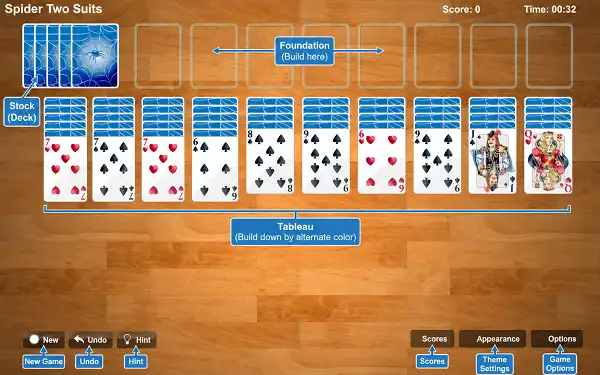
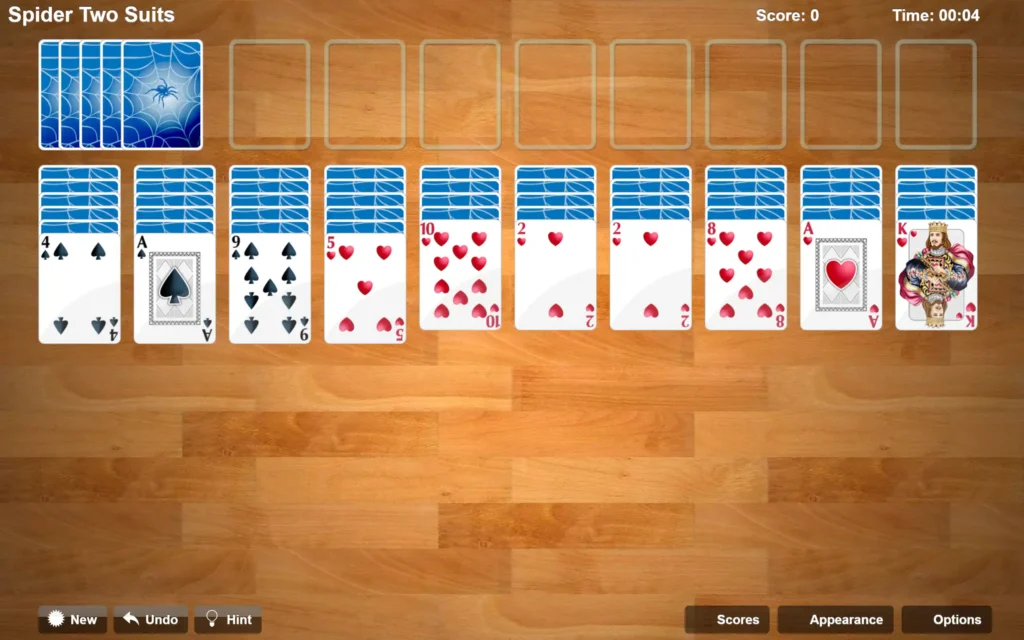
opening layout with ten tableau columns
How to play Spider Solitaire 2 Suits
Spider uses two full decks, but in the 2-suit version every card is either a spade or a heart — four of each suit’s worth of cards, 52 spades and 52 hearts. Ten columns are dealt face down, with the top card of each turned face up. The remaining 50 cards sit in the stock.
The goal
Assemble eight complete runs, each one King down to Ace in a single suit. As soon as a run is complete it lifts off the tableau automatically. Clear all eight and you’ve won.
Building in the tableau
You can place any card on a card one rank higher, regardless of suit. A red 8 goes on a black 9 quite happily. This is the rule that makes Spider feel generous at first — and it’s also the trap.
The rule that decides the game
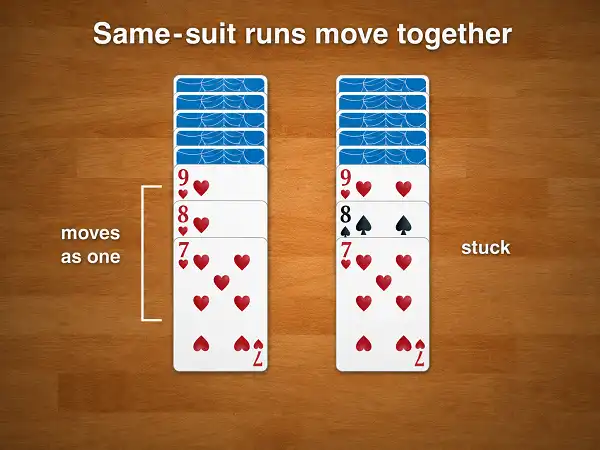
You can only move a group of cards as a unit if they form a descending run in the same suit. A 9-8-7 all in hearts moves as one block. A 9 of hearts with an 8 of spades under it does not — you can only pick up the 8. So every time you drop a heart onto a spade, you’ve built something that looks tidy and is actually frozen. In 1-suit Spider this problem doesn’t exist, because every card matches. In 2-suit it’s the entire game.
Dealing from the stock
When you run out of useful moves, deal a new row: one card to every column, face up. You get five deals. You cannot deal while any column is empty — every column must have at least one card first. Plan for this, because being forced to fill a hard-won empty column just to deal is one of the most common ways a promising game collapses.
Empty columns
Any single card or any valid same-suit sequence can move into an empty column. An empty column is the most valuable thing you can own in this game. More on that below.
Strategy: what actually changes at two suits
Most Spider advice you’ll find is written for the game in general. These are the decisions that specifically separate a 2-suit win from a 2-suit loss.
1. Uncovering face-down cards beats everything else
At the start you can see ten cards and 44 are hidden. Information is the scarce resource. If you have a choice between a move that looks neat and a move that flips a face-down card, flip the card — almost always.
2. Treat a mixed-suit join as a small debt
Putting a heart on a spade isn’t forbidden and sometimes it’s the only move available. But every one of those joins is a place where the column stops being movable. Before you make one, ask what will let you undo it later. If the answer is nothing, look for another move first.
3. Empty one column and defend it
A single empty column roughly doubles what you can do. It lets you park a blocking card, break a mixed-suit run apart, and reassemble sequences you’d otherwise have to abandon. Getting one is the main strategic goal of the early game. The shortest column is usually the cheapest to clear, so start there.
4. Time your deals deliberately
Because you can’t deal with an empty column open, you face a repeating choice: use the space now, or fill it and deal. The rough rule is to use the empty column to fix as much structure as you can, then fill it and deal only when you’ve run out of productive moves. Dealing on top of a messy tableau buries your problems under ten more cards.
5. Build the two suits in different places
If you scatter hearts and spades of the same ranks across the same columns, you’ll spend the whole game shuffling one to reach the other. Try to let certain columns become heart columns and others spade columns. It won’t hold perfectly, but the tendency pays.
6. Kings are anchors, not assets
Nothing goes on top of a King. A King at the head of a column is fine — that’s where a run starts. A King sitting on top of face-down cards is a wall, and the only way past it is an empty column.
7. Move from the longest column when the choice is equal
Long columns hide the most cards and are the hardest to clear later. All else being equal, take your card from there.
8. Use undo, but understand what it teaches you
Undo is not cheating; it’s how you learn which branch was correct. The players who improve fastest undo often early on and then gradually need it less, because they start seeing two moves ahead instead of one.
What’s the real win rate for 2-suit Spider?
Here’s something no other page on this keyword will tell you straight: the published figures disagree wildly, and most sites quote one of them as fact. Across major solitaire sites you’ll find 2-suit win rates given as 16.6%, 20%, 20–30%, 30–40%, 35–50% and 55–65%. They aren’t all wrong. They’re measuring different things.
- Theoretical solvability — what percentage of deals could be won by a perfect player who can see every card. For Spider generally this is very high, with studies putting it near 99%. That number is close to useless for a human, because you can’t see the face-down cards.
- Observed player win rate — what real people on a real site actually achieve. This is far lower, and it varies with the audience. A site full of beginners reports a lower number than a site full of enthusiasts.
- Skilled-play win rate — what a strong player with unlimited undo achieves. Higher again.
There is no peer-reviewed study of Spider solvability the way there is for Klondike, where the well-known Yan, Diaconis, Rusmevichientong and Van Roy paper established roughly 82% for thoughtful play. Every Spider number in circulation is a site’s own telemetry or an estimate.
The realistic expectation: if you’re competent and you use undo, plan on winning somewhere around one game in three or four. If you’re new to 2-suit and coming off a strong 1-suit record, expect to lose considerably more than that at first — and don’t read it as a sign you’ve got worse. You’ve changed games.
How the three Spider versions compare
| Version | Suits used | Typical player win rate | What makes it hard |
|---|---|---|---|
| Spider 1 Suit | Spades only | Roughly 60–90% | Almost nothing. Every card stacks with every other card, so the only real skill is managing column space. |
| Spider 2 Suits | Spades and Hearts | Roughly 20–35% | Suit separation. Half your moves create stuck stacks, and you have to plan how to take them apart again. |
| Spider 4 Suits | All four | Under 10% | Everything at once. Suit separation plus space management plus a genuine tolerance for losing repeatedly. |
The jump from one suit to two is much larger than the jump from two to four. One suit is a tidying exercise. Two suits is the first version that’s genuinely a puzzle.
Scoring
The standard Spider scoring system, inherited from the Windows version, works like this:
- You start with 500 points.
- Every move costs 1 point, including undos.
- Every completed King-to-Ace run earns 100 points.
Eight completed runs is 800 points on top of your starting 500, so a win in very few moves approaches 1,300. In practice a good 2-suit win lands somewhere around 1,100–1,180. If you’re chasing score rather than just wins, the lever is move count — every unnecessary shuffle costs you a point, and undos are not free.
Frequently asked questions
Which two suits are used in Spider Solitaire 2 Suits?
Spades and hearts. The deck is still 104 cards from two full decks, but every card is converted to one of those two suits — 52 spades and 52 hearts.
Is Spider Solitaire 2 Suits always winnable?
No. Some deals cannot be won no matter how you play them, and many more become unwinnable after a single early mistake. Theoretical solvability for Spider is very high — close to 99% for a player who can see all the cards — but a real player working blind wins far less often, typically around one game in three or four at two suits.
How many suits do you need to complete to win?
Eight. Each completed run is a full King-to-Ace sequence in one suit, and there are eight of them across the two decks — four spades and four hearts.
Why can’t I move a sequence of cards together?
Because the cards aren’t all the same suit. You can stack any card on a card one rank higher regardless of suit, but you can only pick up a group if it’s a descending run entirely in one suit. This is the single rule that makes 2-suit Spider difficult.
Why won’t the game let me deal from the stock?
You have an empty column. Spider will not deal a new row while any column is empty, so you need to place a card into it first.
Is 2-suit Spider harder than 4-suit?
No, 4 suits is harder — but the gap between 1 and 2 suits is bigger than the gap between 2 and 4. Going from one suit to two changes the nature of the game. Going from two to four mostly just turns up the difficulty on decisions you’re already making.
Can I play Spider Solitaire 2 Suits for free without downloading anything?
Yes. The game on this page is free and runs in the browser. There’s no download, no installation and no account.
What’s a good score in Spider Solitaire 2 Suits?
You begin with 500 points, lose 1 per move and gain 100 per completed run, so a win scores 1,300 minus your move count. Anything above 1,100 is a strong result, and above 1,150 is very efficient play.
How do I get better at 2-suit Spider?
Three things, in order: uncover face-down cards ahead of everything else, avoid mixed-suit joins unless you can see how to undo them, and clear one column early and protect it. Those three habits account for most of the difference between a 10% player and a 30% player.
Card Games