









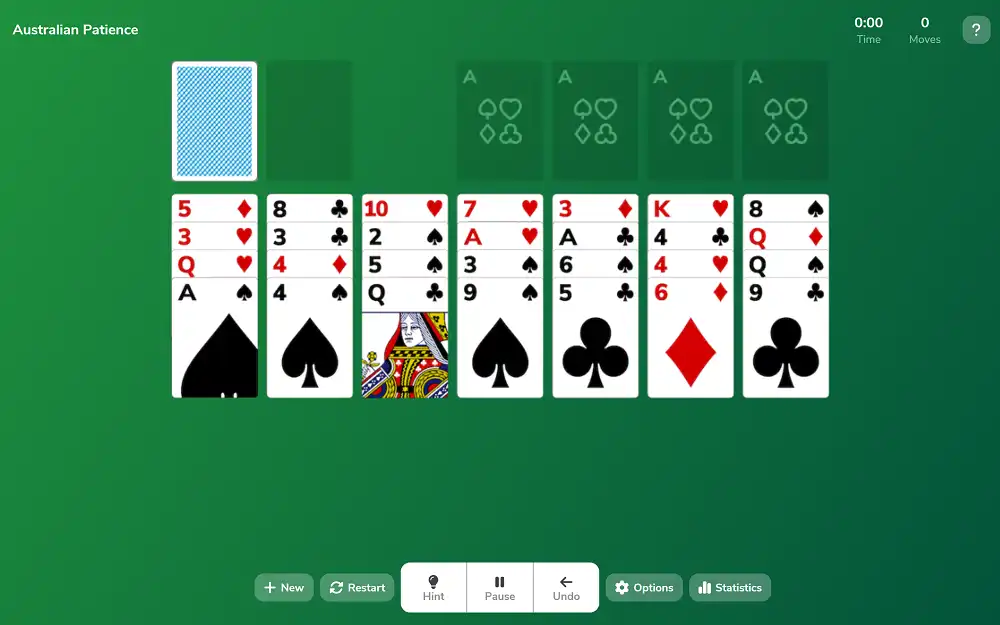




Play Australian Patience Solitaire online and take on a challenging one-deck card game that combines the open movement of Yukon-style solitaire with strict same-suit building. Twenty-eight cards begin face up across seven tableau columns, so you can see much of the puzzle immediately. The remaining 24 cards wait in a stock pile that can be used only once, making every draw important.
Your goal is to move all 52 cards to four foundations, building each suit upward from Ace to King. On the tableau, cards build downward by the same suit. A 7 of hearts can go only on the 8 of hearts, not on another 8. You can also move a face-up card together with every card covering it, even when the carried cards are not arranged in sequence. That combination gives Australian Patience its distinctive balance: large moves are possible, but legal destinations are limited.
What Is Australian Patience Solitaire?
Australian Patience is a single-player patience game played with one standard 52-card deck. It uses seven tableau columns, four foundations, a stock, and a waste pile. The game is often described as combining ideas from Klondike, Yukon, and Scorpion because it borrows familiar mechanics from each without playing exactly like any of them.
The tableau begins completely face up, with four cards in each of seven columns. There are no hidden tableau cards to uncover. Instead, uncertainty comes from the 24-card stock. Cards are drawn from the stock one at a time to the waste, and standard Australian Patience allows only a single pass through that stock.
The tableau itself is strict: cards build down by suit. But movement is unusually flexible. Any face-up card in a column can be selected as the head of a move, and every card covering it travels with it. Only the selected card needs to make a legal connection with the destination. The rest of the carried group does not need to be sorted.
How to Play Australian Patience
- Study all seven tableau columns before drawing. Every tableau card is visible from the beginning, so look for Aces, same-suit connections, and possible King moves first.
- Move available Aces to the foundations. Each foundation begins with an Ace and builds upward by suit.
- Build tableau columns downward by suit. For example, 6♣ can be placed on 7♣, but not on a 7 of another suit.
- Move flexible groups when useful. You can choose a face-up card from inside a column and carry every card covering it, even if the extra cards are not in sequence.
- Create empty columns when possible. Standard rules allow an empty tableau column to be filled only by a King or a group headed by a King.
- Draw one card from the stock when you need another option. The drawn card goes face up to the waste and can be played to the tableau or a foundation if legal.
- Use the waste carefully. You cannot redeal the stock in standard Australian Patience, so cards buried in the waste are unavailable until the cards above them are moved.
- Build foundations upward by suit. Add 2, 3, 4 and the remaining ranks until each suit reaches King.
- Win by clearing the entire deck. The game is complete when all 52 cards are on the four foundations.
Australian Patience Setup
The standard game uses one 52-card deck with no Jokers. After shuffling, deal 28 cards face up into seven tableau columns, with four cards in each column. All four cards in every column remain visible.
The remaining 24 cards form a face-down stock. Beside it is an empty waste pile. Four empty foundation spaces are also available, one for each suit.
| Area | Starting Cards | Purpose |
|---|---|---|
| Tableau | 28 cards: 7 columns × 4 cards | Build downward by suit and reorganize cards |
| Stock | 24 face-down cards | Draw one card at a time |
| Waste | Empty | Holds cards drawn from the stock |
| Foundations | 4 empty piles | Build each suit upward from Ace to King |
Australian Patience Rules
Foundations Build from Ace to King by Suit
There are four foundations, one for each suit. Each begins with an Ace and builds upward in rank without changing suit:
Ace → 2 → 3 → 4 → 5 → 6 → 7 → 8 → 9 → 10 → Jack → Queen → King
For example, after placing A♦ on the diamonds foundation, you need 2♦ next, followed by 3♦ and so on. A card of another suit cannot be substituted.
Tableau Builds Down by the Same Suit
The seven tableau columns build in descending rank and in the same suit. If 9♠ is exposed, it can receive only 8♠. The 8♣, 8♥, and 8♦ are not legal moves onto that card.
This same-suit requirement is the main reason Australian Patience feels tighter than Yukon. In alternating-color solitaire, a card often has two possible destination suits. Here it has only one exact next-rank destination.
You Can Move an Unordered Group
Australian Patience uses a powerful Yukon-style movement rule. Any face-up card can be selected and moved together with all cards covering it, provided that selected card fits legally on the destination.
Suppose a 6♥ has a Queen, a 2, and a 10 sitting below it in the same column. If 7♥ is exposed elsewhere, you can move the 6♥ plus those three unrelated cards onto the 7♥. The carried cards do not need to form a same-suit sequence among themselves.
This rule is essential. If you try to play as though only clean sequences can move, you will miss many legal moves and make the game much harder than it should be.
Only Kings Can Fill Empty Tableau Columns
When an entire tableau column becomes empty, standard Australian Patience allows only a King or a group headed by a King to move into that space.
Because empty columns cannot hold just any temporary card, clearing one is most useful when you already have an accessible King that you want to reposition. A well-timed King move can expose several useful cards at once.
The Stock Is Drawn One Card at a Time
The 24-card stock is turned over one card at a time. Each drawn card goes face up on the waste pile. The exposed top waste card can be moved to a legal tableau column or foundation.
If the waste card is not useful, you may draw another card on top of it. But doing so should be deliberate because the earlier waste card becomes buried.
There Is No Redeal in Standard Australian Patience
Once all 24 stock cards have been turned to the waste, standard Australian Patience does not allow you to flip the waste over and start the stock again.
This single-pass rule has a major strategic effect. A useful card buried too deeply in the waste may become unreachable if you cannot remove the cards above it. That makes stock timing more important than in solitaire variants with repeated redeals.
Controls
| Action | Desktop | Mobile / Tablet |
|---|---|---|
| Select a card or group | Click the face-up card you want to move | Tap the face-up card you want to move |
| Move cards | Drag to a legal tableau or foundation destination | Drag with your finger to a legal destination |
| Draw from the stock | Click the stock pile | Tap the stock pile |
| Move a waste card | Click or drag the exposed waste card | Tap or drag the exposed waste card |
| Undo | Use Undo if available | Tap Undo if available |
| Start a new game | Select New Game / Deal | Tap New Game / Deal |
Some browser versions support double-clicking cards to send them automatically to a foundation, while others use click-to-move rather than drag-and-drop. Those interface choices do not change the underlying rules.
How to Win Australian Patience
Winning Australian Patience is mainly about preserving access. Since tableau destinations are suit-specific and the stock cannot normally be redealt, a careless move can block the one card you need later. Strong play comes from reading the visible tableau before drawing and from controlling which cards get buried in the waste.
1. Make Useful Tableau Moves Before Drawing
Before touching the stock, check the entire tableau for foundation moves, same-suit builds, and opportunities to move groups. Every useful move you make first preserves more flexibility in the waste.
Drawing too quickly can bury a useful card under several others. If the tableau already contains a productive sequence of moves, finish that sequence first.
2. Prioritize Aces and Low Foundation Cards
Aces unlock the foundations, and low cards such as 2s and 3s are often worth moving upward when doing so opens access to other cards.
For higher cards, consider whether the card is still needed as a tableau landing point before moving it permanently to a foundation.
3. Search Inside Every Face-Up Column
Do not look only at the bottom card of a tableau column. Since an internal face-up card can head a movable group, a legal move may be sitting in the middle of a column.
If 5♣ is buried under three unrelated cards and 6♣ is exposed elsewhere, the entire group beginning with 5♣ can move onto 6♣. This is often the move that opens the board.
4. Avoid Bad Same-Suit Reversals
Australian Patience becomes difficult when cards of the same suit are blocked in the wrong relative order. If a lower card is trapped beneath the higher card it eventually needs to move onto, several extra moves may be required before the connection can be repaired.
Before moving a large unordered group, scan the cards inside it. A legal move can still create a future deadlock if it buries important same-suit ranks badly.
5. Create Empty Columns with a King Ready
An empty column is useful only if you can take advantage of the King-only rule. If you spend several moves clearing a column but have no playable King, the empty space may not improve the position.
Look ahead for an exposed King or King-led group. Moving it into the empty column can release whatever was underneath it and create another chain of moves.
6. Do Not Burn Through the Stock
The stock is not something you should empty as quickly as possible. Every click can bury the previous waste card. If the current waste card could become playable after one or two tableau moves, make those moves before drawing again.
When an important card appears in the waste—such as an Ace, a needed low foundation card, or the exact same-suit connector for a tableau move—try to use it before covering it.
7. Remember That the Carried Group Can Be Messy
A common mistake is trying to straighten every sequence before moving it. Australian Patience does not require that. The destination checks only the first card you select.
Use this freedom to expose cards and relocate large sections of the tableau. You can sort the carried cards later as new same-suit destinations open up.
Common Australian Patience Mistakes
- Building by alternating color. Australian Patience builds down by the same suit.
- Assuming moved groups must be in sequence. The cards carried beneath the selected card can be unordered.
- Drawing too many stock cards in a row. With no redeal, useful waste cards can become difficult to recover.
- Ignoring internal tableau cards. Any face-up card can potentially head a legal group move.
- Clearing a column without an available King. Standard rules allow only Kings or King-led groups into empty columns.
- Sending foundation cards up automatically. Sometimes a card remains valuable as a tableau destination.
- Forgetting that the stock has only one pass. The final stock card is not followed by a reset in the standard game.
Australian Patience vs. Yukon Solitaire
| Feature | Australian Patience | Yukon Solitaire |
|---|---|---|
| Decks | 1 | 1 |
| Tableau columns | 7 | 7 |
| Initial tableau | 28 cards, all face up | All 52 cards are dealt to the tableau, with some face down |
| Tableau building | Down by the same suit | Down in alternating colors |
| Group movement | Any face-up card can carry the cards covering it | Any face-up card can carry the cards covering it |
| Stock | 24 cards, drawn one at a time | No stock in standard Yukon |
| Redeals | None in standard play | Not applicable |
| Empty columns | King or King-led group | King or King-led group |
The movement system is the strongest similarity. If you understand Yukon’s “lift from any face-up card” rule, Australian Patience will feel familiar immediately. The major difference is that same-suit building gives each card fewer possible destinations, while the one-pass stock adds another source of pressure.
Australian Patience vs. Scorpion Solitaire
Scorpion and Australian Patience both build tableau cards downward by suit and both allow unordered groups to travel together. Their objectives and layouts are different.
Scorpion starts with 49 cards in the tableau and only three reserve cards. It aims to assemble complete King-to-Ace suit runs in the tableau. Australian Patience starts with 28 tableau cards, keeps 24 cards in a one-pass stock, and uses traditional Ace-to-King foundations as the final destination.
Australian Patience vs. Klondike Solitaire
Both games use one deck, a stock and waste pile, and four Ace-to-King foundations. Beyond that, their tableau play is very different.
Klondike builds downward in alternating colors and begins with hidden cards spread across seven columns. Australian Patience deals four face-up cards to every column and builds down by suit. Klondike also commonly allows some form of stock redeal depending on the version, while standard Australian Patience allows only one pass.
Australian Patience Variations
Canberra
Canberra is a close variation that generally allows one redeal after the first stock pass. The extra pass can rescue cards that became buried in the waste.
Tasmanian Solitaire
Tasmanian Solitaire relaxes the stock further by allowing repeated redeals, making stock order less final than it is in standard Australian Patience.
Brisbane
Brisbane changes the opening tableau arrangement while keeping the game within the Australian Patience family. The different deal alters which cards are immediately accessible.
Double Australian Patience
Double Australian Patience expands the game to two decks, more tableau cards, and eight foundations while preserving the same-suit building concept.
Is Australian Patience Hard?
Yes. Australian Patience is generally considered harder than many familiar one-deck solitaire games. The challenge comes from three rules working together: tableau cards must build by the same suit, empty columns accept only Kings, and the stock has no standard redeal.
At the same time, the game gives you two important advantages. Every tableau card is visible from the opening deal, and unordered groups can be moved when their leading card has a legal destination. Good play is about using those advantages before stock order closes off your options.
Are All Australian Patience Deals Winnable?
No. The initial shuffle can create positions where essential same-suit connections are inaccessible or where critical stock cards become impossible to recover from the waste. Even strong play cannot guarantee a win on every deal.
Strategy still matters. Decisions about when to draw, which group to move, when to clear a column, and which cards to send to the foundations can strongly affect whether a playable deal is successfully converted.
Does Australian Patience Have Scoring?
Traditional Australian Patience is based on a simple objective: move every card to the four foundations. There is no single universal scoring formula.
Online versions may add elapsed time, move count, streaks, foundation progress, or a custom score. Those systems belong to the specific browser or app implementation rather than to the core rules.
Other Similar Games
- Yukon Solitaire
- Pyramid Solitaire
- Scorpion Solitaire
- TriPeaks Solitaire
- Golf Solitaire
- Clock Solitaire
- Google Soliatire
- Solitaire 2 Suits
- Canfield Solitaire
Frequently Asked Questions
What is Australian Patience Solitaire?
Australian Patience is a one-deck solitaire game with seven face-up tableau columns, four foundations, a 24-card stock, and a waste pile. Tableau cards build downward by the same suit, while foundations build upward by suit from Ace to King.
How many cards are used?
Australian Patience uses one standard 52-card deck without Jokers.
How many cards are dealt to the tableau?
Twenty-eight cards are dealt face up into seven columns of four cards each.
How many cards are in the stock?
After the 28-card tableau is dealt, the remaining 24 cards form the stock.
Are any tableau cards face down?
No. In standard Australian Patience, all 28 tableau cards are face up from the beginning.
How do tableau cards build?
Tableau cards build downward by rank in the same suit. For example, 8♦ can receive 7♦.
Can I build by alternating colors?
No. Unlike Klondike and Yukon, Australian Patience requires the same suit for tableau building.
Can I move an unordered group of cards?
Yes. You may move a face-up card together with every card covering it, even when those carried cards are not arranged in sequence. The selected card must make a legal same-suit descending connection on the destination.
Can any card fill an empty column?
No. Under standard Australian Patience rules, an empty tableau column can be filled only by a King or a group headed by a King.
How do the foundations work?
Each foundation begins with an Ace and builds upward in the same suit through 2, 3, 4 and the remaining ranks until King.
How does the stock work?
Cards are drawn from the stock one at a time to the waste pile. The exposed waste card can be played to a foundation or legal tableau destination.
Can I go through the stock more than once?
Not in standard Australian Patience. There is only one pass through the stock. Variants such as Canberra and Tasmanian Solitaire change the redeal rule.
What happens to a buried waste card?
It becomes available only if the cards above it are moved away. Since there is no standard redeal, repeatedly covering useful waste cards can leave them inaccessible.
How do you win Australian Patience?
You win by moving all 52 cards to the four foundations, with each suit completed from Ace to King.
Is Australian Patience the same as Yukon?
No. They share the flexible group-movement rule, but Yukon normally builds tableau cards in alternating colors and uses no stock. Australian Patience builds by suit and has a 24-card one-pass stock.
Is Australian Patience the same as Scorpion?
No. Both build down by suit and allow flexible group movement, but Scorpion aims to create complete King-to-Ace suit runs in the tableau. Australian Patience uses four Ace-to-King foundations and a larger stock.
What is the best first priority?
Scan all 28 visible tableau cards for Aces, immediate foundation moves, same-suit connections, and moves that can create an empty column before drawing heavily from the stock.
Should I draw from the stock immediately?
You can reveal a waste card early to increase your options, but inspect the tableau first. Since the stock has only one pass, unnecessary draws can bury cards you may need.
Should I move Aces to the foundations immediately?
Aces are usually valuable to move because they open the foundations. For higher cards, consider whether the card is still needed as a tableau destination before moving it permanently upward.
Why can’t I move a 6 onto another 7?
The suit must match. A 6♠ can move only onto 7♠. Correct rank alone is not enough.
Why can I move cards that are not in order?
Australian Patience uses a Yukon-style group rule. When you select a face-up card, all cards covering it travel together. Only the selected card needs to fit the destination correctly.
What should I do if I get stuck?
Check every face-up card inside every tableau column, not just the exposed end card. Look for same-suit connections, foundation moves, and a way to create a King-ready empty column. If no useful tableau move remains, draw the next stock card if the stock is not empty.
Can I play Australian Patience on mobile?
Yes. Browser-based versions can work on phones and tablets when the game supports touch input. Cards are usually moved by tapping or dragging, and the stock can be tapped to draw.
Card Games