

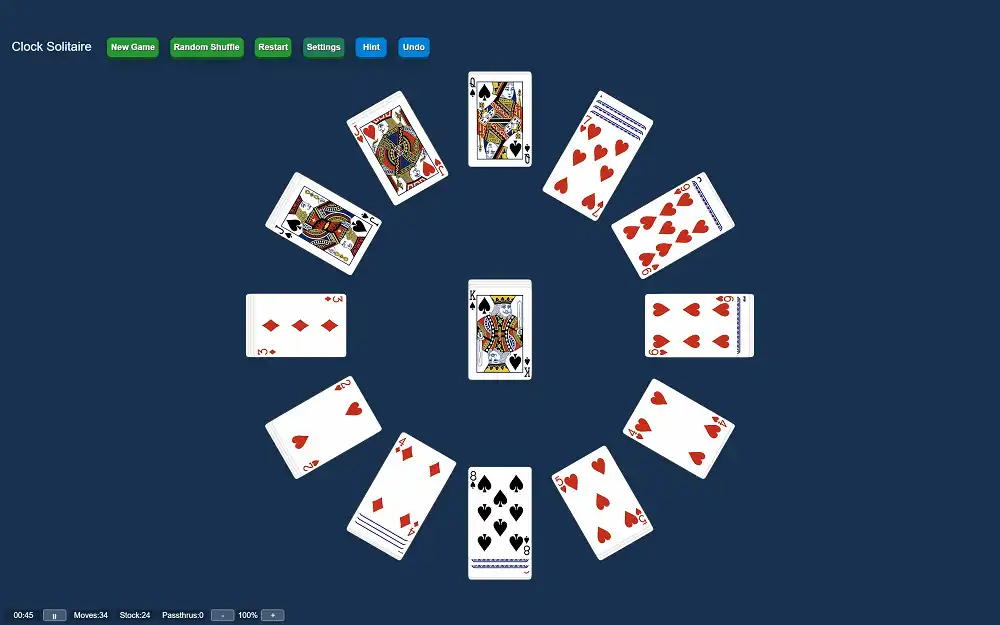

Play Clock Solitaire online and see whether the cards fall your way in one of the simplest and most unusual patience games played with a standard deck. Instead of building descending sequences, alternating colors, or moving cards between tableau columns, Clock Solitaire arranges the deck like the face of a clock. Each card you reveal tells you exactly which pile to visit next.
The goal is to turn over all 52 cards before the fourth King ends the game. Aces belong at 1 o’clock, 2s at 2 o’clock, and so on through Jacks at 11 and Queens at 12. Kings go into the center pile. If the final King appears only after every other card has already been revealed, you complete the clock and win.
What Is Clock Solitaire?
Clock Solitaire, also known as Clock Patience, is a one-player card game played with a single 52-card deck. It gets its name from the layout: twelve piles are arranged in a circle to represent the twelve hours on a clock face, while a thirteenth pile sits in the center.
Unlike Klondike, Spider, Scorpion, or Yukon Solitaire, there is almost no decision-making once a Clock Solitaire game begins. You do not choose where a card should go. Its rank determines the destination automatically. Reveal a 5 and it goes to the 5 o’clock pile. Reveal a Queen and it goes to 12 o’clock. Reveal a King and it returns to the center.
This makes Clock Solitaire a game of chance rather than a game of tactical card movement. The appeal comes from watching the hidden deck gradually organize itself into four cards of each rank and hoping the fourth King does not appear too soon.
How to Play Clock Solitaire
- Start with the center pile. Turn over one card from the central King pile.
- Check the rank of the revealed card. Its rank tells you which clock position it belongs to.
- Move the card to its matching pile. An Ace goes to 1 o’clock, a 2 to 2 o’clock, a 3 to 3 o’clock, and so on.
- Use Jack as 11 and Queen as 12. Jacks are placed at the 11 o’clock position and Queens at 12 o’clock.
- Send Kings to the center. The central thirteenth pile is the destination for all four Kings.
- Reveal the next card from the destination pile. After placing a card into its correct position, turn over the next face-down card from that same pile.
- Follow the new card to its matching position. Continue moving from pile to pile according to the rank you reveal.
- Keep going until the fourth King appears. If all other cards are already face up when the fourth King is revealed, you win. If face-down cards remain elsewhere, the game ends in a loss.
Clock Solitaire Setup
Clock Solitaire uses all 52 cards from a standard deck with the Jokers removed. Shuffle the deck thoroughly, then deal all cards face down into 13 piles of four cards each.
Twelve piles form the outside of the clock:
- 1 o’clock: Aces
- 2 o’clock: 2s
- 3 o’clock: 3s
- 4 o’clock: 4s
- 5 o’clock: 5s
- 6 o’clock: 6s
- 7 o’clock: 7s
- 8 o’clock: 8s
- 9 o’clock: 9s
- 10 o’clock: 10s
- 11 o’clock: Jacks
- 12 o’clock: Queens
The thirteenth pile goes in the center and represents the Kings. Every pile begins with four face-down cards. You do not look at the cards while dealing because the hidden order determines the outcome of the game.
Clock Solitaire Card Positions
| Card Rank | Clock Position |
|---|---|
| Ace | 1 o’clock |
| 2 | 2 o’clock |
| 3 | 3 o’clock |
| 4 | 4 o’clock |
| 5 | 5 o’clock |
| 6 | 6 o’clock |
| 7 | 7 o’clock |
| 8 | 8 o’clock |
| 9 | 9 o’clock |
| 10 | 10 o’clock |
| Jack | 11 o’clock |
| Queen | 12 o’clock |
| King | Center pile |
Suits do not affect where cards are placed in Clock Solitaire. A 7 of hearts, 7 of clubs, 7 of diamonds, and 7 of spades all belong at the 7 o’clock position. The game sorts cards entirely by rank.
Clock Solitaire Rules
Every Rank Has One Fixed Destination
There are no optional tableau moves. Each revealed card is moved to the pile matching its rank. Number cards go to the matching numbered hour, Aces go to 1, Jacks to 11, Queens to 12, and Kings to the center.
Because all four suits of a rank share the same destination, a successfully completed clock ends with four Aces at 1 o’clock, four 2s at 2 o’clock, four 3s at 3 o’clock, and so on around the circle.
The Next Card Comes from the Same Pile
After you move a revealed card to its correct position, you immediately reveal a face-down card from that destination pile. That newly revealed card then sends you to another pile.
For example, suppose the center pile reveals a 6. Move that 6 to the 6 o’clock pile, then reveal a card from the 6 o’clock pile. If that card is a Jack, place it at 11 o’clock and reveal a card from the 11 o’clock pile. The game continues as a chain from one rank to the next.
Kings Return to the Center
Kings do not correspond to an hour on the outside of the clock. All Kings are placed in the center pile. Whenever you reveal a King, return it face up to the center and reveal the next available face-down card from the center.
This is why the Kings control the end of the game. Once the fourth King is revealed, there are no more hidden center cards available to keep the chain going.
The Fourth King Ends the Game
The game ends when the fourth and final King is turned face up. At that moment, check the rest of the layout.
- You win if every other card has already been revealed and sorted into its correct rank pile.
- You lose if one or more cards elsewhere on the clock are still face down.
This means the fourth King must effectively be the last unrevealed card in a winning game.
There Are No Traditional Foundations
Clock Solitaire does not use the four suit foundations found in Klondike or Yukon. You are not building Ace to King by suit. Instead, each clock position becomes a completed set of four cards of the same rank.
Controls
| Action | Desktop | Mobile / Tablet |
|---|---|---|
| Reveal the next card | Click the highlighted face-down card or pile | Tap the highlighted face-down card or pile |
| Place a revealed card | Click or drag it to its matching clock position if manual placement is required | Tap or drag it to the matching position if manual placement is required |
| Start a new deal | Select New Game / Deal Again | Tap New Game / Deal Again |
| Restart | Use Restart if available | Tap Restart if available |
Many browser versions automate some of the movement because there is only one legal destination for each card. In those versions, you may simply click or tap the next card and let the game place it automatically. Other versions let you move the card yourself to reinforce the clock-matching mechanic.
Example of a Clock Solitaire Turn
Imagine the first card revealed from the center is the 8 of hearts. Because every 8 belongs at 8 o’clock, move it to the 8 o’clock pile. Now reveal the next face-down card from that pile.
If the next card is the Queen of clubs, it belongs at 12 o’clock. Move it to the Queen pile, then reveal a card from 12 o’clock. If that card is the 3 of spades, move it to 3 o’clock and continue from there.
You do not return to the center unless a King appears. The rank of each newly revealed card determines where the game travels next.
How Do You Win Clock Solitaire?
To win Clock Solitaire, all 52 cards must be revealed and placed into their correct rank positions before play stops. The outside piles should each contain all four cards of their matching rank, while the center contains all four Kings.
The key condition is the timing of the final King. If the fourth King is revealed while another pile still contains hidden cards, the game ends immediately and those remaining cards can no longer be reached. If the fourth King is the final unrevealed card after every other pile has been completed, you win.
What Are the Odds of Winning Clock Solitaire?
The probability of winning standard Clock Solitaire is exactly 1 in 13, or approximately 7.7%. That is much lower than many familiar solitaire games, but the reason is not that Clock Solitaire requires difficult strategic decisions. It is difficult because the shuffled order of the deck determines whether the final King appears at the correct time.
In a successful deal, the fourth King is effectively the last card reached in the reveal sequence. Since you cannot change the route through the piles under standard rules, playing better does not improve the mathematical win rate.
Is Clock Solitaire Skill or Luck?
Standard Clock Solitaire is almost entirely luck. Once the deck has been shuffled and dealt, the sequence of moves is determined by the cards themselves. You cannot choose between several legal destinations, rearrange piles to create space, save a card for later, or decide which suit to build.
This makes the game very different from tactical solitaire variants. The player’s job is primarily to follow the chain correctly:
- Reveal the correct next card.
- Identify its rank.
- Move it to the matching position.
- Continue from that destination pile.
If you are playing a version that follows the classic rules exactly, there is no hidden strategy that can turn a losing deal into a winning one.
Clock Solitaire Tips
Because the game is driven by chance, these tips are mostly about avoiding rule mistakes and making play easier to follow rather than increasing your odds of receiving a winning deal.
- Memorize the face-card positions. Ace is 1, Jack is 11, Queen is 12, and King is the center. Once those are automatic, the game moves much faster.
- Always continue from the pile where you just placed a card. The most common beginner mistake is revealing a card from the wrong position.
- Keep face-up and face-down cards visually separate. In a physical game, tuck completed cards underneath or beside their pile so it is obvious which card should be revealed next.
- Watch the King count. Seeing the first three Kings tells you that the next King will end the game. The suspense comes from how many other cards you can reveal before it arrives.
- Do not worry about suits. Only rank matters. All four cards of the same rank belong together.
- Start a new deal after a loss. There is normally no alternate line of play to try, so replaying the same shuffled arrangement will produce the same result.
Clock Solitaire vs. Klondike Solitaire
| Feature | Clock Solitaire | Klondike Solitaire |
|---|---|---|
| Decks | 1 | 1 |
| Main layout | 13 piles arranged like a clock | 7 tableau columns |
| Card placement | By rank and clock position | Descending alternating colors in tableau |
| Foundations | No traditional suit foundations | 4 foundations built Ace to King by suit |
| Player choices | Very few or none under standard rules | Many possible moves and strategic choices |
| Main loss condition | Fourth King appears while other cards remain hidden | No legal route remains to complete the foundations |
| Role of luck | Essentially determines the outcome | Luck and decision-making both matter |
Players who expect traditional Solitaire may find Clock Solitaire surprising because there is no tableau puzzle to solve. Its entertainment comes from the reveal sequence itself and from watching each pile gradually collect all four cards of a rank.
Clock Solitaire vs. Grandfather’s Clock
Clock Solitaire should not be confused with Grandfather’s Clock, another patience game with a clock-inspired layout. The names sound similar, but the gameplay is very different.
Clock Solitaire is a rank-matching reveal game where twelve outer piles represent Ace through Queen and Kings go in the center. Grandfather’s Clock is a building solitaire game with foundations arranged to resemble a clock face and requires actual card-management decisions.
If the game you are playing asks you to reveal a card and move to the pile matching its rank, you are playing Clock Solitaire or Clock Patience rather than Grandfather’s Clock.
Clock Solitaire and the Watch Variation
A common variation is called Watch. It gives the player a little extra life when the fourth King appears. Instead of ending immediately, the fourth King can be exchanged with a face-down card that remains elsewhere in the clock, allowing play to continue.
The exact implementation of Watch can vary, so a browser version may describe the additional rule differently. Standard Clock Solitaire does not include this rescue move: the fourth King ends the game immediately.
Does Clock Solitaire Have Scoring?
Traditional Clock Solitaire does not require a universal point system. The basic result is simply a win or a loss. Some online versions add a score based on how many cards or rank piles you reveal before the fourth King appears.
A simple progress measure is to count completed rank piles or the total number of cards uncovered. However, any numerical scoring formula shown in a browser game belongs to that particular implementation rather than to the classic rules.
Why Is It Called Clock Solitaire?
The name comes directly from the layout. Twelve piles are placed around a circle like the twelve numbered hours of an analog clock, and the thirteenth King pile sits in the middle. Each outside position is tied to its equivalent card rank, so the physical shape is part of the game’s rules rather than just decoration.
The visual design also makes the rules easy to remember. A 4 goes to 4 o’clock, a 9 goes to 9 o’clock, a Jack goes to 11, and a Queen goes to 12. After only a few turns, most players can follow the layout without needing instructions.
Other Similar Games
- Yukon Solitaire
- Pyramid Solitaire
- Scorpion Solitaire
- TriPeaks Solitaire
- Golf Solitaire
- Hearts Game
- Four Colors
- Google Soliatire
Frequently Asked Questions
What is Clock Solitaire?
Clock Solitaire is a one-player card game where 52 cards are dealt into 13 face-down piles arranged like a clock. Cards are revealed and moved to the position matching their rank, with Kings going into the center.
Is Clock Solitaire also called Clock Patience?
Yes. Clock Solitaire and Clock Patience are common names for the same classic card game.
How many cards are used in Clock Solitaire?
The game uses one standard 52-card deck with no Jokers.
How many piles are there?
There are 13 piles of four cards each. Twelve piles form the outside of the clock and one pile sits in the center.
Where do Aces go in Clock Solitaire?
Aces belong at the 1 o’clock position.
Where do Jacks go?
Jacks are treated as rank 11 and go to the 11 o’clock pile.
Where do Queens go?
Queens represent 12 and go to the 12 o’clock pile.
Where do Kings go?
All four Kings go into the central thirteenth pile.
Do suits matter in Clock Solitaire?
No. Cards are sorted by rank, not suit. All four 5s belong at 5 o’clock regardless of whether they are hearts, diamonds, clubs, or spades.
How do I know which card to turn over next?
After placing a revealed card into its matching rank pile, turn over the next face-down card from that same pile. The rank of the new card then tells you where to go next.
How do you win Clock Solitaire?
You win if all 52 cards are revealed before play stops. In practice, the fourth King must appear only after every other card has already been turned face up.
Why does the fourth King end the game?
Kings are sent to the center pile. Once all four Kings have been revealed, no hidden card remains in the center to continue the chain. If cards elsewhere are still face down, they can no longer be reached under the standard rules.
What are the odds of winning Clock Solitaire?
The exact probability of winning standard Clock Solitaire is 1 in 13, which is about 7.7%.
Can strategy improve my chances of winning?
Not under the standard rules. Each revealed card has a fixed destination, so the shuffled deal determines the sequence. Correct play prevents mistakes, but it does not change whether the deal itself is a winner.
Can I choose which pile to play from?
No. You normally begin in the center, and every revealed card determines the next pile. You continue from the destination that matches the card’s rank.
Is Clock Solitaire easier than regular Solitaire?
The rules are easier to learn because there are almost no strategic choices, but winning is uncommon. Clock Solitaire has an exact win probability of only about 7.7% under standard rules.
What happens when I lose?
The fourth King appears while one or more cards are still face down. Since the reveal chain has ended, the remaining hidden cards cannot be completed and the deal is lost.
Can every Clock Solitaire deal be won?
No. Most shuffled deals lose. Only about one out of every thirteen deals is a winner under the standard rules.
What is the Watch version of Clock Solitaire?
Watch is a related variation that can allow the fourth King to be exchanged with a remaining face-down card, giving the reveal sequence another chance to continue.
Is Clock Solitaire the same as Grandfather’s Clock?
No. They are different solitaire games. Clock Solitaire sorts hidden cards by rank around a 13-pile clock, while Grandfather’s Clock uses a different layout and traditional building mechanics.
Can I play Clock Solitaire on a phone or tablet?
Yes. A browser-based version can work well on phones and tablets because the game only requires simple card reveals and rank-based placement. Touch controls usually use taps or short drags.
What should I do if the game seems stuck?
Check the pile matching the rank of the last card you revealed. That is where the next face-down card should come from. If the fourth King has already appeared, the deal is over under standard rules.
Card Games