






Play Scorpion Solitaire online and take on a challenging one-deck card game that combines the flexible stack movement of Yukon with the same-suit sequencing found in Spider-style solitaire. Your goal is to organize all 52 cards into four complete suit runs, each descending from King to Ace. There is no traditional draw pile to cycle through repeatedly: almost the entire deck begins in the tableau, with only three reserve cards held back for a single deal later in the game.
Scorpion Solitaire can look chaotic at first because long groups of cards are often mixed together. That is intentional. You are allowed to move an exposed card together with every card attached beneath it, even when the carried cards are not arranged in order. The catch is that the card you choose to move must land on the next higher card of the same suit. This creates a game with surprisingly large moves but very strict destinations, so planning ahead matters from the first turn.
What Is Scorpion Solitaire?
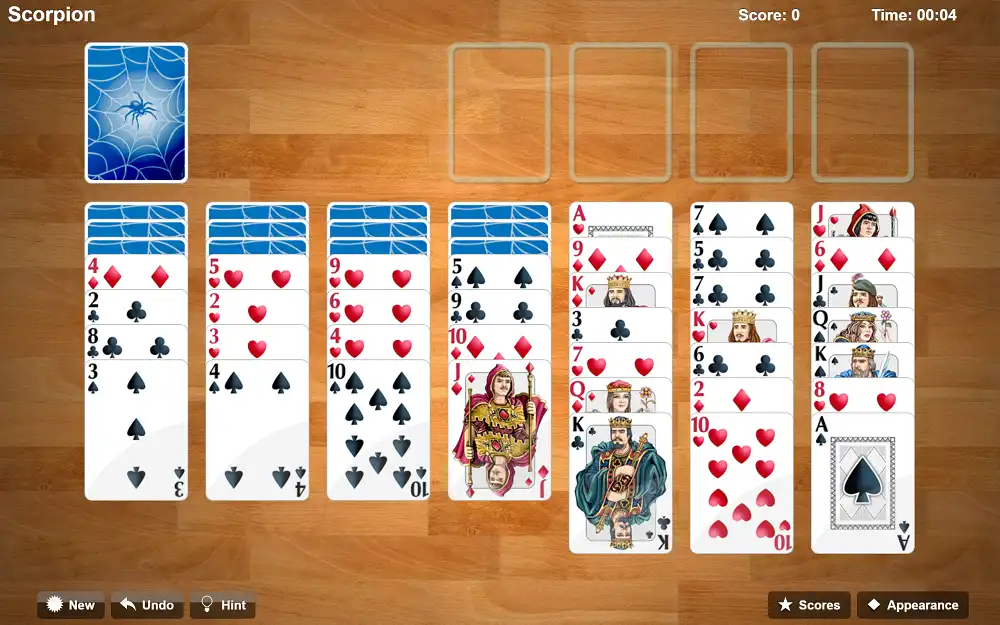
Scorpion Solitaire is a single-player patience game played with one standard 52-card deck. The tableau contains seven columns, and 49 cards are dealt before play starts. Twelve cards begin face down, while the remaining tableau cards are visible. The last three cards form a small reserve that can be dealt onto the tableau once during the game.
The objective is different from Klondike-style solitaire. You do not build four foundations upward from Ace during normal play. Instead, you arrange cards directly in the tableau into complete descending suit sequences: King, Queen, Jack, 10, 9 and so on down to Ace. When a full 13-card sequence of one suit is completed, many digital versions automatically remove it to a completed foundation area. Finish all four suits to win.
Scorpion is especially recognizable for its unusual movement rule. Any face-up card can become the starting card of a move. If other cards are attached to it, they travel with it as one group whether or not those extra cards form a legal sequence. Only the first card of the group has to make a valid same-suit descending connection on the destination pile.
How to Play Scorpion Solitaire
- Study all seven tableau columns before moving anything. Most of the deck is visible immediately, so use that information to find same-suit connections and identify the face-down cards you may be able to uncover.
- Build downward by suit. A card can be placed on the next higher card of the same suit. For example, 8♠ can be placed on 9♠, but not on 9♥ or 10♠.
- Move attached cards together. You can move any face-up card along with every card attached beneath it. Those carried cards do not need to be in sequence.
- Expose face-down cards. When you remove all face-up cards covering a hidden card, that card is turned face up and becomes available for play.
- Create complete suit runs. Work toward uninterrupted sequences from King down through Queen, Jack and the numbered cards to Ace.
- Use empty columns for Kings. Under standard Scorpion rules, an empty tableau column can be filled only by a King or by a group whose first card is a King.
- Delay the three-card reserve until you need it. The reserve is dealt only once, adding one face-up card to each of the first three tableau columns.
- Complete all four suits. Once every suit has been assembled from King to Ace, the game is won.
Scorpion Solitaire Setup
Scorpion uses one 52-card deck. The initial deal places 49 cards into seven tableau columns, with seven cards in each column.
- Columns 1 to 4: Each contains three face-down cards followed by four face-up cards.
- Columns 5 to 7: All seven cards are dealt face up.
- Reserve: The remaining three cards are kept face down and can be dealt once later.
That means 12 cards are hidden at the beginning, 37 tableau cards are visible, and three cards wait in reserve. Unlike Klondike, there is no large stock that you repeatedly turn over. The puzzle is mainly about reorganizing what is already in front of you.
Scorpion Solitaire Rules
Build Down by the Same Suit
Tableau sequences are built in descending rank and must stay within the same suit. A 7 of clubs can be placed on the 8 of clubs. The 7 of spades, even though it has the correct rank, cannot be placed there because it is a different suit.
This rule is stricter than Yukon, where alternating colors are used, and stricter than many versions of Spider, where cards may sometimes be temporarily placed in mixed-suit descending order. In standard Scorpion, the receiving connection itself must be same-suit and one rank lower.
Any Face-Up Card Can Start a Move
You do not need to clean up a whole group before moving it. If a face-up 6♥ is buried beneath several other face-up cards, you may move the 6♥ together with every card attached below it as long as the 6♥ can be placed on the 7♥.
The extra cards that travel with the 6♥ might be completely out of order. That is legal. This is one of the most important rules to understand because many strong Scorpion moves come from pulling a useful card out of the middle of a messy column and carrying the rest of the column with it.
Face-Down Cards Turn Up When Exposed
The 12 hidden cards in the first four columns become playable as soon as the cards covering them are moved away. Revealing these cards is one of the main strategic priorities because hidden cards can contain the exact ranks needed to complete a suit or unlock a King.
Only Kings Can Fill Empty Columns
If you clear an entire tableau column, you cannot place just any card into the space. Standard Scorpion allows only a King or a group headed by a King to move into an empty column.
This makes empty columns powerful but specialized. Clearing a column is most useful when it lets you reposition a King and everything attached to it, opening access to cards that were previously trapped elsewhere.
The Reserve Can Be Used Once
Three cards remain outside the tableau after the initial deal. When the reserve is used, one card is dealt face up onto each of the first three tableau columns. There is no second redeal.
Because those new cards land on top of existing columns, using the reserve too early can cover useful cards or break up work you were about to finish. In most games, it is better to make as much progress as possible before introducing the three reserve cards.
Complete Runs Go from King to Ace
A finished Scorpion sequence contains all 13 cards of one suit in descending order:
King → Queen → Jack → 10 → 9 → 8 → 7 → 6 → 5 → 4 → 3 → 2 → Ace
Once a complete run is formed, it is considered finished and is normally removed from active play in digital versions. The game is won after all four suits are completed.
Controls
| Action | Desktop | Mobile / Tablet |
|---|---|---|
| Select a card or group | Click the face-up card you want to move | Tap the face-up card you want to move |
| Move cards | Drag to a legal destination or use click-to-move if supported | Drag with your finger or tap a legal destination if supported |
| Deal the reserve | Click the 3-card reserve / stock | Tap the 3-card reserve / stock |
| Undo a move | Use the Undo button if available | Tap Undo if available |
| Start over | Select New Game or Restart | Tap New Game or Restart |
The precise buttons can vary between browser versions, but the card rules remain the same. If your version supports automatic movement, hints, or undo, those features can make it easier to test difficult positions without changing how Scorpion itself is played.
How to Win Scorpion Solitaire
Scorpion is not a game where every legal move is automatically helpful. The biggest challenge is avoiding self-created blocks. A poorly placed card can trap the exact same-suit rank you need later, while an apparently messy move may be excellent if it exposes a hidden card or frees a King.
1. Reveal Face-Down Cards Early
The 12 hidden cards are the largest source of uncertainty. Whenever two legal moves are available, favor the move that exposes a face-down card unless it clearly creates a serious block somewhere else. The sooner you know where the hidden Kings, Queens, low cards, and connecting ranks are, the easier it becomes to plan complete suit runs.
2. Think in Same-Suit Chains
Do not look only for individual moves such as 7♣ onto 8♣. Look ahead for chains: if moving the 7♣ exposes the 6♣, and the 5♣ is already accessible, that single move may start a much longer sequence.
Because suits cannot be mixed at the destination connection, knowing where the next one or two ranks of a suit are located is far more useful than simply moving cards whenever a matching pair appears.
3. Be Careful with Low Cards
Aces are endpoints. Nothing can be placed on an Ace because there is no lower rank. A low card at the exposed end of a column can therefore make that column difficult to extend or reorganize.
Before exposing an Ace or 2, check what it will do to the pile. Sometimes revealing a low card is necessary, but sometimes a different sequence of moves gives you more flexibility first.
4. Avoid Reversing the Natural Order of a Suit
One of the most damaging positions occurs when a lower card of a suit becomes trapped in a way that prevents it from eventually joining the higher card it needs. For example, if the 4♠ ends up in a position that cannot be moved until after the 5♠ has already become blocked beneath it, rebuilding the correct 5♠-4♠ connection may require several extra moves or become impossible.
Before moving a large group, scan the cards inside it for same-suit ranks. Long unordered groups are legal, but they can hide structural problems that become important later.
5. Treat Empty Columns as King Tools
An empty column is not a universal temporary holding space as it is in some solitaire games. Only a King-led group can enter it. That means the best time to clear a column is often when you already know which King you want to move there and what that move will uncover.
If clearing a column takes several moves but leaves you with no useful King available, the effort may not improve the position at all.
6. Save the Reserve Until the Tableau Is Nearly Exhausted
The three reserve cards can rescue a stalled game, but they can also cover valuable cards. Work through every promising tableau move first. Check cards inside face-up groups, not just the visible end card of each column, because Scorpion allows moves starting from inside a group.
When you finally deal the reserve, reassess all three affected columns from scratch. The new cards may create same-suit links you did not have before.
7. Preserve Completed or Nearly Completed Runs
If you have already assembled a long clean sequence such as K♦ through 6♦, avoid disturbing it unless doing so is necessary to reveal a face-down card or solve a critical blockage. Every clean section you preserve reduces the amount of sorting left to do.
Common Scorpion Solitaire Mistakes
- Playing Scorpion like Klondike. Alternating colors do not matter here. Builds must be in the same suit.
- Assuming a movable group must already be ordered. It does not. Any exposed card can carry all attached cards with it if that starting card makes a legal same-suit move.
- Looking only at the bottom card of each column. Useful movable cards can be located inside an exposed group.
- Using the reserve immediately. The three extra cards are often more useful after you have exhausted the current tableau moves.
- Clearing a column without a King ready. An empty column cannot accept an ordinary card.
- Breaking clean suit sequences for no reason. A legal move is not worth making if it destroys more progress than it creates.
- Ignoring where Aces and 2s will end up. Low cards can turn the end of a pile into a dead end if they appear at the wrong time.
Scorpion Solitaire vs. Yukon Solitaire
| Rule | Scorpion Solitaire | Yukon Solitaire |
|---|---|---|
| Decks | 1 standard 52-card deck | 1 standard 52-card deck |
| Tableau columns | 7 | 7 |
| Tableau building | Descending by the same suit | Descending in alternating colors |
| Group movement | Any face-up card can carry attached cards, even if the carried group is unordered | Any face-up card can carry attached cards, even if the carried group is unordered |
| Reserve / stock | 3 cards, dealt once | No stock in standard Yukon |
| Empty columns | King or King-led group only | King or King-led group only |
| Goal | Complete four same-suit King-to-Ace runs | Build four suit foundations upward from Ace to King |
The shared movement system is why Yukon players often understand Scorpion quickly. The major adjustment is suit discipline. In Yukon, a red 8 can move onto either black 9. In Scorpion, an 8♣ has only one correct type of destination: the 9♣. Fewer destinations make every blockage more important.
Scorpion Solitaire vs. Spider Solitaire
Scorpion and Spider both focus on creating complete same-suit runs from King down to Ace, but they play very differently. Standard Spider uses two decks and ten tableau columns, while Scorpion uses one deck and seven columns. Spider also has a much larger stock that deals additional rows across the tableau. Scorpion holds back only three cards.
The movement rule is also different. Scorpion allows an exposed card to carry an unordered group with it as long as the selected card makes a legal same-suit connection. That freedom makes Scorpion feel more like Yukon in the way large sections of cards can be shifted around, even though its final King-to-Ace goal resembles Spider.
Scorpion Solitaire Variations
Wasp Solitaire
Wasp is one of the closest relatives of Scorpion. The major difference is how empty columns work. In Wasp, empty spaces are generally more flexible and can accept cards or sequences that standard Scorpion would not allow. That extra freedom can make difficult layouts easier to reorganize.
Scorpion II
Scorpion II changes which opening columns contain the face-down cards. The basic building, group movement, and King-to-Ace objective remain recognizable, but the altered distribution of hidden information changes the difficulty and early strategy.
Three Blind Mice
Three Blind Mice is another member of the Scorpion family with a different tableau layout. It keeps the core idea of same-suit descending builds and flexible group movement while changing how the cards are initially distributed.
Does Scorpion Solitaire Have Scoring?
There is no single universal scoring system for traditional Scorpion Solitaire. The essential win condition is completing all four King-to-Ace suit sequences. Browser and app versions may add their own scores based on moves, time, completed sequences, hints, or other statistics.
If your game displays a numerical score, treat it as a feature of that particular implementation rather than a standard Scorpion rule. For strategy, completing the game with a stable tableau matters more than chasing a score formula that may differ from one site to another.
Why Is Scorpion Solitaire Difficult?
Scorpion gives you considerable freedom to move cards, but it also restricts where those cards can go. A movable 8♣ does not have two color-based choices or several mixed-suit options; it specifically needs the 9♣. If that 9♣ is buried, attached to a dangerous group, or trapped beneath a low card, the entire club sequence may stall.
The 12 face-down cards add another layer of uncertainty, and the reserve can be used only once. As a result, some deals can become unsolvable even when many legal moves were available earlier. Good play is about preserving future connections, not simply maximizing the number of moves made.
Other Similar Games
- Yukon Solitaire
- Pyramid Solitaire
- TriPeaks Solitaire
- Golf Solitaire
- Hearts Game
- Four Colors
- Google Soliatire
Frequently Asked Questions
What is Scorpion Solitaire?
Scorpion Solitaire is a one-deck patience game where you rearrange seven tableau columns to create four complete same-suit sequences from King down to Ace.
How do you win Scorpion Solitaire?
You win by completing all four suits as descending King-to-Ace runs. In many online versions, a completed 13-card suit sequence is automatically removed from the tableau.
How many cards are used in Scorpion Solitaire?
Scorpion uses one standard 52-card deck. Forty-nine cards begin in the seven tableau columns, and the final three cards form the reserve.
How many cards start face down?
Twelve tableau cards begin face down. The first four columns each contain three hidden cards underneath four face-up cards.
Can you move a mixed or unordered stack in Scorpion Solitaire?
Yes. Any face-up card can be moved together with every card attached to it, even if those carried cards are not in sequence. The selected card itself must land on the next higher card of the same suit.
Can I put a red card on a black card?
No. Color is not the building rule in Scorpion. Cards must build down by the same suit, such as 9♥ onto 10♥.
What can go into an empty column?
Under standard Scorpion rules, only a King or a group headed by a King can fill an empty tableau column.
What happens to a face-down card when it is uncovered?
It is turned face up and becomes available for play.
How does the reserve work?
The reserve contains three cards. When used, one card is dealt face up onto each of the first three tableau columns. The reserve can be dealt only once.
When should I use the three reserve cards?
Usually after you have made as much progress as possible with the existing tableau. Dealing the reserve too early can cover useful cards, so first check for moves that reveal hidden cards, create suit sequences, or open a column.
Can cards be moved directly to foundations?
Standard Scorpion is normally played by completing an entire same-suit King-to-Ace sequence in the tableau first. Digital versions then remove the finished sequence to a completed foundation area. Individual cards are not normally built onto foundations one at a time during play.
Is Scorpion Solitaire the same as Spider Solitaire?
No. Both games aim to complete descending same-suit runs, but Scorpion uses one deck, seven columns, and only a three-card reserve. Spider normally uses two decks, ten columns, and a larger stock.
Is Scorpion Solitaire similar to Yukon?
Yes. Both games allow you to move an exposed card together with all cards attached to it even if the carried group is not properly sequenced. The major difference is that Scorpion builds down by the same suit, while Yukon normally builds down in alternating colors.
Why can’t I move a card even though the rank looks correct?
Check the suit. In Scorpion, being one rank lower is not enough. The moving card must also match the suit of the destination card. For example, 6♦ can move onto 7♦, but not onto 7♣.
What should I do if I get stuck?
Check every exposed card inside each column, not only the last visible card. Because any face-up card can start a move, a legal same-suit connection may be hidden inside a long group. If no useful tableau move remains, use the three-card reserve if it is still available. If your version provides Undo, testing a different move order can also reveal a better route.
Are all Scorpion Solitaire deals winnable?
No. Traditional Scorpion can produce deals that cannot be solved. Strong strategy improves your chances, but some layouts can still become blocked because essential same-suit connections are inaccessible.
Can I play Scorpion Solitaire on a phone or tablet?
Yes. A browser-based version can be played on mobile devices when its interface supports touch input. Card movement usually works by tapping or dragging just as it does with a mouse on desktop.
What is the best first priority in Scorpion Solitaire?
Look for moves that reveal the face-down cards in the first four columns while preserving useful same-suit connections. Opening hidden information usually gives you more strategic value than simply making a move that lengthens an already visible pile.
Card Games