








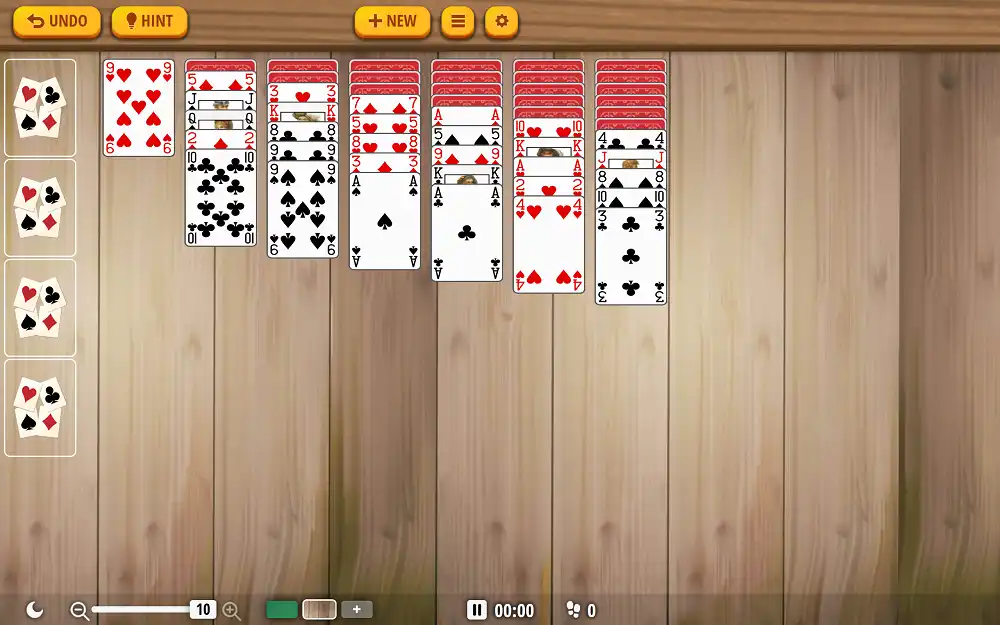
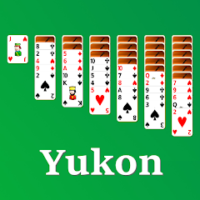


Play Yukon Solitaire online and take on a more open, tactical version of classic solitaire. All 52 cards are dealt onto the table at the beginning, so there is no stock pile to draw from and no waste pile to cycle through. Your goal is to uncover the hidden cards, rearrange the tableau in descending alternating colors, and move every card to the four foundation piles from Ace through King.
Yukon looks familiar if you have played Klondike Solitaire, but one rule changes the entire game: you can move a face-up card together with every card lying on top of it, even when those carried cards are not arranged in a perfect sequence. That extra freedom creates larger moves, deeper combinations, and plenty of situations where choosing the right card to uncover matters more than simply making the first legal move you see.
What Is Yukon Solitaire?
Yukon Solitaire is a single-player patience card game played with one standard 52-card deck. It belongs to the same broad family as Klondike, using seven tableau columns and four suit-based foundations, but it removes the traditional draw pile. Every card is already somewhere in the tableau when the game begins.
The objective is to move all 52 cards to the foundations. Each foundation starts with an Ace and is built upward in the same suit: Ace, 2, 3, and so on until the King. To reach those cards, you reorganize the tableau by placing cards in descending rank and alternating colors, such as a red 8 on a black 9 or a black Queen on a red King.
What makes Yukon distinctive is its flexible stack movement. In Klondike, a movable stack normally needs to be correctly ordered before you can pick it up as a group. In Yukon, any face-up card can usually be moved onto a legal destination card, and every card above it travels with it. The cards being carried do not have to form an alternating descending sequence among themselves.
How to Play Yukon Solitaire
- Look across all seven tableau columns before making your first move. Because there is no stock pile, the cards already visible are the only immediate resources you have.
- Build downward in alternating colors on the tableau. A red 7 can be placed on a black 8, while a black Jack can be placed on a red Queen.
- Move exposed groups to reach useful cards. You may move a face-up card along with all cards above it when the first card of the group fits legally on the destination column.
- Reveal face-down cards whenever possible. Clearing the face-up cards covering a hidden card turns that card face up and creates new options.
- Move Aces to the foundations when they become available. Foundations are built upward by suit from Ace to King.
- Use empty tableau columns carefully. Under standard Yukon rules, an empty column can be filled only by a King or a group of cards headed by a King.
- Continue opening the tableau and building foundations. You win when every card has been transferred to the four foundation piles.
Yukon Solitaire Rules
Tableau Building
Cards in the seven tableau columns are arranged in descending order with alternating colors. The suit itself does not matter when building on the tableau; only rank and color matter. For example, the 10 of hearts can be placed on the Jack of clubs or Jack of spades, but not on a red Jack.
Moving Groups of Cards
This is the rule that defines Yukon Solitaire. You can select a face-up card and move it together with every card stacked above it, provided the selected card can legally be placed on the destination card. The rest of the carried group does not need to be in sequence.
For example, if a red 6 has several unrelated face-up cards above it, you can move the entire group onto a black 7. You do not have to rearrange the cards above the red 6 first. This makes it possible to shift large sections of the tableau in a single move and expose cards that would remain blocked in many other solitaire variants.
Foundation Building
There are four foundation piles, one for each suit. Each foundation begins with an Ace and builds upward in suit until the King. A foundation might therefore run Ace of hearts, 2 of hearts, 3 of hearts, and continue in order all the way to the King of hearts.
Empty Columns
When a tableau column becomes empty, standard Yukon rules allow a King to be moved into that space. A King may arrive alone or as the first card of a larger group being moved with it. Empty columns are especially valuable because they can help free heavily blocked cards and give you more room to reorganize the layout.
No Stock or Waste Pile
Yukon has no draw pile. All 52 cards are dealt before play begins, with some cards face down and the rest face up across the seven tableau columns. This means there is no rescue card waiting in a stock pile: progress comes entirely from reorganizing the cards already on the board.
Yukon Solitaire Setup
The game uses seven tableau columns. The first column contains a single face-up card. Columns two through seven begin with increasing numbers of face-down cards, and each of those six columns receives five additional face-up cards. This uses the complete 52-card deck at the start of the game.
The resulting tableau contains 1 card in the first column, followed by columns containing 6, 7, 8, 9, 10, and 11 cards. The four foundation spaces begin empty and are filled during play as Aces and higher cards become available.
Controls
| Action | Desktop | Mobile / Tablet |
|---|---|---|
| Select a card or group | Click the face-up card you want to move | Tap the face-up card you want to move |
| Move cards | Click a legal destination or drag and drop | Tap a legal destination or drag with your finger |
| Move to a foundation | Select or drag an available card to its foundation | Tap or drag an available card to its foundation |
| Start a new game | Use the New Game / Restart control | Use the New Game / Restart control |
Because browser versions can use slightly different interfaces, some editions also support automatic foundation moves, hints, or undo. The underlying Yukon rules stay the same even when the on-screen controls differ.
Yukon Solitaire vs. Klondike Solitaire
| Feature | Yukon Solitaire | Klondike Solitaire |
|---|---|---|
| Deck | One 52-card deck | One 52-card deck |
| Tableau columns | 7 | 7 |
| Stock pile | No | Yes in standard play |
| Tableau building | Descending, alternating colors | Descending, alternating colors |
| Moving card groups | Any face-up card can carry the cards above it if the starting card makes a legal move | Moved stacks normally must already form a valid descending alternating sequence |
| Empty tableau column | King or group headed by a King | King or valid sequence headed by a King |
The absence of a stock pile makes Yukon feel less dependent on waiting for the next draw and more dependent on reading the tableau. At the same time, the looser group-movement rule gives you ways to reach buried cards that would not be possible in standard Klondike.
How to Win Yukon Solitaire
Winning Yukon is not just about making legal moves. A move can be valid and still make the position worse. The strongest strategy is usually to increase access to hidden cards while keeping enough flexibility to reorganize the tableau later.
- Prioritize face-down cards. Exposing a hidden card gives you new information and often creates an entirely new route through the tableau.
- Look for moves that uncover more than one future option. Moving a large group can be useful, but the best move is often the one that exposes a card while leaving useful landing spots available.
- Get Aces moving early. Low foundation cards free space in the tableau and can uncover cards that would otherwise remain trapped.
- Do not rush every card to the foundation. Sometimes a low card is still useful in the tableau as a landing point for an opposite-color card. If sending it upward blocks your only route to a hidden card, delaying the foundation move can be smarter.
- Create an empty column with a purpose. Empty columns are powerful, but only Kings can normally occupy them. Try to know which King or King-led group you want to move before clearing a column.
- Use the flexible group rule aggressively but carefully. Yukon lets you move messy groups, which is excellent for exposing cards. However, shifting a large block can also bury a card you will need soon.
- Track both colors of the next rank. If you need to move a red 8, look for either black 9. Keeping both possible destinations in mind prevents tunnel vision.
- Check foundation consequences before committing. A foundation move is often good, but tableau mobility is usually more important than automatically sending every available card upward.
Common Mistakes to Avoid
- Making the first legal move immediately. Yukon rewards planning. Scan the whole board first because one move may open a much stronger chain.
- Ignoring cards buried inside movable groups. Because an unsequenced group can travel together, a card that appears trapped may actually be movable right now.
- Filling an empty column too quickly. Once a King occupies the space, you may lose an important temporary opening for reorganizing the tableau.
- Sending too many cards to foundations too soon. Removing a useful tableau card can eliminate a landing spot needed to uncover a face-down card.
- Building long piles without checking what they cover. Large stacks are not automatically progress. The real objective is access: expose hidden cards and keep useful ranks available.
Does Yukon Solitaire Have Scoring?
Traditional Yukon Solitaire does not have one universal scoring system. The core goal is simply to move all cards to the four foundations. Online versions may add their own statistics, such as number of moves, completion time, win streaks, hints used, or a numerical score. If a score is displayed in the game, its exact calculation depends on that particular version rather than on the classic rules of Yukon itself.
Why Yukon Solitaire Is More Strategic Than It First Looks
Yukon gives you a large amount of visible information from the opening deal, but it also puts many cards under long face-up groups. The challenge is deciding which group to move and which hidden card to expose first. Because almost any face-up card can become the head of a movable group, the number of possible moves can grow quickly.
This makes Yukon especially satisfying for players who enjoy planning several moves ahead. Instead of repeatedly drawing from a stock pile, you spend most of the game reshaping the tableau. A strong move can unlock several columns at once, while a careless move can leave the right card trapped behind a King, an unusable color, or a foundation card you moved too early.
Yukon Solitaire Variations
Several solitaire games are closely related to Yukon. The best-known is Russian Solitaire. It uses a similar layout and the same idea of moving large face-up groups, but tableau building is typically done by suit rather than by alternating color. That change makes the game feel considerably tighter because there are fewer legal destination cards.
Other Yukon-family games may modify how empty spaces work or change the direction and suit rules used in the tableau. If you already know standard Yukon, these variants are easy to recognize because the all-cards-dealt opening and flexible group movement remain central ideas.
Other Similar Games
- FreeCell Solitaire
- Pyramid Solitaire
- TriPeaks Solitaire
- Golf Solitaire
- Hearts Game
- Four Colors
- Google Soliatire
Frequently Asked Questions
What is Yukon Solitaire?
Yukon Solitaire is a one-deck solitaire card game in which all 52 cards are dealt to seven tableau columns at the start. You rearrange cards in descending alternating colors and build four suit foundations from Ace to King.
How do you win Yukon Solitaire?
You win by moving all 52 cards to the four foundation piles. Each foundation must be built in the same suit from Ace through King.
Does Yukon Solitaire have a draw pile?
No. Yukon has no stock or waste pile. Every card is dealt into the tableau before the first move.
Can you move an unorganized stack in Yukon Solitaire?
Yes. You can move a face-up card together with all cards above it as long as the selected card can legally be placed on the destination card. The cards traveling with it do not need to form an ordered sequence.
What cards can be placed in an empty column?
Under standard Yukon rules, only a King or a group headed by a King can be moved into an empty tableau column.
How are cards arranged in the tableau?
Tableau cards build downward by rank while alternating colors. For example, a black 10 can be placed on a red Jack, and a red 6 can be placed on a black 7.
How are the foundations built?
Foundations are built upward by suit. Start with an Ace, then add the 2, 3, 4 and subsequent cards of the same suit until the King.
What is the difference between Yukon and Klondike Solitaire?
Yukon deals all 52 cards to the tableau and has no stock pile. It also allows you to move a face-up card with all cards above it even when that carried group is not correctly sequenced. Standard Klondike uses a stock pile and normally requires moved stacks to already be arranged in descending alternating colors.
Is Yukon Solitaire the same as Russian Solitaire?
No. The games are closely related, but Russian Solitaire generally requires tableau cards to be built down by suit, while Yukon normally builds down in alternating colors.
Is Yukon Solitaire harder than regular Solitaire?
It can feel harder because there is no stock pile to provide new cards later. However, Yukon also gives you more freedom to move groups of face-up cards. The difficulty comes from planning how to expose hidden cards without blocking important future moves.
Should I move every Ace to the foundation immediately?
Aces are usually valuable to move early because they start the foundations and help free the tableau. After that, be more selective with higher cards: sometimes keeping a low card in the tableau temporarily gives you an important landing spot.
Can I play Yukon Solitaire on mobile?
Yes, a browser-based Yukon game can be played on phones and tablets when the game interface supports touch controls. Tap or drag cards just as you would click or drag them with a mouse on desktop.
Why are some Yukon Solitaire deals difficult to solve?
Important low cards, Kings, or useful alternating-color destinations can begin buried under other cards. Since there is no stock pile, you must create access by carefully moving groups and exposing face-down cards in a useful order.
What should I do if I get stuck?
Recheck every face-up card, not just the top card of each column. Yukon lets you move a card from inside a face-up group together with all cards above it, so legal moves are easy to overlook. If your version includes Undo, you can also backtrack and try a different order of moves.
Card Games