









Play Canfield Solitaire online and take on a compact but demanding one-deck patience game where the foundations do not always begin with Aces. Instead, one card is dealt directly to a foundation at the start, and its rank becomes the base rank for all four suits. If the opening foundation card is a 7, for example, every foundation must begin with a 7 and then build upward by suit through 8, 9, 10, Jack, Queen, King, Ace and eventually 6.
Canfield combines a small four-column tableau with a 13-card reserve and a stock pile. The challenge is to release the reserve, keep useful alternating-color sequences available, and work through the stock without blocking the ranks you need. It has familiar Klondike-style building rules, but the random foundation rank, reserve pile, wraparound sequences, and tighter tableau make it a very different puzzle.
What Is Canfield Solitaire?
Canfield Solitaire is a single-player card game played with one standard 52-card deck. It is also commonly known as Demon Patience, especially in British sources. The game uses four foundation piles, four tableau columns, a 13-card reserve, a stock, and a waste pile.
The goal is to move all 52 cards to the four foundations. Unlike Klondike Solitaire, the foundations are not automatically based on Aces. A random card dealt during setup determines the starting rank for every foundation. Each foundation then builds upward by suit, wrapping from King back to Ace when necessary.
The tableau builds downward in alternating colors, also with wraparound allowed. This means an Ace can be followed by an opposite-color King in the tableau. That “turn the corner” rule is important because the game would be far more restrictive without it.
How to Play Canfield Solitaire
- Check the foundation base rank. The first foundation card tells you which rank must start all four foundation piles.
- Look at the exposed reserve card. Only the available card from the 13-card reserve can be played, so releasing reserve cards is a major priority.
- Build the tableau downward in alternating colors. Place a red card on the next higher black card or a black card on the next higher red card.
- Use wraparound tableau moves. In standard Canfield, an opposite-color King can follow an Ace.
- Start the other foundations with matching base ranks. If the first foundation begins with a 9, the other three foundations must also begin with 9s.
- Build foundations upward by suit. Continue from the base rank and wrap from King to Ace when required.
- Create empty tableau columns. While reserve cards remain, an empty tableau space is filled from the reserve under classic rules.
- Deal from the stock. Traditional Canfield commonly turns three cards at a time to the waste.
- Reorganize to improve access. Use tableau moves, reserve cards, and waste cards to uncover the ranks needed for the foundations.
- Move all 52 cards to the foundations. Completing four 13-card suit piles wins the game.
Canfield Solitaire Setup
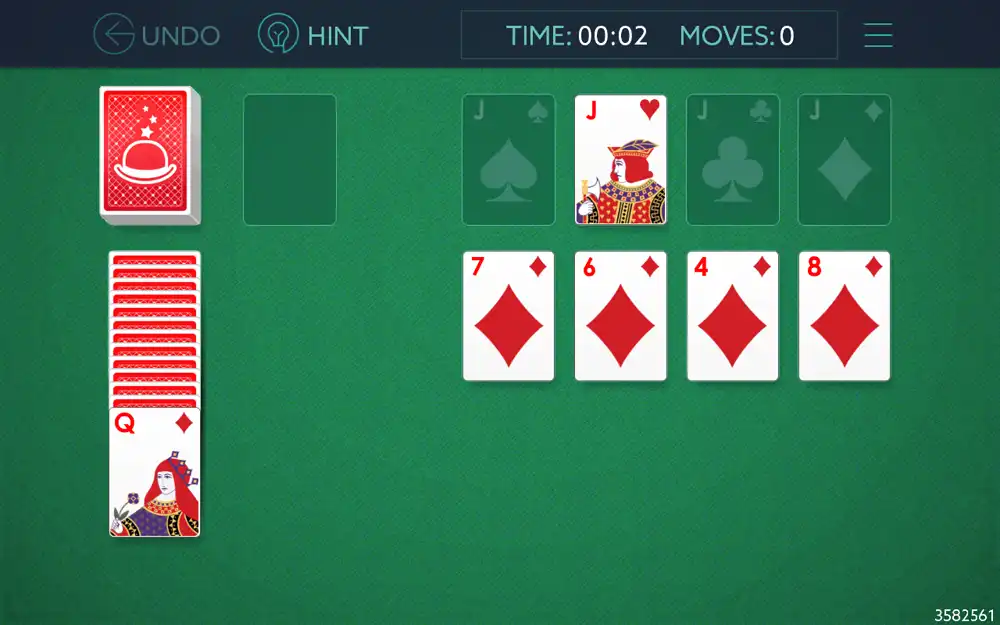
Canfield uses one 52-card deck. The classic opening layout is much smaller than Klondike’s seven-column tableau:
- Reserve: Deal 13 cards into a pile, with only the available top card exposed for play.
- Foundation: Deal the next card face up to start the first of four foundations. Its rank becomes the base rank for all four foundations.
- Tableau: Deal one face-up card to each of four tableau columns.
- Stock: The remaining 34 cards form the stock.
- Waste: Cards dealt from the stock are placed here and can be played when exposed.
Because only four cards begin in the tableau, the 13-card reserve has a major influence on the opening. Clearing a tableau column is often especially useful because it allows another reserve card to enter play.
Canfield Solitaire Rules
Foundations Start with a Random Base Rank
The first foundation card determines the starting rank for all four foundations. Suppose the game deals the 8 of diamonds as the base card. The other three foundations must begin with the 8 of clubs, 8 of hearts, and 8 of spades when those cards become available.
Each foundation then builds upward in the same suit. Because Canfield uses wraparound building, an 8-based foundation runs:
8 → 9 → 10 → Jack → Queen → King → Ace → 2 → 3 → 4 → 5 → 6 → 7
The final card on each foundation is therefore the rank immediately below the base rank.
Foundations Build Up by Suit
Once a foundation has its correct base card, only the next higher card of the same suit can be added. A 10 of clubs foundation needs the Jack of clubs next; a card of another suit cannot replace it.
The foundation is the final destination for the deck. You win only when all four foundations contain 13 cards.
Tableau Builds Down in Alternating Colors
The four tableau columns build in descending rank while alternating between red and black cards. A black 9 can receive a red 8, a red Queen can receive a black Jack, and a black 4 can receive a red 3.
The exact suit does not matter in the tableau as long as the rank decreases by one and the color alternates.
The Tableau Can Wrap from Ace to King
Canfield’s tableau does not stop at Ace. An opposite-color King can be placed on an Ace, allowing a descending sequence to continue around the rank cycle.
For example, this can be a legal Canfield sequence:
3♣ → 2♥ → A♠ → K♦ → Q♣
Every step still alternates color and moves down one rank, but Ace is treated as immediately above King for the wraparound move.
The Reserve Contains 13 Cards
The reserve is one of Canfield’s defining features. Only its exposed playable card is available at a time. When that card is moved to a foundation or tableau, the next reserve card becomes available.
Freeing the reserve is one of the main strategic goals. A deal can look promising on the foundations but still fail if critical cards remain trapped deep inside the reserve.
Empty Tableau Columns Use the Reserve
Under classic Canfield rules, when a tableau column becomes empty and reserve cards remain, the exposed reserve card is used to refill that space. Many digital versions perform this automatically.
After the reserve is exhausted, the exact rule for filling an empty column can vary slightly between implementations. Some browser versions let an available waste card or another legal card fill the space, while others automate the permitted move.
The Stock Is Commonly Dealt Three at a Time
Traditional Canfield commonly uses a Turn 3 stock. Cards are dealt from the stock to the waste in groups of three, and the exposed waste card is playable. If that card is moved, another card beneath it may become accessible.
Classic descriptions allow repeated passes through the stock under normal play conditions, while modern versions may limit redeals or offer an easier Turn 1 mode. If your playable game provides Turn 1 and Turn 3 options, those are stock-rule variations rather than different objectives.
Controls
| Action | Desktop | Mobile / Tablet |
|---|---|---|
| Select a card | Click an available face-up card | Tap an available face-up card |
| Move a card or legal sequence | Drag it to a legal tableau or foundation destination | Drag with your finger to a legal destination |
| Deal from the stock | Click the stock pile | Tap the stock pile |
| Play the reserve card | Click or drag the exposed reserve card | Tap or drag the exposed reserve card |
| Undo | Use Undo if available | Tap Undo if available |
| Start a new game | Select New Game | Tap New Game |
Some online versions support click-to-move, automatic foundation moves, hints, or automatic reserve refills. Those interface features do not change the basic Canfield objective.
How Foundation Wraparound Works
Canfield becomes much easier to understand once you stop treating Ace as the permanent bottom of every suit. The opening base rank determines where the foundation cycle begins.
If the base rank is 5, each foundation runs:
5 → 6 → 7 → 8 → 9 → 10 → J → Q → K → A → 2 → 3 → 4
If the base rank is King, the foundation runs:
K → A → 2 → 3 → 4 → 5 → 6 → 7 → 8 → 9 → 10 → J → Q
This means Aces are not automatically the first cards you need. Their timing depends on the randomly selected foundation rank.
How to Win Canfield Solitaire
Canfield rewards access and planning. The tableau is small, the reserve releases cards one at a time, and stock order can restrict what you can reach. Strong play is therefore not simply about making every foundation move immediately.
1. Prioritize the Reserve
The 13-card reserve is often the biggest obstacle. Whenever possible, look for useful ways to play its exposed card.
Clearing a tableau column is especially valuable while reserve cards remain because another reserve card can fill the opening. This removes a card from the reserve and exposes the next one.
2. Find the Other Three Base Cards
Only one foundation is active at the start. The other three cannot begin until you expose the matching base rank in their suits.
If the opening base is a 6, keep track of the other three 6s. Starting additional foundations creates more destinations and often relieves pressure on the tableau.
3. Remember Both Wraparound Rules
Players coming from Klondike often miss legal moves around the Ace/King boundary. In Canfield, foundations can go King to Ace, while tableau sequences can go Ace to an opposite-color King.
Before deciding that a card has nowhere to go, check whether a wraparound move is available.
4. Create Space Instead of Chasing Long Tableau Runs
A long alternating-color sequence can look productive, but tableau space is often more valuable than neatness. If a move empties a column and releases a reserve card, it may be stronger than simply extending an existing stack.
5. Track the Stock Order
In Turn 3 Canfield, stock order matters. A card that is blocked on one pass may become available later after you remove another waste card.
Pay attention to foundation starters, foundation continuations, and useful tableau connectors as they pass through the waste. Playing one card can change which cards become exposed on a later cycle.
6. Do Not Automatically Move Every Card to a Foundation
Foundation progress is the goal, but a tableau card can also be a useful landing point. If moving it upward removes the only destination for a reserve or waste card, the move may reduce your flexibility.
7. Respect the Movement Rules of Your Version
Traditional Canfield descriptions can be stricter about moving grouped tableau cards than some modern browser implementations. Classic rules often require a complete packed tableau column to move as a unit, while many online games allow any correctly built exposed sequence to move together.
Follow the movement behavior of the playable version. The strategic goal remains the same: use group moves to gain access to reserve cards, stock cards, and foundation continuations.
Common Canfield Solitaire Mistakes
- Assuming foundations always start with Aces. The random base rank controls every foundation.
- Forgetting foundation wraparound. After King comes Ace when the foundation cycle requires it.
- Forgetting tableau wraparound. An opposite-color King can follow an Ace.
- Ignoring the reserve. Essential cards can remain trapped in the 13-card reserve even when the foundations look strong.
- Missing chances to empty a tableau column. Empty columns are one of the main ways to release reserve cards.
- Playing stock cards without tracking later access. Turn 3 stock order can change after you remove a waste card.
- Treating Canfield exactly like Klondike. The smaller tableau and reserve system require a different approach.
Canfield Solitaire vs. Klondike Solitaire
| Feature | Canfield Solitaire | Klondike Solitaire |
|---|---|---|
| Decks | 1 | 1 |
| Tableau columns | 4 | 7 |
| Reserve | 13-card reserve | No separate 13-card reserve |
| Foundation starting rank | Random base rank | Ace |
| Foundation building | Up by suit with King-to-Ace wraparound | Up by suit from Ace to King |
| Tableau building | Down in alternating colors with Ace-to-King wraparound | Down in alternating colors |
| Empty tableau spaces | Filled from reserve while it remains | Normally filled by a King or King-led sequence |
| Typical stock rule | Traditionally Turn 3 | Commonly Turn 1 or Turn 3 |
Canfield may look like a smaller Klondike, but the 13-card reserve changes the rhythm of the game. Klondike focuses heavily on exposing hidden tableau cards. Canfield focuses on releasing a hidden reserve queue while making the most of only four tableau columns.
Canfield Solitaire Turn 1 vs. Turn 3
Many online versions offer more than one stock setting. Turn 3 is closer to the traditional game: three cards are dealt to the waste at a time, making stock order an important part of the puzzle.
Turn 1 reveals stock cards individually. This usually makes cards easier to access and is a good way to learn the reserve and foundation mechanics before moving to the more restrictive Turn 3 game.
Redeal limits can differ between browser implementations, so use the rules shown by the game when deciding how many times the stock can be cycled.
Canfield Solitaire Variations
Superior Canfield
Superior Canfield makes the reserve more open and relaxes some restrictions, giving the player more information and flexibility than standard Canfield.
Chameleon
Chameleon changes the reserve size, tableau layout, building rules, and stock behavior while preserving the compact Canfield-family feel.
Rainbow
Rainbow relaxes the standard alternating-color tableau rule, although stock and redeal rules can vary between published versions.
Storehouse
Storehouse, also called Reserve or Thirteen Up in some collections, is another reserve-based relative with different foundation and building rules.
Selective Canfield
Selective Canfield gives the player some control over the foundation base by allowing a choice from several opening cards. That creates an important decision before the rest of the game develops.
Why Is It Called Canfield Solitaire?
The game known as Canfield in the United States is historically connected with Demon Patience, an English patience game documented in the late nineteenth century. The American name later became associated with gambler and casino operator Richard A. Canfield.
The history is not completely settled. Sources disagree over exactly which solitaire game was played in connection with Canfield’s casino, and older books sometimes used the names Canfield, Demon, and Klondike differently. Today, “Canfield Solitaire” usually means the one-deck game with a 13-card reserve and foundations that begin from a randomly dealt base rank.
Does Canfield Solitaire Have Scoring?
The classic objective is simply to move all 52 cards to the foundations, so there is no single universal modern scoring system. Online versions may track moves, time, cards sent to foundations, streaks, or a custom numerical score.
Canfield also has a historical association with gambling-style scoring, but modern browser versions are typically played as ordinary free solitaire games rather than as wagering games.
Other Similar Games
- Yukon Solitaire
- Pyramid Solitaire
- Scorpion Solitaire
- TriPeaks Solitaire
- Golf Solitaire
- Clock Solitaire
- Google Soliatire
- Solitaire 2 Suits
Frequently Asked Questions
What is Canfield Solitaire?
Canfield Solitaire is a one-deck patience game with four tableau columns, a 13-card reserve, four foundations, a stock, and a waste pile. The foundations begin from a randomly dealt base rank rather than always beginning with Aces.
Is Canfield Solitaire also called Demon?
Yes. The game is closely associated with the older name Demon Patience, which is still used in some solitaire collections.
How many cards are used?
Canfield uses one standard 52-card deck without Jokers.
How many cards are in the reserve?
The classic reserve contains 13 cards, with only the exposed playable card available at a time.
How many tableau columns are there?
There are four tableau columns, each beginning with one face-up card.
How many cards remain in the stock?
After 13 reserve cards, one foundation base card, and four tableau cards are dealt, 34 cards remain in the stock.
Do the foundations start with Aces?
Not necessarily. The rank of the first foundation card becomes the starting rank for all four foundations.
How do foundations build?
Foundations build upward by suit from the base rank and wrap from King to Ace when necessary.
Can a foundation go from King to Ace?
Yes. Foundation sequences wrap from King to Ace if the base rank requires the sequence to continue.
How does the tableau build?
The tableau builds downward by rank in alternating colors.
Can the tableau go from Ace to King?
Yes. An opposite-color King can follow an Ace in standard Canfield tableau building.
What happens when a tableau column becomes empty?
While reserve cards remain, the reserve is used to refill the empty column under classic rules. Many digital versions do this automatically.
Can reserve cards go directly to a foundation?
Yes. If the exposed reserve card is the correct next card for a foundation, it can be moved there. It can also be played legally onto the tableau.
How does the stock work?
Traditional Canfield commonly deals three cards at a time to the waste. Modern online versions may also offer Turn 1 or different redeal limits.
What is Canfield Turn 1?
Turn 1 reveals stock cards one at a time, which usually makes stock access easier.
What is Canfield Turn 3?
Turn 3 deals stock cards in groups of three and is closer to the traditional form of Canfield.
How do you win?
You win by moving all 52 cards to the four foundations, with each foundation containing a complete 13-card suit sequence beginning from the original base rank.
What should I focus on first?
Look for ways to release reserve cards and locate the other three cards matching the foundation base rank. Opening more foundations and reducing the reserve usually increases your options.
Should I move every card to the foundations as soon as possible?
Not always. A card can still be useful as a tableau landing point, especially if keeping it helps release a reserve card or empty a column.
Why can’t I fill an empty column with any card?
Canfield prioritizes the reserve for empty tableau spaces while reserve cards remain, unlike Klondike’s King-only empty-column rule.
Is Canfield harder than Klondike?
Canfield is generally more restrictive because it has only four tableau columns, a 13-card reserve, and stock-order pressure in Turn 3 play. The random foundation base rank also changes which cards are immediately useful.
Is Canfield purely luck?
No. The deal matters, but players make meaningful decisions about reserve access, tableau organization, stock timing, and foundation moves.
Can I move sequences between tableau columns?
Rules vary by implementation. Traditional Canfield can be stricter about group movement, while many modern browser versions allow a correctly built exposed sequence to move together. Follow the movement rules used by the playable version.
Can I play Canfield Solitaire on mobile?
Yes. Browser-based versions can be played on phones and tablets when the interface supports touch controls.
What should I do if I get stuck?
Recheck the exposed reserve card, waste card, foundation continuations, and any legal Ace-to-King tableau wrap. Also look for a move that empties a tableau column, because that can release another reserve card and change the position.
Card Games