



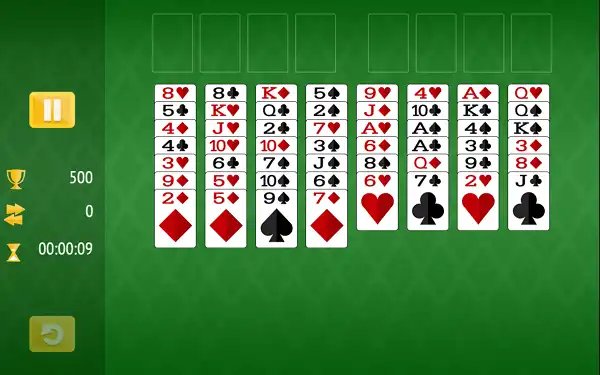

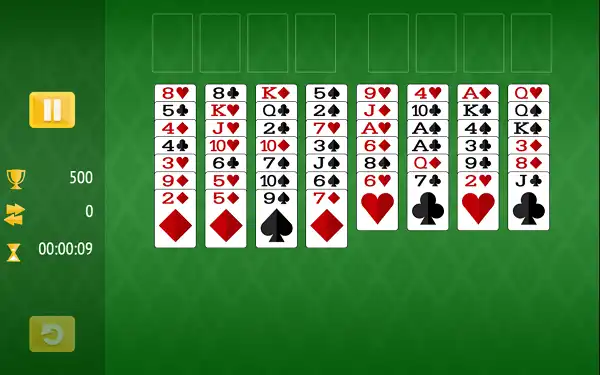
FreeCell flips the usual Solitaire setup on its head: every single card is dealt face-up from the start. No hidden cards, no guessing — just a puzzle laid out in front of you, and four empty “free cells” you can use to temporarily park cards while you work out your plan.
That openness changes everything. Where Klondike Solitaire has a real luck component sometimes the cards just don’t cooperate FreeCell is almost entirely about strategy. Nearly every deal can be won. The only question is whether you can find the way.
A Short History of FreeCell Solitaire
FreeCell is older than most people guess — it first showed up on PLATO, an early computer-based education system, back in the mid-1970s, and was later refined for Unix systems by Paul Alfille in the late 1980s. It didn’t reach a mass audience, though, until Microsoft bundled it into Windows 95 in 1995 — five years after Klondike had already become a Windows staple via Windows 3.0.
That one decision turned FreeCell from a niche puzzle into one of the most-played games on the planet, and its core appeal hasn’t changed since: it’s the Solitaire variant for people who’d rather think their way to a win than hope for one. The version on this page keeps that same all-cards-visible, four-free-cell structure — just built to run on its own, in any browser.
How to Play FreeCell Solitaire
Objective
Move all 52 cards into four foundation piles — one per suit — building each from Ace up to King. Clear the tableau completely, and the game is won.
Game Setup
FreeCell uses a single 52-card deck, and unlike most Solitaire games, every card is dealt face-up from the very first move:
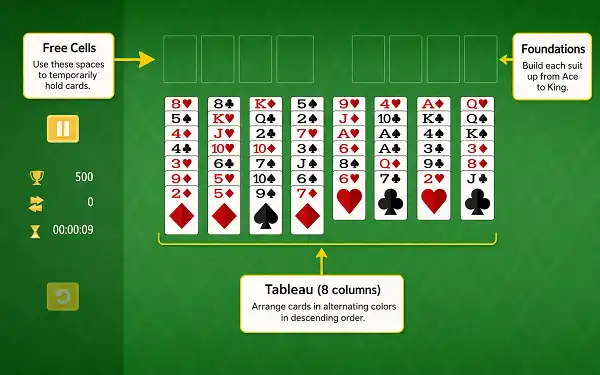
- The Tableau — eight columns across the board. The first four columns get 7 cards each, and the last four get 6 cards each. All of them are visible immediately.
- The Free Cells — four empty slots, usually shown in the top-left. Each one holds exactly one card, of any rank or suit, for as long as you need.
- The Foundations — four empty piles, one per suit, in the top-right. These build up from Ace to King and are how you win.
There’s no stock pile and no waste pile in FreeCell — everything you need to know is on the board from the start.
Rules of Play
- Build tableau columns in descending order, alternating colors. Same rule as Klondike — a red 7 can sit on a black 8, and so on.
- Free cells hold one card each, any card. Use them to temporarily set a card aside while you work on the column underneath it.
- Any card — not just Kings — can fill an empty column. This is one of the biggest differences from Klondike, where only Kings can start a new pile in an empty space.
- You can move “supermoves” — sequences of cards at once. Technically, only one card moves at a time. But most digital versions (including this one) let you move a properly-ordered sequence in one go, as if you’d shuttled each card through a free cell or empty column individually. How many cards you can move depends on how many free cells and empty columns you currently have open.
- Foundations build by suit, Ace to King. Once an Ace is free, move it up — then 2, 3, and onward in that same suit.
- The game ends when no moves are left. If every column, free cell, and foundation move is blocked, the game is over — though with FreeCell’s win rate, that’s a sign to try undo before giving up.
Understanding Supermoves (and Why They Matter)
This is the one FreeCell mechanic that trips up players coming from Klondike, so it’s worth its own short section.
In strict, by-the-book FreeCell, you can only move one card at a time — a sequence gets moved by shuttling each card through a free cell or empty column individually. Digital versions skip the tedium and let you grab the whole sequence at once, as a “supermove,” as long as you’d have enough free cells and empty columns to do it the long way.
The math: (empty free cells + 1) × 2 for every empty column. So with two empty free cells and one empty column, you can move up to six cards in a single sequence. With two empty free cells and no empty columns, that drops to three. Every empty column you create roughly doubles your reach — which is exactly why empty columns are the most valuable real estate on the board.
Strategies to Win FreeCell Solitaire

FreeCell rewards planning more than almost any other Solitaire variant. These habits are what separate a 30% win rate from an 80%+ one.
- Find your Aces and 2s before you make a single move. Since every card is visible, take ten seconds at the start of each game to spot where your Aces are buried and what’s sitting on top of them.
- Don’t fill your free cells early. Every occupied free cell shrinks your supermove capacity and limits your options. Treat them as a last resort, not a first move — try to keep at least one or two open at all times.
- Empty columns are worth more than free cells. An empty column can hold an entire sequence and doubles your supermove reach. If you’re choosing between freeing up a cell or clearing a column, the column usually wins.
- Don’t rush cards to the foundations. Once a card’s on a foundation, it can’t come back down to help you in the tableau. If sending a low card up now means losing a spot you’ll need later for a sequence, it can pay to hold it back a turn or two.
- Keep your foundation piles roughly even. If one suit’s foundation is several ranks ahead of the others, you may have moved cards up too aggressively — those gaps often mean you’re missing tableau-building opportunities.
- Clear your shortest columns first. Fewer cards means fewer obstacles, and an emptied short column gives you that valuable supermove boost early.
- Use hint and undo without hesitation. With win rates this high, getting stuck is almost always a sign there’s a better sequence you haven’t spotted yet — not that the deal is unbeatable.
How Difficult Is FreeCell Solitaire?
Here’s the headline number: roughly 99.999% of FreeCell deals are mathematically solvable. That figure comes from an exhaustive computer analysis of the original Microsoft deal set, and it’s the reason FreeCell has a reputation as “the thinking person’s Solitaire” — if you lose, it’s very rarely the deal’s fault.
That said, “solvable” and “easy” aren’t the same thing. In practice, win rates track skill level closely:
- Players with no real strategy — filling free cells freely, rushing cards to foundations — tend to win around 30% of games.
- Players using basic strategy (prioritizing Aces and 2s, protecting empty columns, keeping free cells open) commonly reach around 60%.
- Experienced players who plan several moves ahead and manage supermoves carefully report win rates of 80% or higher.
There’s also one fun bit of trivia worth knowing: of the original 32,000 Microsoft FreeCell deals, exactly one — deal #11982 — has been proven completely unsolvable. If you ever land on that exact deal number and can’t find a path through, it’s not you.
Is FreeCell the Same as Klondike?
They share a deck and a goal — build four foundations, Ace to King, by suit — but the experience is quite different.
Google Solitaire deals most cards face-down, uses a stock and waste pile, and only Kings can start a new column in an empty space. Luck plays a real role — some deals are genuinely tougher than others, even with perfect play.
FreeCell deals every card face-up, has no stock pile at all, and lets any card fill an empty column — plus those four free cells for temporary storage. With everything visible from the start, FreeCell is closer to a logic puzzle than a card game with hidden information.
Other Similar Card Games
- Spider Solitaire
- Pyramid Solitaire
- TriPeaks Solitaire
- Golf Solitaire
- Hearts Game
- Four Colors
- Google Soliatire
Frequently Asked Questions
What’s different about FreeCell compared to other Solitaire games?
Every card is dealt face-up from the start — there’s no hidden information. You also get four free cells for temporarily storing cards, and any card (not just Kings) can fill an empty tableau column.
Is FreeCell really almost always winnable?
Yes — roughly 99.999% of deals are solvable, with one famous exception (deal #11982 from the original Microsoft set) that’s been proven impossible. If you’re stuck, it’s overwhelmingly likely there’s a path you haven’t found yet.
What’s a “supermove”?
It’s moving a sequence of cards together in one action, instead of one card at a time. How many cards you can move depends on your empty free cells and empty columns — specifically, (empty free cells + 1) × 2 for each empty column.
Do I need to download anything or sign up?
No. The game runs entirely in your browser — nothing to install, nothing to create an account for.
Can I play FreeCell on my phone?
Yes. The board resizes for smaller screens, and drag-and-drop works the same with touch as it does with a mouse.
What happens if I make a mistake?
Use undo there’s no limit and no penalty. Given how solvable FreeCell is, undo is often all it takes to find the right path.
Why are there no face-down cards in FreeCell?
That’s by design it’s part of what makes FreeCell a game of pure strategy rather than a game with a luck element. Every card being visible from the start is the defining feature of the variant.
Card Games