What Is Google Solitaire? History of the Google Doodle Card Game
Google Solitaire is a free, fully playable version of Klondike Solitaire hidden inside Google Search. Type “solitaire” into Google, click Play, and the game loads directly on the search results page — no website to visit, no download, nothing to install. It’s one of Google’s most popular hidden Easter eggs, and it’s been quietly entertaining people for years.
But the game itself is much older than Google. Understanding where it came from makes it a lot more interesting to play.
What Is Google Solitaire, Exactly?
Google Solitaire is Klondike Solitaire — the same game that’s been the default “Solitaire” on Windows computers since 1990 and the version almost everyone pictures when they hear the word. Seven columns of cards, four foundation piles, a draw pile in the corner. Move cards in alternating colors and descending order. Send all 52 cards to the foundations by suit from Ace to King and you win.
Google’s version adds one choice before you start: Easy Mode (one card flipped from the stock at a time, unlimited redeals) or Hard Mode (three cards at a time, limited redeals). That single setting changes the win rate dramatically — Easy Mode is winnable most of the time with good play, Hard Mode is significantly tougher. Everything else follows standard Klondike rules.
New to the game? Our Complete Beginner’s Guide walks through the rules from scratch. Want the full rulebook? See Google Solitaire Rules: Everything You Need to Know.
Where Solitaire Actually Comes From
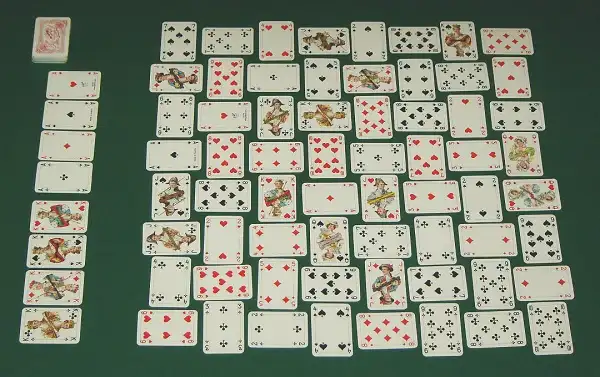
The game traces back to 18th-century Europe — most likely France, Germany, or Scandinavia. Early versions were played as fortune-telling exercises, not competitive games. Each card carried meaning, and the arrangement of cards at the end of a “patience” was read like a horoscope. In Northern Europe it was called “Kabale,” from a word meaning secret or mystery. The British called it “Patience,” a name that stuck in the UK and much of Europe to this day.
The first English-language book on patience games appeared in 1826. Lady Cadogan’s Illustrated Games of Patience, published in 1870, codified dozens of variants and brought the hobby to mainstream Victorian parlors. By the 1890s, hundreds of patience variants existed in print.
The specific variant most people know — Klondike — gets its name from the Klondike Gold Rush of 1896–1899 in Canada’s Yukon Territory. Prospectors waiting out long, cold nights in mining camps played single-deck patience games to pass the time. The regional name stuck, and by the early 20th century Klondike had become so dominant in North America that people simply called it “Solitaire” — unaware that hundreds of other patience games existed.
The Intern Who Made It the Most Played Game in History
Solitaire might have stayed a niche card game forever if not for a Microsoft summer intern named Wes Cherry.
In 1988, Microsoft was preparing Windows 3.0 — its first operating system designed for everyday consumers rather than technical users. The problem: the mouse. Clicking, dragging, dropping — these were completely new concepts for most people, and Microsoft needed a way to teach them naturally. Cherry, then a student intern, coded a digital version of Klondike Solitaire as the solution. The card art was designed by Susan Kare, the same designer behind the original Macintosh icons. Cherry was never paid royalties for the game. He later became a cider maker in the Pacific Northwest.
On May 22, 1990, Windows 3.0 shipped with Solitaire pre-installed on every copy. The educational purpose was forgotten almost immediately. People just played. Within years it had become the most-played computer game in history — not because of marketing or reviews, but because it was simply there on every Windows PC, always ready, always free.
Microsoft shipped Solitaire with every version of Windows through Windows 7. In 2012, the Microsoft Solitaire Collection launched for Windows 8, bundling Klondike, Spider, FreeCell, Pyramid, and TriPeaks into a single app. By 2025 it had over 100 million active users.
How Google Built Its Own Version
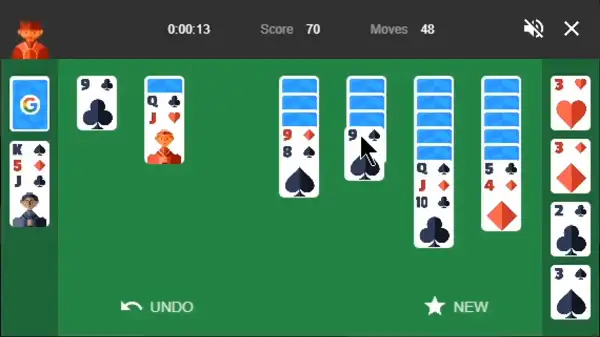
Google has hidden playable games inside its search results for years — Pac-Man, Snake, Minesweeper, Tic-Tac-Toe among them. Solitaire is one of the most popular. Search “solitaire” on Google and a preview of the game appears at the top of the results. Click Play and it expands into a full playable game right on the page, with Easy and Hard mode options, undo, and hint buttons.
It works on desktop and mobile. It requires no download, no account, and no separate website. It’s just there — part of Google’s long-running tradition of hiding useful or entertaining things inside the world’s most-visited page.
The version on this site embeds that same game so you can play it directly here, any time, without going through Google Search first. Play Google Solitaire here.
Why People Keep Playing It
Solitaire has been the world’s most-played card game for over 30 years. The reasons haven’t changed much. It’s a single-player game, so there’s no waiting for opponents and no social pressure. A round takes between two and ten minutes. You can stop mid-game and come back. It requires just enough attention to be engaging without demanding full focus — which makes it perfect for short breaks.
The Google version adds browser convenience on top of all that. No app to update, no account to log into, no ads interrupting the game. Just open a tab and play. For a game invented by Yukon prospectors killing time in the snow, it has adapted remarkably well to the smartphone era.
Frequently Asked Questions
What is Google Solitaire?
Google Solitaire is a free playable version of Klondike Solitaire built into Google Search as a hidden Easter egg. Search “solitaire” on Google and click Play to open it. It includes Easy Mode (draw one card) and Hard Mode (draw three) and works on both desktop and mobile.
Is Google Solitaire the same as Klondike Solitaire?
Yes. Google Solitaire follows standard Klondike rules — seven tableau columns, four suit-based foundations, alternating-color descending stacking, and a draw pile. The only addition is the Easy/Hard mode toggle. If you’ve played Solitaire on any Windows PC, you already know the rules.
Who made Google Solitaire?
Google built it as part of its family of search Easter eggs — hidden interactive features inside Google Search. The underlying game is Klondike Solitaire, originally popularized by Wes Cherry’s version for Microsoft Windows 3.0 in 1990.
Is Google Solitaire free?
Completely free. No sign-up, no download, no payment. It runs in the browser and loads instantly.
What other Solitaire games are there?
Klondike is the most famous, but dozens of variants exist. The most played after Klondike are Spider Solitaire (two decks, same-suit sequences), FreeCell (all cards visible, four open cells), and Pyramid Solitaire (pair cards that total 13). All three are free on this site.
Ready to Play?
Play Google Solitaire here — free, no download, Easy or Hard mode. If you want to get better at it, our 10 Tips to Win Google Solitaire covers the strategies that actually make a difference.
Blog
Muzamil Aslam
Muzamil Aslam is the founder and author behind GoogleSolitaire.me. He enjoys writing about solitaire, browser-based games, and gaming strategies, helping players improve their skills while enjoying classic card games online.