Solitaire Variants Explained: 12 Types Every Player Should Know
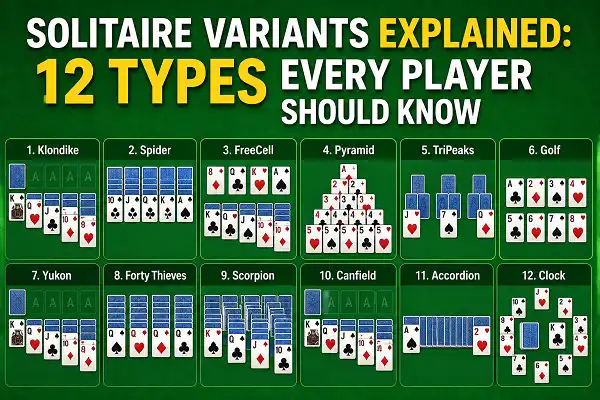
Most people know two or three versions of Solitaire. There are hundreds. These twelve are the ones that matter — covering everything from the classic most people grew up with to the pure-luck game where strategy literally cannot help you.
Quick Reference: Difficulty and Win Rates
| Variant | Decks | Approx. Win Rate | Difficulty |
|---|---|---|---|
| Klondike (Easy) | 1 | ~33% | Beginner–Medium |
| TriPeaks | 1 | ~90% | Beginner |
| Golf | 1 | ~50% | Easy |
| FreeCell | 1 | ~99.999%* | Medium (skill-based) |
| Yukon | 1 | ~65% | Medium |
| Spider 1-Suit | 2 | ~52% | Medium |
| Pyramid | 1 | ~15–20% | Hard |
| Spider 4-Suit | 2 | ~6% | Very Hard |
| Forty Thieves | 2 | ~10% | Very Hard |
| Scorpion | 1 | ~15% | Hard |
| Canfield | 1 | ~3–8% | Very Hard |
| Clock Solitaire | 1 | ~7.7% | Pure luck (no strategy) |
*FreeCell win rate assumes skilled play — only one deal out of 32,000 original numbered games is confirmed unwinnable.
1. Klondike — The One Everyone Knows
Klondike is what almost everyone means when they say “Solitaire.” Seven tableau columns, four suit-based foundations, a draw pile. Move cards in alternating colors and descending order; send all 52 to the foundations Ace-to-King to win. Easy Mode draws one card at a time with unlimited redeals; Hard Mode draws three with limited passes. Both Microsoft’s Windows Solitaire and Google Solitaire are Klondike.
➜ Play Klondike (Google Solitaire) · Full guide: How to Play Google Solitaire
2. Spider — The Two-Deck Challenge
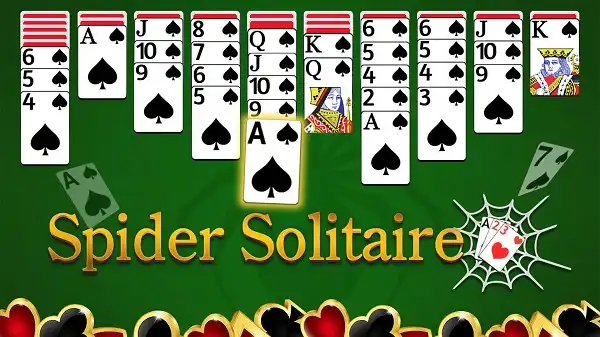
Two decks, ten tableau columns, no separate foundations to build toward. Instead, you build complete King-to-Ace sequences of the same suit within the tableau itself — they clear automatically when finished. Groups can only be moved together if they’re same-suit. Click the stock to deal one new card to each column simultaneously; you get five deals total. Three difficulty levels — 1-suit, 2-suit, 4-suit — with dramatically different win rates.
➜ Play Spider Solitaire · Full guide: How to Play Spider Solitaire
3. FreeCell — The Skill Game
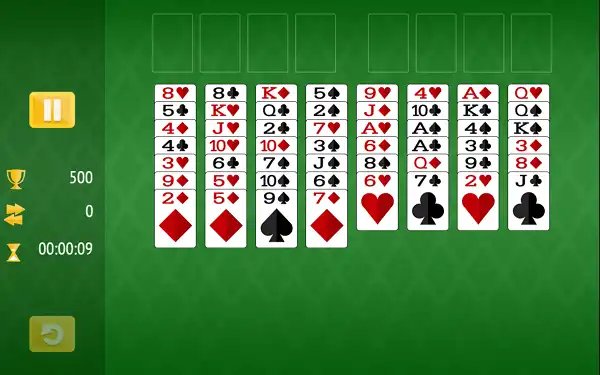
All 52 cards dealt face-up across eight columns from the start — nothing hidden, no stock. Four free cells above the tableau let you temporarily park single cards. Nearly every deal is solvable; the only question is whether you find the winning sequence. Of the original 32,000 Microsoft FreeCell numbered deals, exactly one (deal #11982) is confirmed unwinnable. Winning or losing is almost entirely about the quality of your decisions.
➜ Play FreeCell · Full guide: FreeCell Tips: How to Win Almost Every Game
4. Pyramid — Pair to 13
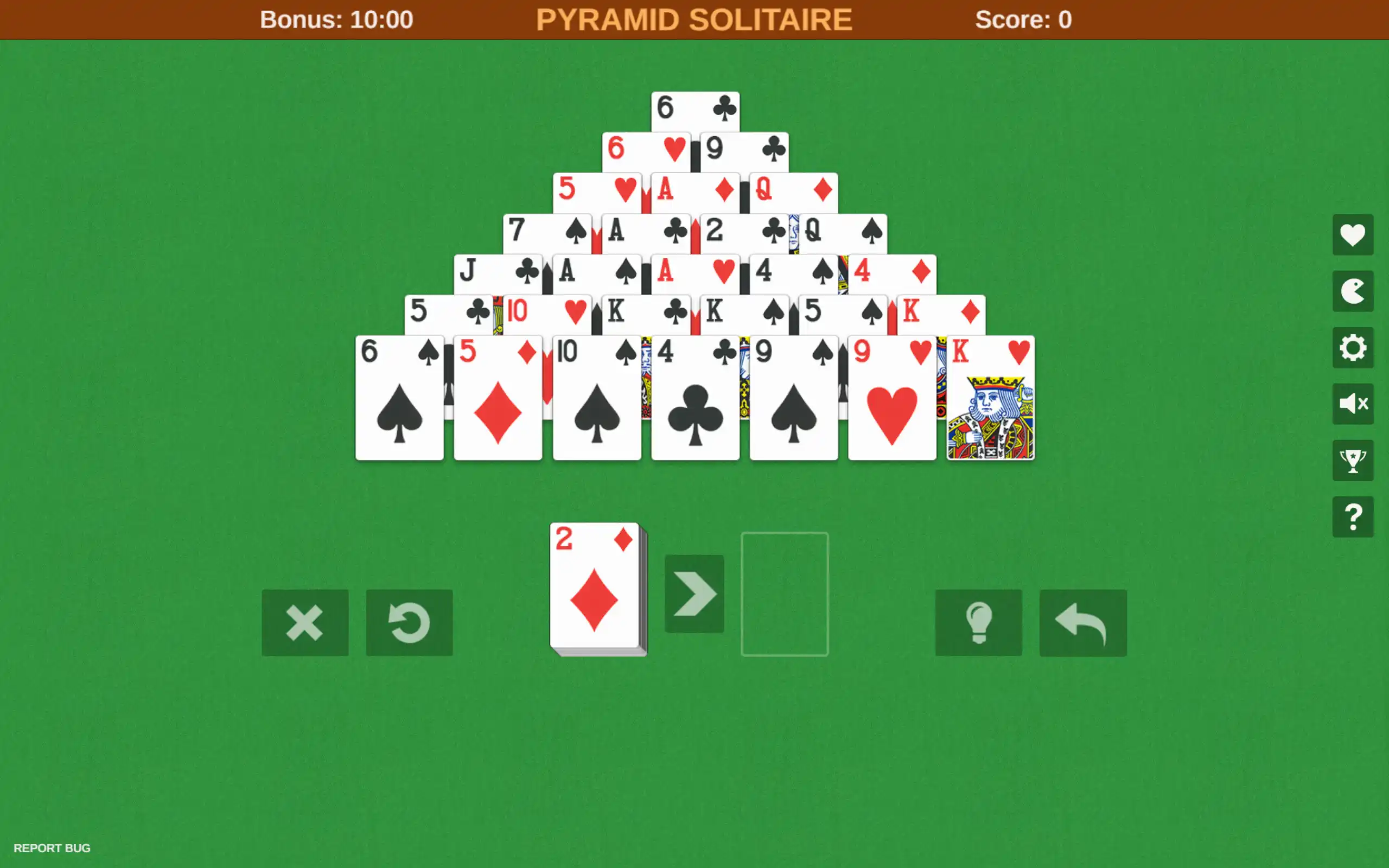
Twenty-eight cards arranged in a seven-row pyramid; 24 form the stock. Remove exposed cards by pairing any two that add up to 13 — or remove Kings alone (they’re worth 13 on their own). Suits don’t matter. You get three passes through the stock. Clear the pyramid to win. One of the harder common variants with one of the lowest win rates — luck plays an unusually large role.
➜ Play Pyramid Solitaire · Full guide: Pyramid Solitaire Rules and How to Win
5. TriPeaks — The Fastest Solitaire
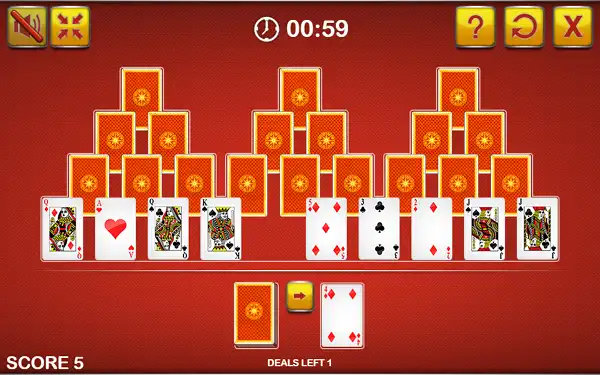
Twenty-eight cards dealt into three overlapping peaks; 24 form the stock. Flip one stock card at a time — remove any tableau card that is exactly one rank higher or lower than the current waste card. Chain removals together for bonus scoring. The highest win rate of any common Solitaire variant, and rounds typically finish in under five minutes. Good for short breaks; bad for anyone who wants to lose themselves in a long game.
6. Golf — Score Low, Like the Sport
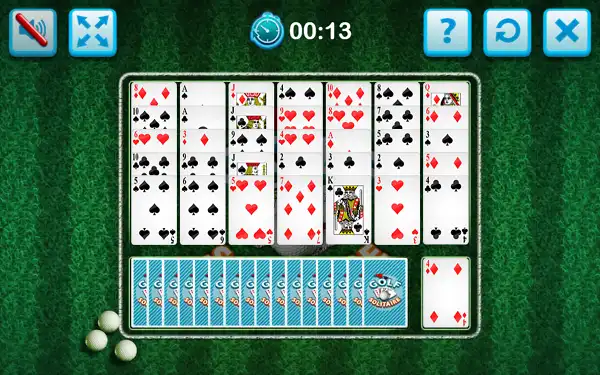
Thirty-five cards dealt into seven columns of five; 17 form the stock. Flip one stock card at a time and remove tableau cards one rank higher or lower than the top waste card, chaining as long as you can. Cards remaining at the end of the round are your score — lower is better, hence the name. Unlike TriPeaks, Aces are strictly low in standard Golf (no King-Ace-2 wrap). A quick, accessible game that rewards spotting chain opportunities over deep strategic planning.
7. Yukon — Klondike with More Freedom
Yukon uses the same seven-column, four-foundation setup as Klondike — but with one significant difference: you can move any group of face-up cards as a unit, regardless of whether they’re in proper sequence. In Klondike, only correctly ordered groups can move together. In Yukon, any face-up card plus everything below it can be picked up and moved onto a card of higher rank and opposite color. All cards are dealt to the tableau at the start; there’s no stock. This extra flexibility makes Yukon more winnable than Klondike despite the similar layout.
8. Forty Thieves — Napoleon’s Game
Two decks, 10 tableau columns of four cards each — 40 starting cards, hence the name. The remaining 64 form the stock with one pass through. Build same-suit descending sequences in the tableau, Ace-to-King foundations. The strict rule: only one card can be moved at a time, no group moves allowed. One of the hardest common variants. Legend attributes Forty Thieves to Napoleon during his exile at Saint Helena — unverified, but the story has stuck for over a century.
9. Scorpion — Spider Meets Yukon
Seven columns of seven cards: the first four have three face-down cards with four face-up on top; the last three are fully face-up. Three cards form a small stock. Goal: build four complete same-suit King-to-Ace sequences within the tableau (like Spider). Movement: any face-up card plus all cards beneath it can move as a group onto the right card (like Yukon) — even if the group isn’t in sequence. The three stock cards deal one to each of the first three columns when you’re stuck. A genuine hybrid that rewards the strategic instincts of both Spider and Yukon players.
10. Canfield — The Casino Game
Named after Richard Albert Canfield, a 19th-century American gambler who ran it as a casino game — players bought 52 cards for $52 and won $5 back per card moved to the foundation. The setup is unusual: a 13-card reserve pile (drawn one at a time to the waste), four one-card tableau columns, and a randomly chosen card that sets the starting rank for all four foundations (which wrap around — a foundation starting on 7 builds 7, 8, 9… K, A, 2, 3… 6). One of the hardest common variants. Also called “Demon” in the UK.
11. Accordion — The Collapsing Game
All 52 cards dealt in a single horizontal row. Move any card onto the card immediately to its left, or the card three positions to its left, if they share the same suit or same rank. The goal: collapse the entire row into a single pile. Sounds simple. The practical win rate is under 1% — almost no one wins Accordion. No other common Solitaire game packs this much frustration into rules you can explain in two sentences.
12. Clock Solitaire — Pure Luck, No Decisions
Deal 52 cards into 13 face-down piles arranged like a clock face — 12 piles at clock positions plus one center pile (Kings). Flip the top card of the center pile. Place it face-up beneath the pile corresponding to its rank (Aces at 1 o’clock, 2s at 2 o’clock, and so on). Flip the top card of the new pile and repeat. You win if all cards are face-up before all four Kings are revealed; once the fourth King flips, the game ends. Win rate is exactly 1 in 13 — about 7.7%. No strategy exists. It’s the only Solitaire game where your decisions genuinely cannot influence the outcome.
Frequently Asked Questions
Which solitaire variant is easiest for beginners?
TriPeaks has the highest win rate (~90%) and the simplest rules — match one rank higher or lower, chain as long as you can. Golf is similar and also very accessible. Klondike on Easy Mode is the most familiar starting point for most people since it’s the version they’ve seen on Windows and Google.
Which solitaire variant is hardest?
Canfield (3–8% win rate) and Accordion (under 1%) are the hardest by win rate. Spider 4-suit (~6%) and Forty Thieves (~10%) are the hardest that reward serious strategic skill. Clock Solitaire has a 7.7% win rate but is pure luck — skill can’t help you there.
Which variant is best if I hate losing to bad luck?
FreeCell. Nearly every deal is theoretically solvable, all cards are visible from the start, and losses are almost always strategic mistakes rather than bad draws. It’s as close to a pure skill game as Solitaire gets. Full strategy in our FreeCell guide.
What’s the difference between Klondike and Yukon?
Same basic setup — seven columns, four suit-based foundations — but Yukon lets you move any group of face-up cards regardless of whether they’re in sequence. Klondike only allows correctly ordered alternating-color groups to move together. Yukon also has no stock pile; all cards start on the tableau.
Blog
Muzamil Aslam
Muzamil Aslam is the founder and author behind GoogleSolitaire.me. He enjoys writing about solitaire, browser-based games, and gaming strategies, helping players improve their skills while enjoying classic card games online.