Why Solitaire Is Good for Your Brain (Science-Backed)
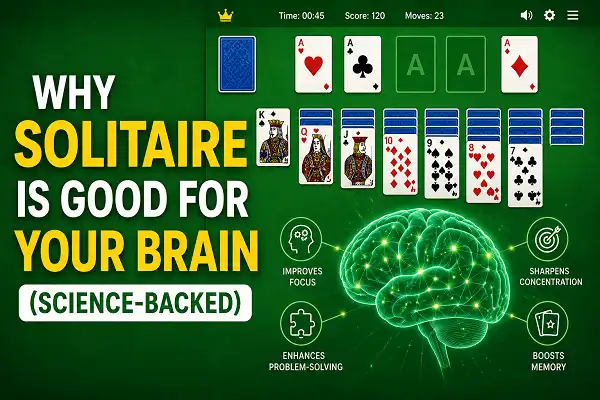
Most people assume Solitaire is just a way to kill time. The research suggests otherwise. Regular card game play is linked to stronger working memory, lower stress, and meaningfully reduced risk of cognitive decline as you age. None of those benefits require a special version of the game — the Solitaire you’ve been playing is doing the work.
Here’s what the evidence actually says — with appropriate caveats about what’s proven versus what’s strongly suggested.
It Exercises Your Working Memory
Every game of Solitaire requires you to hold and manage multiple pieces of information simultaneously: which cards are face-down in which columns, what’s been played to the foundations, what suits you still need, what the waste pile recently showed. That constant tracking exercises working memory — the cognitive system that temporarily holds and manipulates information.
Working memory is one of the most important components of executive function — the mental processes that govern planning, decision-making, and flexible thinking. Research consistently shows that regularly engaging working memory helps maintain and, in younger adults, improve this capacity over time. Solitaire isn’t a passive activity; every move involves active information management.
It Builds Planning and Decision-Making Skills
Solitaire presents a continuous series of decisions with no clearly “right” answer visible. Do you send this card to the foundation now or keep it in the tableau? Do you fill the empty column with a King or wait? Which stock card takes priority?
These aren’t trivial choices — many of them have consequences several moves down the line. Making them repeatedly, in a low-stakes environment where the cost of a wrong decision is just losing a game, trains the kind of forward-planning thinking that psychologists associate with strong executive function. The game is essentially a decision-making gym with a simple interface.
It Reduces Stress Through the Flow State
Psychologist Mihaly Csikszentmihalyi described flow as the mental state of being completely absorbed in a moderately challenging task — enough difficulty to hold your attention, not so much that it triggers anxiety. Solitaire fits that description almost perfectly for most players.
When you’re in a game, your attention narrows to the board. The mental chatter from your day — to-do lists, worries, unfinished tasks — quiets down because your cognitive resources are occupied. Focused attention on a low-stakes absorbing task is one of the most reliable ways to interrupt the stress response. This is why many people instinctively reach for Solitaire during a difficult workday — not just as procrastination, but as a genuine mental reset.
It May Help Protect Cognitive Function as You Age
This is where the research is most compelling — and where appropriate nuance matters.
A landmark study published in the New England Journal of Medicine (Verghese et al., 2003) followed 469 adults over age 75 for more than five years. Those who regularly engaged in cognitive leisure activities — including card games — had a significantly lower risk of developing dementia. Playing cards specifically was associated with a 74% lower risk of dementia in that population.
More recent research supports the broader principle: mentally stimulating activities contribute to what neuroscientists call cognitive reserve — the brain’s accumulated resilience against age-related decline. The hypothesis is that a lifetime of cognitive engagement builds more neural connections, giving the brain more redundancy when some connections deteriorate with age.
What the science doesn’t say: Solitaire alone won’t prevent dementia, and no single activity is a guaranteed shield against cognitive decline. The protective effect is associated with regular, varied mental engagement over a lifetime. Solitaire is one contributing factor, not a cure.
It Teaches Patience and Emotional Regulation
Solitaire is not always winnable. About 18% of deals are mathematically impossible regardless of how well you play. Learning to work methodically through a difficult board — and recognizing when to accept that a game can’t be won — is a quiet exercise in frustration tolerance and emotional regulation.
Repeated exposure to low-stakes outcomes (losing a card game is genuinely low stakes) in a structured environment is associated with better emotional control in more significant situations. The game trains a kind of measured patience that’s increasingly rare in a world of instant feedback.
It Gives You Time to Think Alone
Solitary focused activities have long been associated with improved introspective thinking. When you’re absorbed in Solitaire — particularly in a longer, more strategic session — you’re giving the problem-solving part of your brain something to do while the rest of your mind processes the background noise of your day. Many people report that their best ideas or clearest thinking happens during or right after low-demand activities like this.
This isn’t magic. It’s the well-documented effect of diffuse thinking — the mode your brain enters when not under direct task pressure, known to be important for creativity and problem resolution.
A Note on Moderation
The cognitive benefits of Solitaire come from regular, moderate play — not marathon sessions. Research on cognitive leisure activities generally points to 15–30 minutes as the range where mental engagement benefits occur without diminishing returns. Playing to the point of compulsive avoidance of other responsibilities reverses the benefit. The goal is a genuine mental break, not a replacement for other activity.
Rotating between Solitaire variants also helps — Spider Solitaire, FreeCell, and Pyramid each challenge slightly different cognitive skills, which prevents the brain from simply automating a familiar pattern.
Frequently Asked Questions
Is there actual scientific evidence that Solitaire is good for your brain?
Research on cognitive leisure activities — including card games — consistently links regular mental engagement to maintained cognitive function, better working memory, and reduced dementia risk. Solitaire specifically hasn’t been isolated in clinical trials, but it shares the key characteristics of activities that have been studied: it demands planning, working memory, pattern recognition, and sustained attention.
Can Solitaire help prevent dementia?
No single activity prevents dementia. The Verghese et al. (2003) NEJM study found card games were associated with a significantly lower dementia risk in older adults — but the association is with regular cognitive engagement over a lifetime, not card games alone. Solitaire contributes to cognitive reserve as part of an overall mentally active lifestyle.
How long should I play to get the cognitive benefits?
Most research on cognitive leisure points to 15–30 minutes of regular, focused play as the useful range. The benefits come from the mental engagement during play, not from accumulating hours. A daily short session is more valuable than an occasional long one.
Is Solitaire better for your brain than other games?
It’s good at what it specifically exercises: planning, working memory, patience, and pattern recognition. Different games exercise different skills. Rotating between Solitaire variants — Klondike, FreeCell, Spider — challenges the brain more than playing only one version, since each demands slightly different thinking.
Does it matter whether I win or lose?
The cognitive engagement happens during play, not at the win screen. The planning, tracking, and decision-making that occur through a losing game provide the same mental exercise as a winning one. The emotional regulation benefits — tolerating an uncertain outcome, accepting an unwinnable deal — arguably only come from the games you don’t win.
Play Solitaire
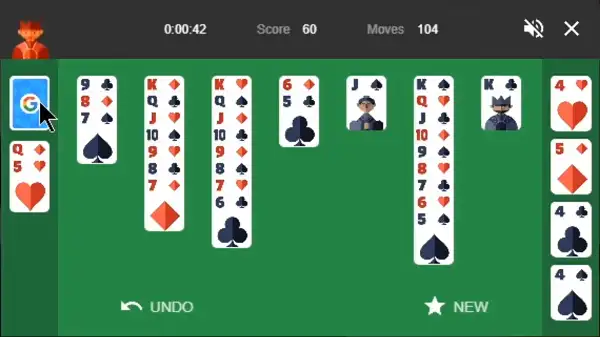
Google Solitaire is free here — Easy and Hard mode, no download. If you’re ready to try a variant that exercises your planning skills more deeply than Klondike, FreeCell is the one to start with — every card visible, nearly every game winnable, pure decision-making from the first move.
Blog
Muzamil Aslam
Muzamil Aslam is the founder and author behind GoogleSolitaire.me. He enjoys writing about solitaire, browser-based games, and gaming strategies, helping players improve their skills while enjoying classic card games online.