10 Tips to Win Google Solitaire Every Time
Most people who play Google Solitaire lose more than they win. That’s not a knock — it’s just what happens when you’re playing on instinct rather than strategy. You move whatever card seems movable, draw from the stock when you’re stuck, and hope the deal works out. Sometimes it does. Often it doesn’t.
The good news: Google Solitaire is over 80% winnable in Easy Mode when played correctly. That means the majority of your losses aren’t bad luck — they’re missed moves, rushed decisions, or habits that quietly kill your chances three turns before you realize it.
These 10 tips address exactly that. Not obvious advice you already know, but the specific decisions that separate players who win consistently from players who restart more than they finish.
New to the game entirely? Start with our Complete Beginner’s Guide first — these tips will make a lot more sense once the rules are clear. Already know the basics? Let’s get into it.
Tip 1: Flip the First Stock Card Before Anything Else
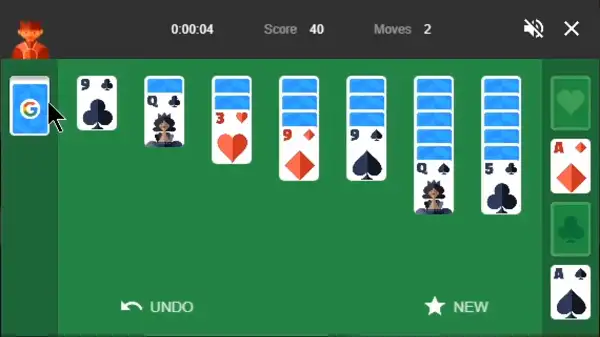
The single move most players miss at the start of every game: before touching a single tableau card, flip the top card from the stock.
Why? Because that card might be exactly what changes which tableau move is best. If you move cards on the board first and then flip the stock, you could have burned a perfectly good move on something the stock card would have handled better — or missed a sequence that the new card unlocks.
Check the stock first. It costs you nothing. Then survey the entire board — all seven tableau columns plus the waste pile — before committing to a move. The player who moves last after seeing the most information wins more often than the player who moves first on instinct.
Tip 2: Always Ask “Does This Flip a Hidden Card?”
Before every single move, ask yourself one question: will this reveal a face-down card?
Revealing hidden cards is the most valuable thing you can do in Google Solitaire. Every face-down card you flip is a new option — and the more options you have, the more likely you are to find the move that unlocks everything. A move that doesn’t flip anything is often a low-value move, even if it looks tidy.
This becomes your internal filter: given two valid moves, take the one that flips a card. If neither does, look harder — there might be a third option you’re missing. If there truly isn’t, then take the move that best sets up your next flip.
Tip 3: Target the Longest Columns First
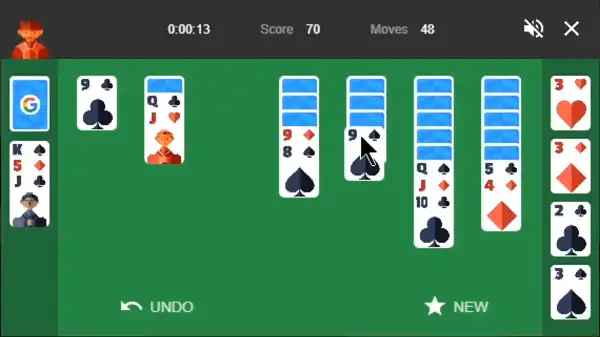
Look at the right side of your tableau. Columns 5, 6, and 7 — the ones with five, six, and seven cards at the start — have the most cards buried underneath them. That means they hold the most potential and the most risk.
Experienced players attack those long columns early, while they still have enough loose cards elsewhere to make moves. Leave them until late in the game and you’ll often find yourself stuck: the column is still packed, the short columns are bare, and there’s nothing to maneuver with.
The rule of thumb: when you have a choice between uncovering a card in a long column and uncovering a card in a short one, go for the long column every time. More hidden cards there means more potential moves sitting underneath.
Tip 4: Don’t Rush Cards to the Foundation
This one catches people off guard because it feels wrong. Isn’t the foundation where cards are supposed to go? Yes — eventually. But not always immediately.
Here’s the problem: a low card on the foundation can’t help you in the tableau. If you send a black 3 up the moment it’s free and there’s still a red 2 buried somewhere, you’ve just removed the only card that could accept that red 2 when it finally surfaces. Now you’re stuck — and you won’t even realize why for several moves.
The safe rule: Aces and 2s always go to the foundation immediately. For 3s, 4s, and 5s — pause and ask whether the card is still doing useful work in the tableau. If it is, leave it a little longer. If it’s sitting there with nothing below it and nothing to receive, send it up.
The deeper principle is keeping your foundations roughly balanced. If one suit is at 8 while the others are at 3, you’ve limited yourself. Cards in the lagging suits are still sitting in the tableau, taking up space and blocking moves. Try to build all four piles at a similar pace.
Tip 5: Plan Before You Fill an Empty Column
An empty tableau column is one of the most powerful things in Google Solitaire. And it’s one of the most commonly wasted.
The moment a column clears, the temptation is to drop a King into it immediately. Resist that. Look at the board first. Ask: which King opens the most for me?
The answer depends on what Queens you have available. A black King is only useful if you can put a red Queen on it. A red King only works if you have a black Queen ready. If you have a red Jack sitting in a long column blocking a pile of hidden cards, you need a black Queen to land on, which means you need a red King — not a black one.
Choosing the wrong King is one of the subtlest ways to lose a winnable game. The empty column is still there, but it’s now occupied by a King with nowhere useful to go. Take 10 seconds to look at your Queens before placing any King into an empty space.
Tip 6: The Stock Is Your Last Resort, Not Your First Move
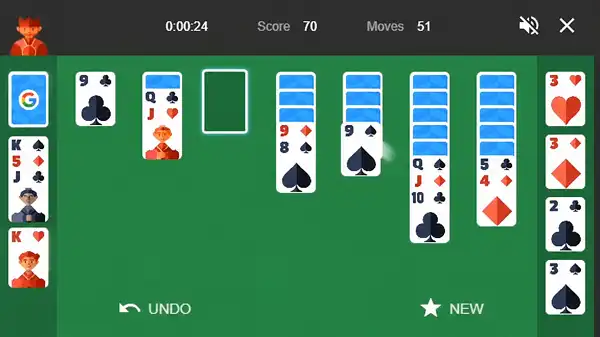
Most players reach for the stock the moment they don’t immediately see a move. This is the single most common mistake in Google Solitaire.
In Easy Mode, your stock passes are unlimited — so it feels harmless to just flip a new card whenever you’re unsure. But every time you draw without exhausting your tableau options first, you’re giving up information. You might miss a move that flips a hidden card, clears a column, or sets up a King placement.
Before touching the stock, do a full pass:
- Can any face-up card move onto another in the tableau?
- Can the waste pile top card go anywhere?
- Can any card go to the foundation?
- Is there a group of cards that can move as a unit?
If the answer to all four is no — then draw. Not before.
Tip 7: Choose Tableau Moves Over Foundation Moves When Both Are Available
If you can send a card to the foundation or use it in a tableau move, almost always choose the tableau move first.
The reason: tableau moves reveal information. A card moved within the tableau might flip a hidden card, create a cascade, or open an empty column. The same card moved to the foundation does none of those things — it just sits there, one step closer to the win but contributing nothing to the current position.
The exception is when the tableau move offers nothing — the card just shifts to a different column with no chain effect. In that case, if the foundation needs it, send it up. But given a choice between a “useful” tableau move and a foundation move, take the tableau.
Tip 8: Treat the Waste Pile Like a Queue You Can Manage
In Hard Mode especially — but worth doing in Easy Mode too — the waste pile isn’t just a random output. It’s a sequence you can partially control.
Here’s what most players miss: you don’t have to play a card from the waste pile just because you can. Sometimes leaving a card on top of the waste pile is smarter than playing it, because the card underneath it is more valuable for where you are right now.
Think of the waste pile as a queue. The card you play now determines what becomes available next. Before playing the waste pile top card, ask: what’s underneath it, and do I want that card to be available sooner rather than later? This level of planning is what separates advanced players from everyone else.
This matters most in Hard Mode, where the stock draw is limited. For a deeper look at how Hard Mode changes your whole approach, see our post on Easy Mode vs Hard Mode.
Tip 9: Use Undo as a Planning Tool, Not Just a Panic Button
Google Solitaire gives you an undo button with no penalty. Most players use it reactively — they make a move, immediately see it was wrong, and hit undo. That’s fine, but it’s the least valuable way to use it.
The more powerful way: use undo proactively. Try a move. See what it opens up. If the next card that flips is good, keep going. If the position looks worse or it opens a dead end, undo it and try a different move instead.
This turns undo into a free look-ahead. You’re not guessing what a move leads to — you’re testing it, seeing the result, and deciding. Digital Solitaire gives you this advantage that physical card players never had. Use it. There’s no shame and no penalty, and it genuinely improves your win rate.
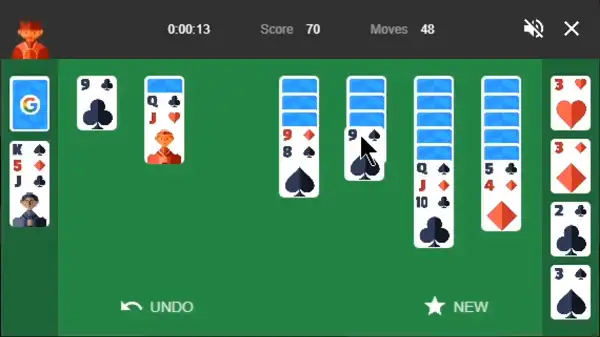
Tip 10: Know When to Start Over
Not every deal is winnable. Even with perfect play, some arrangements of cards lead to positions where no progress is possible — this is a known characteristic of Klondike Solitaire, not a flaw in your strategy.
The skill is recognizing the difference between a game that’s stuck and a game that’s over. A stuck game has hidden cards to flip, stock cards you haven’t seen, or moves you haven’t tried. An over game has all cards visible, a fully cycled stock with nothing new, and no valid moves left.
When you reach a genuine dead end — stock fully cycled, no moves in the tableau, no foundation moves possible — start a new deal. Spending ten more minutes on an unwinnable game teaches you frustration, not strategy. Fresh deals are free and instant. Don’t burn time on a lost cause.
Curious about exactly how many Google Solitaire deals are unwinnable? We break down the numbers in our post on whether Google Solitaire is always winnable.
Quick Reference: 10 Tips at a Glance
| # | Tip | Why It Matters |
|---|---|---|
| 1 | Flip the stock first before any tableau move | More information = better decisions |
| 2 | Prioritize moves that reveal face-down cards | Hidden cards are the biggest constraint in the game |
| 3 | Target the longest columns early | Most hidden cards live there — expose them while you have options |
| 4 | Don’t rush cards to the foundation | Low cards in the tableau keep sequences open |
| 5 | Plan before filling an empty column | Wrong King = wasted column |
| 6 | Use the stock as a last resort | Tableau moves first — stock flips are limited in Hard Mode |
| 7 | Prefer tableau moves over foundation moves | Tableau moves reveal cards; foundation moves don’t |
| 8 | Manage the waste pile as a queue | Leave cards on the waste when the card below is more valuable right now |
| 9 | Use undo as a planning tool | Test moves before committing — it’s free and has no penalty |
| 10 | Know when a game is unwinnable | Saves time — fresh deals are free and instant |
Frequently Asked Questions
What is the most important tip for winning Google Solitaire?
Tip 2 — always prioritizing moves that reveal face-down cards. Everything else in the game flows from how many cards you can see. The more face-up cards you have, the more moves you have. The more moves you have, the harder it is to get stuck. If you only adopt one habit from this list, make it that one.
Should I play Easy or Hard mode if I want to win more?
Easy Mode. In Easy Mode, most deals are mathematically winnable with good play. In Hard Mode, a notable portion of deals are unwinnable regardless of strategy. Easy Mode is also where these tips have the most impact — Hard Mode introduces a level of card inaccessibility that limits how much strategy can overcome. See our full comparison at Easy Mode vs Hard Mode.
Is it okay to use hints?
Absolutely. Hints exist in the game for a reason, and there’s no penalty for using them. They’re especially useful for breaking tunnel vision — when you’ve been staring at the same board for a while and stop seeing options that are actually there. Think of hints as a nudge, not a crutch.
What should I do if I keep losing?
Focus on Tips 2 and 6 first. Most losing runs come from not uncovering enough hidden cards early (tip 2) and burning stock draws before the tableau is exhausted (tip 6). Fix those two habits and your win rate will improve noticeably before anything else clicks.
How do I know if a game is unwinnable?
A game is likely unwinnable when you’ve cycled through the entire stock, have no valid tableau moves, no foundation moves available, and all remaining face-down cards are blocked by cards you can’t move. At that point, starting fresh is the right call. If any of those conditions isn’t met — keep playing.
Does moving cards back from the foundation ever help?
Rarely, but yes. If moving a card back from the foundation unlocks a tableau move that reveals a hidden card or clears a column, it can be worth it. The downside is that the card now needs to travel back up to the foundation again. It’s a last resort, not a routine play — but it’s a legal move and occasionally the right one. Our complete rules guide covers this in detail.
Ready to Put These to Work?
Reading tips is easy. Applying them mid-game is where most people fall short — especially tips 4, 5, and 8, which require slowing down and thinking one or two moves ahead rather than reacting to what’s immediately in front of you.
The best way to internalize these is repetition. Open Google Solitaire here, pick Easy Mode, and run through a few games with just tips 2, 3, and 6 in mind. Once those feel automatic, layer in the others one at a time.
When you’re ready to go deeper into strategy, these are worth reading next:
- Easy Mode vs Hard Mode: What’s the Difference? — How the draw setting changes your strategy from the first move.
- Is Google Solitaire Always Winnable? — The win rate breakdown for Easy and Hard Mode.
- Klondike vs Spider Solitaire: Which Is Harder? — Once you’ve mastered Klondike, here’s what comes next.
And if the strategies here have you curious about other card games on the site, FreeCell is the natural next step — it rewards exactly the kind of ahead-thinking that makes these tips work, and nearly every deal is solvable if you plan far enough ahead.
Blog
Muzamil Aslam
Muzamil Aslam is the founder and author behind GoogleSolitaire.me. He enjoys writing about solitaire, browser-based games, and gaming strategies, helping players improve their skills while enjoying classic card games online.