Klondike vs Spider Solitaire: Which Is Harder?
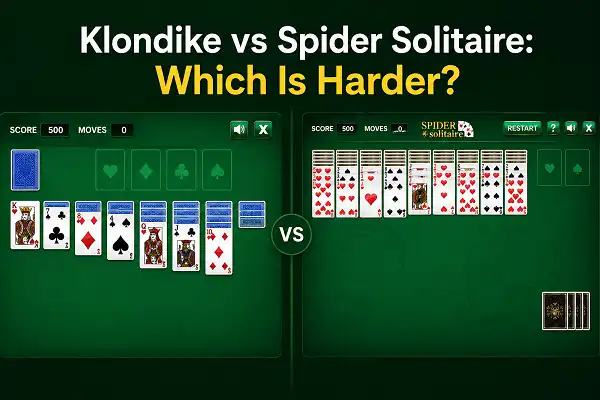
The honest answer isn’t what most people expect. Spider Solitaire isn’t simply harder or easier than Klondike — it depends entirely on which difficulty level of Spider you’re playing. Spider 1-suit is actually easier than Klondike. Spider 4-suit is one of the hardest mainstream card games that exists.
Here’s the full breakdown.
How the Two Games Differ
Both games use a standard card deck and share the same basic concept — organize cards into ordered sequences. But the setup and rules are meaningfully different.
| Klondike (Google Solitaire) | Spider Solitaire | |
|---|---|---|
| Decks used | 1 deck (52 cards) | 2 decks (104 cards) |
| Tableau columns | 7 | 10 |
| Goal | Build 4 foundation piles by suit, Ace to King | Build 8 complete Ace-to-King sequences in the tableau, then remove them |
| Tableau stacking rule | Descending order, alternating colors | Descending order, any color (but same-suit sequences score/clear) |
| Empty columns | Kings only | Any card |
| Stock use | Draw 1 or 3 cards to waste pile on demand | Deal a new row of 10 cards across all columns when stuck |
| Difficulty levels | Easy (Draw 1) / Hard (Draw 3) | 1 suit / 2 suits / 4 suits |
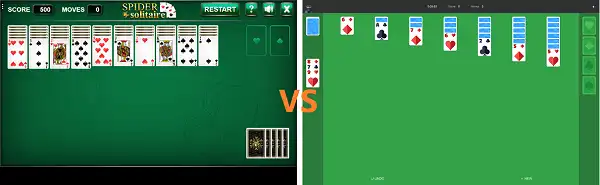
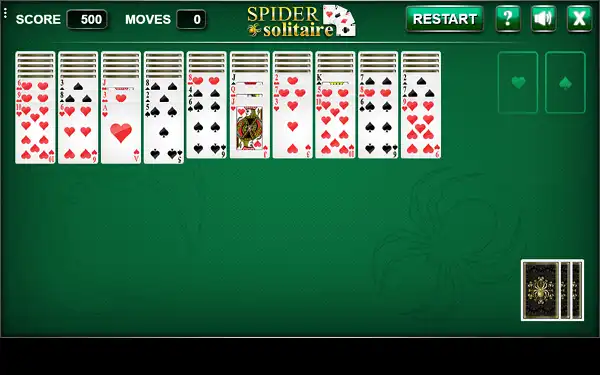
The biggest structural difference: in Klondike, you’re building foundations from the start. In Spider, you build complete sequences within the tableau itself — only finished Ace-to-King sequences of the same suit get removed. That shift changes the entire feel of the game.
The Win Rate Data
This is where the comparison gets interesting. These figures come from large-scale game data across multiple solitaire platforms:
| Game | Theoretical Winnability | Practical Win Rate (Average Player) |
|---|---|---|
| Klondike – Easy Mode (Draw 1) | ~82% | ~33% |
| Klondike – Hard Mode (Draw 3) | ~82% | ~11% |
| Spider – 1 Suit | ~99% | ~52% |
| Spider – 2 Suits | High | ~17% |
| Spider – 4 Suits | Moderate | ~6% |
Spider 1-suit is easier than Klondike Easy Mode by a significant margin — 52% vs 33% practical win rate. Spider 4-suit is the hardest of the group at 6%, making it roughly twice as hard as Klondike Hard Mode in practice.
Spider’s difficulty range is the widest of any mainstream Solitaire variant. The suit level isn’t just a label — it’s a completely different game in terms of challenge.
Which Is Actually Harder — and Why
What Makes Klondike Hard
Klondike’s difficulty is heavily luck-driven. About 18% of deals are mathematically unwinnable regardless of skill — the cards simply can’t be arranged to win. Even in winnable deals, face-down cards and stock order are hidden, meaning you’re always making decisions without full information. You can do everything right strategically and still lose because of how the deck was shuffled.
That randomness is frustrating in a way that feels unfair. Some players find Klondike harder than its win rate suggests because losing to luck is more demoralizing than losing to a bad decision.
What Makes Spider Hard
Spider’s difficulty in 2-suit and 4-suit modes is skill-driven, not luck-driven. Most deals are theoretically winnable — but pulling off the win requires long-range planning, managing 10 columns simultaneously, and keeping sequences same-suit as much as possible. Mixed-suit sequences in the tableau create “dead weight” — cards that are in order but can’t complete a removable set, blocking moves and cluttering columns.
In 4-suit Spider, a small mistake in column management ten moves ago can make the entire board unresolvable by move thirty. You often don’t see the problem coming until it’s too late to fix. That’s a different kind of hard than Klondike — less about luck, more about the compounding cost of imperfect decisions.
Which Should You Play?
| If you want… | Play this |
|---|---|
| A quick, familiar card game | Klondike (Easy Mode) |
| A gentle introduction to Spider | Spider 1-suit |
| A step up from Klondike without the luck factor | Spider 2-suit |
| The hardest mainstream solitaire challenge | Spider 4-suit |
| A game where skill nearly always determines the outcome | Spider (any level) |
If you’re comfortable with Klondike and want a natural next challenge, Spider 2-suit is the right step. It requires the same card-organization instincts but adds the same-suit discipline that makes Spider genuinely harder to master.
The Skill vs Luck Split
One more useful way to compare the two: how much does skill actually matter?
In Klondike, skill matters — but luck sets a ceiling. Unwinnable deals exist that no strategy can fix. In Spider (particularly 2-suit and 4-suit), skill matters more and luck matters less. Nearly every deal can theoretically be won, which means losses in Spider are more often the result of strategic mistakes than bad cards.
Players who get frustrated losing to unwinnable deals in Klondike often find Spider more satisfying precisely because the outcome feels more within their control.
Frequently Asked Questions
Is Spider Solitaire harder than Klondike?
It depends on the suit level. Spider 1-suit is easier than Klondike. Spider 2-suit is harder than Klondike Easy Mode. Spider 4-suit is significantly harder than any version of Klondike, with a practical win rate of around 6%.
What’s the difference between Klondike and Spider?
Klondike uses one deck, seven columns, and builds four foundations by suit from outside the tableau. Spider uses two decks, ten columns, and builds complete Ace-to-King sequences within the tableau itself before they’re removed. Spider also allows any card in an empty column, not just Kings.
Which solitaire game has the best odds of winning?
FreeCell — nearly every deal is winnable with the right plan. Spider 1-suit is close behind at ~99% theoretical winnability. Klondike sits at ~82% theoretical, and Spider 4-suit is the hardest at around 6% practical win rate for average players.
Should I learn Klondike or Spider first?
Klondike first. It’s simpler to learn, faster to play, and the rules are more intuitive. Once Klondike feels comfortable, Spider 1-suit is a natural next step — same basic instincts, different goal.
Why do I keep losing Spider Solitaire?
In 2-suit and 4-suit Spider, the most common cause is building mixed-suit sequences in the tableau. Cards in mixed-suit order can move but can’t complete a removable set — they clog columns and block long-range plans. Prioritizing same-suit builds from early in the game is the single biggest improvement most Spider players can make.
Play Both and See for Yourself
Play Klondike (Google Solitaire) here and Spider Solitaire here — both free, no download. If you want to build up to Spider, our Klondike strategy guide is a good place to sharpen the card-management instincts that carry over to both games.
Blog
Muzamil Aslam
Muzamil Aslam is the founder and author behind GoogleSolitaire.me. He enjoys writing about solitaire, browser-based games, and gaming strategies, helping players improve their skills while enjoying classic card games online.