Is Google Solitaire Always Winnable? Win Rate Explained
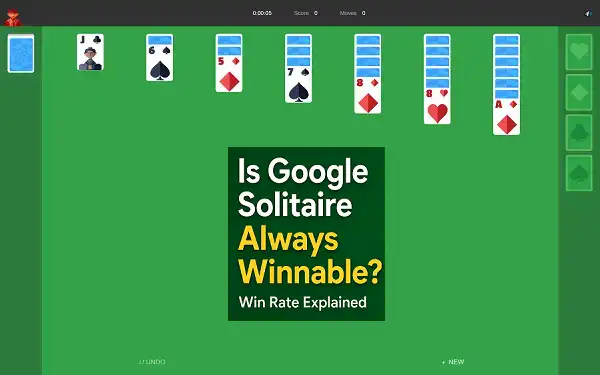
No. About 18% of Google Solitaire deals are mathematically unwinnable — no sequence of moves leads to victory regardless of how well you play. If you’ve ever cycled through the stock a dozen times, tried every combination you could think of, and still couldn’t make progress, there’s a real chance the game simply had no solution from the moment the cards were dealt.
The actual win rate picture is more nuanced than just “some deals are impossible.” Here’s what the data says.
The Win Rate Numbers
| Mode | Deals with a Solution | Average Player Win Rate | Skilled Player Win Rate |
|---|---|---|---|
| Easy Mode (Draw 1) | ~82% | ~33% | Up to 43% |
| Hard Mode (Draw 3) | ~82% | ~11% | Up to 25% |
The ~82% theoretical figure comes from large-scale computer analysis of “Thoughtful Klondike” — a version of the game where all cards are visible from the start. It measures how many deals could be won with perfect information and perfect play. The Solvitaire study (arXiv, updated 2024) put the figure at 81.945% ± 0.084%.
That means roughly 1 in 5 deals is genuinely unsolvable — not hard, not unlikely, but mathematically impossible under any play sequence.
Notice the gap between theoretical winnability (~82%) and actual win rates (11–43%). Even among winnable deals, most players don’t find the winning path. More on that below.
Why Some Deals Are Genuinely Unwinnable
The technical reason is circular dependency. Every card in the game has conditions that must be met before it can move — the card above it must be gone, the destination must have the right card waiting, and so on. Winning requires satisfying all those conditions in some valid order.
Sometimes the conditions create a deadlock. Card A can’t move until card B moves. Card B can’t move until card C moves. Card C can’t move until card A moves. Nobody goes first. The cycle is unbreakable.
This isn’t theoretical. Mathematician Persi Diaconis famously described the inability to calculate the exact odds of winning Klondike as “one of the embarrassments of applied mathematics.” Even with modern computing power, precisely quantifying the proportion of unwinnable deals under real (hidden card) conditions remains unsolved — the ~82% figure is an upper bound derived from the perfect-information version of the game.
What’s clear: a meaningful portion of deals are dead on arrival. The cards don’t lie — they were never going to cooperate.
Two Different Types of Losses
Not all losses are created equal. There’s an important distinction between:
Truly Unwinnable Deals
About 18% of deals. No player — human or computer with perfect information — can win these. The dependency graph has an unresolvable cycle. Starting a new game is the correct response. You didn’t make a mistake.
Winnable Deals You Didn’t Win
A solution existed, but you didn’t find it. This happens because face-down cards in the tableau are hidden, the stock order is unknown, and players make decisions without full information. A move that looks fine now can quietly close off the winning path three turns later — and with hidden cards, you often can’t know that in advance.
This second category is where strategy matters. You can’t fix a truly unwinnable deal, but you can significantly improve how often you win the winnable ones. Our 10 Tips to Win Google Solitaire focuses on exactly that — reducing how often you lose games that were winnable.
Why the Gap Between Theory and Practice Is So Large
~82% of deals are theoretically solvable. But average players only win 33% in Easy Mode. That’s a gap of nearly 50 percentage points. Where does it go?
- Hidden information. In real play, you can’t see face-down cards. Moves that seem correct turn out to close off a sequence you couldn’t see coming.
- Irreversible decisions. Some moves look equivalent but aren’t. Moving the wrong King into an empty column can kill a winnable game without showing any immediate consequences.
- Stock timing. Especially in Hard Mode, which card is on top of the waste pile at which moment matters — and managing that requires deliberate planning most players don’t apply.
The practical upshot: luck operates at the deal level (determining whether a winning path exists), and skill operates at the decision level (determining whether you find it). You can’t control the deal — you can control the decisions.
Does Easy Mode Have Better Odds Than Hard Mode?
Yes, significantly — but not because of the deal. Both modes share the same ~82% theoretical winnability. The difference is access.
In Easy Mode, every card in the stock will eventually surface as the top of the waste pile — giving you complete access to the deck over time. In Hard Mode, the three-at-a-time draw buries useful cards, and limited redeals mean some cards never become available. Theoretically winnable deals become practically unwinnable not because the cards are impossible to arrange, but because the access restriction prevents the correct sequence from ever being executed.
That’s why Easy Mode produces a 33% practical win rate while Hard Mode produces ~11% — same cards, very different access. Full comparison in our Easy Mode vs Hard Mode post.
How to Tell When a Game Is Actually Unwinnable
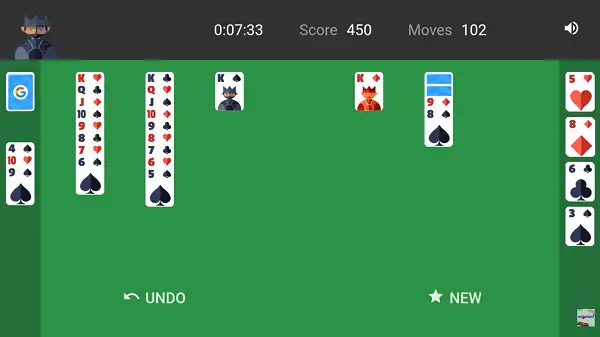
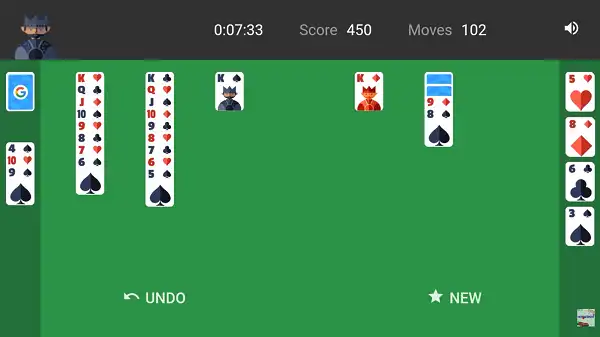
You can’t know for certain mid-game unless you’re running a solver. But these are reliable signs you’ve hit a dead end:
- The stock is fully exhausted — you’ve cycled through it completely
- No valid tableau moves remain (no face-up card can move anywhere)
- No cards can go to the foundation
- All remaining face-down cards are blocked by cards with nowhere to go
If all four conditions are true simultaneously, the game is over. Not because you played badly — the deal may simply have been in the unwinnable 18%. Start fresh.
If even one condition isn’t met — especially if there are still face-down cards to uncover — keep playing. A stuck-looking board isn’t always a lost board.
Frequently Asked Questions
Is every Google Solitaire game winnable?
No. About 18% of deals are mathematically unwinnable regardless of skill or strategy. The remaining ~82% are theoretically solvable — but whether a real player wins them depends on their decisions with incomplete information.
What percentage of Solitaire games can be won?
About 82% of deals are theoretically solvable in both Easy and Hard mode (based on Thoughtful Klondike analysis). In practice, average players win roughly 33% of Easy Mode games and 11% of Hard Mode games. Skilled players reach up to 43% (Easy) and 25% (Hard).
Why can’t some Solitaire games be won?
Circular dependencies in the card arrangement. Card A needs card B to move first. Card B needs card A to move first. Neither can go — the deadlock is unbreakable. No amount of clever play resolves a genuine circular dependency.
Should I keep trying if I seem stuck?
Check whether the stock is fully cycled, all tableau moves are exhausted, and all face-down cards are blocked. If yes to all three — start a new game. If any of those conditions hasn’t been met, keep playing. Stuck-looking positions are sometimes winnable with one correct unblocking move.
Does using hints or undo make games more winnable?
Undo helps significantly in winnable games by letting you recover from wrong decisions. It doesn’t make unwinnable deals winnable — but it does reduce how often you lose a game that had a solution. Using undo freely is one of the easiest ways to improve your practical win rate in Easy Mode.
Which Solitaire game has the best odds?
FreeCell — nearly every deal (about 99.999%) is theoretically winnable, since all cards are visible from the start. It’s as close to a pure skill game as Solitaire gets.
Bottom Line
Google Solitaire is not always winnable. About 1 in 5 deals is genuinely unsolvable, and even among winnable deals, most players lose more than they win because of the hidden information problem. In Easy Mode, with good strategy, you can realistically win around a third of your games — and closer to half if you play carefully. Hard Mode is significantly tougher.
The most useful thing to take from this: when a game feels impossible after a full stock cycle with no remaining moves, it very likely is impossible. Start over without guilt. And when you do win a tough deal, that’s a genuinely good outcome — not luck, but skill finding a path through a problem with limited information.
Play Google Solitaire here — free, no download, Easy and Hard mode.
Blog
Muzamil Aslam
Muzamil Aslam is the founder and author behind GoogleSolitaire.me. He enjoys writing about solitaire, browser-based games, and gaming strategies, helping players improve their skills while enjoying classic card games online.