How to Play Spider Solitaire: Rules, Setup & Winning Strategy
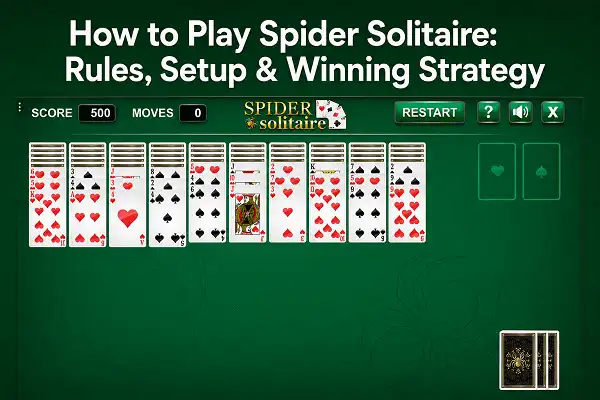
Spider Solitaire looks like Klondike but plays completely differently. There’s no waste pile, no drawing one card at a time, no sending cards to a separate foundation as you go. Everything happens across ten columns on a single board, and the game ends when you’ve cleared all 104 cards in eight complete sequences. That’s the whole game — but getting there is another matter.
This guide covers the full setup, every rule you need to know, what changes between difficulty levels, and the strategies that will actually help you win. If you’re coming from Klondike, there’s a specific section on the habits you’ll need to unlearn.
➜ Play Spider Solitaire free here while you read.
Where the Name Comes From
Spider Solitaire is named after the spider’s eight legs. You need to build eight complete sequences to win the game. The game was first mentioned in print by card game writer Ely Culbertson in 1917 — making it over a hundred years old and predating most of the other solitaire games people play today.
The Setup
Spider uses two standard 52-card decks — 104 cards total. At the start of every game:
- 54 cards are dealt face-down across ten tableau columns
- The first four columns (left side) get 6 cards each — 5 face-down, 1 face-up on top
- The remaining six columns get 5 cards each — 4 face-down, 1 face-up on top
- The remaining 50 cards form the stock pile, kept face-down to the side
- There are no foundation piles at the start — completed sequences clear themselves automatically
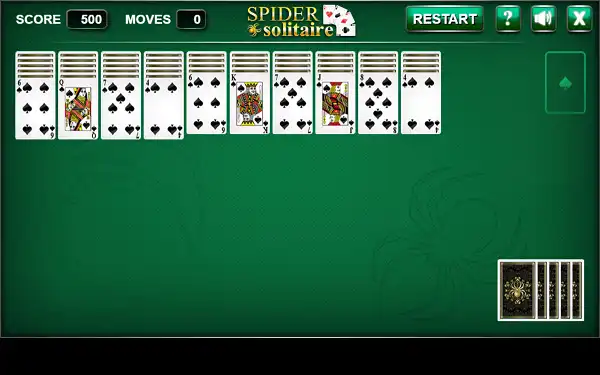
The board looks crowded immediately. That’s intentional — managing 10 columns at once with limited information is the central challenge of the game.
The Goal
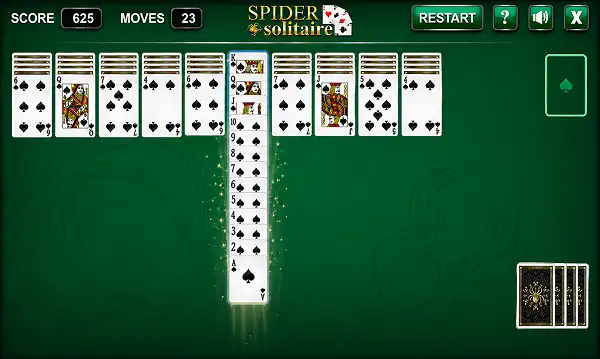
Build eight complete King-to-Ace sequences, each of the same suit, within the tableau columns. The moment a complete 13-card sequence (King down to Ace, all one suit) exists in a column, it automatically clears to the foundation. Clear all eight sequences and you’ve won.
Since you’re using two decks, you’ll need two complete sequences per suit in a four-suit game — or eight sequences all in the same suit if you’re playing 1-suit mode.
How to Move Cards
Moving Individual Cards
Any face-up card can be moved onto another face-up card, provided the card you’re placing is exactly one rank lower. A 7 goes on an 8. A Queen goes on a King. Suit doesn’t matter for placement — a red 9 can go on a black 10 or another red 10.
Moving Groups of Cards
Here’s the rule that confuses most new players. You can only move a group of cards together if they are all the same suit and in proper descending order. A group of black 8, black 7, black 6 can move together. A group of black 8, red 7, black 6 cannot — even though they’re in the right order — because they’re mixed suits.
Mixed-suit groups can exist in your columns, but they must be moved one card at a time. This is the fundamental constraint that makes Spider harder than it looks.
Empty Columns
Unlike Klondike, where empty columns accept Kings only, in Spider any card — or any valid group — can go into an empty column. This makes empty columns enormously powerful: they act as temporary storage that lets you rearrange cards across the board. Protecting and using empty columns well is the single biggest skill gap between new and experienced Spider players.
The Stock — Five Deals, No More
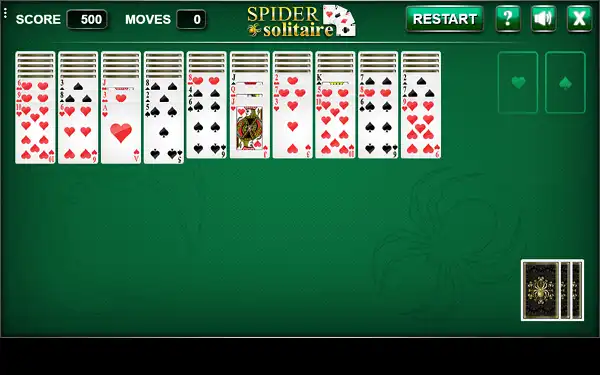
When you’ve exhausted your moves in the tableau, click the stock pile to deal new cards. Each click deals one card face-up to each of the ten columns simultaneously — ten new cards at once.
Two important rules about dealing:
- You cannot deal if any column is empty. All ten columns must have at least one card before the stock can be used. This forces you to fill gaps before advancing, which is often harder than it sounds.
- You only get five deals total. 50 stock cards ÷ 10 columns = 5 rounds. Once the stock is empty, no more cards are coming. Every deal is a finite resource.
Each deal buries whatever you were working with under ten new cards. Use the stock as a last resort — not as a first move when you’re unsure what to do next.
The Three Difficulty Levels
Spider Solitaire’s suit setting isn’t just a difficulty label. It fundamentally changes the game.
| Level | Suits in Play | Practical Win Rate | Best For |
|---|---|---|---|
| 1 Suit | Spades only (all cards same suit) | ~52% | Learning the rules, building confidence |
| 2 Suits | Spades and Hearts | ~17% | Intermediate players ready for a real challenge |
| 4 Suits | All four suits | ~6% | Experienced players who want the hardest version |
In 1-suit mode, every card can move as a group since they’re all the same suit. The game teaches sequencing and board management without the complication of suit-matching. In 2-suit and 4-suit modes, mixed-suit sequences constantly accumulate — cards that are in order but can’t form a removable set, slowly clogging columns and locking out moves. The jump from 1-suit to 4-suit is dramatic. Start at 1-suit and spend real time there before moving up.
Winning Strategy — What Actually Works
Build Same-Suit Sequences Whenever Possible
In 2-suit and 4-suit modes, the temptation is to move cards freely between columns to create space. Resist this when it creates mixed-suit sequences. A mixed-suit sequence looks like progress but is dead weight — it can’t complete and it blocks the cards underneath. Every time you build a sequence, ask: is this same-suit or mixed? Same-suit always.
Uncover Face-Down Cards First
Your most important job in the early game is revealing hidden cards. More face-up cards means more information and more moves. When choosing between two valid plays, take the one that flips a face-down card.
Guard Empty Columns Like Gold
An empty column is the most powerful resource in Spider. It lets you temporarily park cards while you rearrange, break apart stuck sequences, and create maneuver room that didn’t exist before. Don’t fill empty columns carelessly. Every time you’re about to place a card there, ask what problem it solves — not just what moves it opens in the next one turn.
Be Deliberate About the Stock
You get five deals. That’s it. Before clicking the stock, scan every column twice — once for obvious moves, once for less obvious combinations. A sequence shift that takes thirty seconds of thinking now might reveal a move that saves a deal. Five deals is not a lot when you need to clear 104 cards.
Attack Longer Columns First
Columns with more face-down cards underneath hold the most hidden information. Clearing face-up cards from longer columns early — while you still have open columns and unplayed stock — is the fastest way to understand the board. Leave long columns until late and they become nearly impossible to resolve with limited resources.
The Biggest Traps for Klondike Players
If Google Solitaire (Klondike) is your usual game, Spider will feel familiar on the surface and wrong underneath. Three habits to consciously drop:
Filling Empty Columns Immediately
In Klondike, an empty column is filled with a King and that’s usually right. In Spider, empty columns are temporary storage — not permanent homes. Filling one without a clear plan wastes the most valuable resource on the board.
Moving Cards Without Thinking About Suit
Klondike rewards alternating-color builds. Spider only rewards same-suit sequences. You can build in any order in Spider, but only same-suit groups complete and clear. Moving freely across suits — the natural Klondike reflex — creates junk sequences that block everything later.
Using the Stock Too Early
In Klondike Easy Mode, drawing from the stock is almost free — unlimited redeals, one card at a time. Spider’s stock is five deals of ten cards each. There’s no recycling. Treating the stock as “unlimited card supply” rather than “five emergency interventions” is a fast way to run out of options mid-game.
Frequently Asked Questions
How many cards are in Spider Solitaire?
104 cards — two standard 52-card decks. 54 are dealt to the 10 tableau columns at the start. The remaining 50 form the stock pile, available in five deals of 10 cards each.
How many sequences do you need to win?
Eight. Each complete King-to-Ace sequence of the same suit clears automatically from the board. You need eight cleared sequences to win — two per suit in 4-suit mode, or eight of the same suit in 1-suit mode.
Can I put any card in an empty column?
Yes — any card or valid group can fill an empty column. This is a key difference from Klondike, where empty columns accept Kings only.
Why can’t I deal from the stock?
You cannot deal from the stock if any tableau column is empty. All ten columns must contain at least one card before a deal is possible. Fill any empty columns first, then deal.
Which difficulty should I start with?
1-suit. The win rate is around 52% for average players and the rules play out cleanly without the suit-matching complexity. Once you consistently win 1-suit games and understand empty column management, move to 2-suit.
What’s the difference between Spider and Klondike?
Spider uses two decks across ten columns, has no waste pile, and sequences clear within the tableau rather than building up to separate foundations. Empty columns accept any card (not just Kings). The stock deals all ten columns simultaneously with no recycling. The full comparison is in our post on Klondike vs Spider Solitaire: Which Is Harder?
Is Spider Solitaire harder than regular Solitaire?
At 2-suit and 4-suit difficulty levels, yes — significantly. Spider 4-suit has a practical win rate of about 6% for average players, compared to 33% for Klondike Easy Mode. Spider 1-suit is actually easier than Klondike, which makes it the right starting point for new players.
Ready to Play?
Play Spider Solitaire here — free, no download. Start with 1-suit until the board management clicks, then move up. Most players find the jump from 1-suit to 2-suit more challenging than the jump from easy to hard in Klondike — so don’t rush it.
If you want to compare strategies across both games, our post on Klondike vs Spider Solitaire covers the win rate data and strategic differences in full. And if you’re still building confidence with regular Solitaire first, 10 Tips to Win Google Solitaire has the Klondike strategy fundamentals covered.
Blog
Muzamil Aslam
Muzamil Aslam is the founder and author behind GoogleSolitaire.me. He enjoys writing about solitaire, browser-based games, and gaming strategies, helping players improve their skills while enjoying classic card games online.