Google Solitaire Easy Mode vs Hard Mode: What’s the Difference?
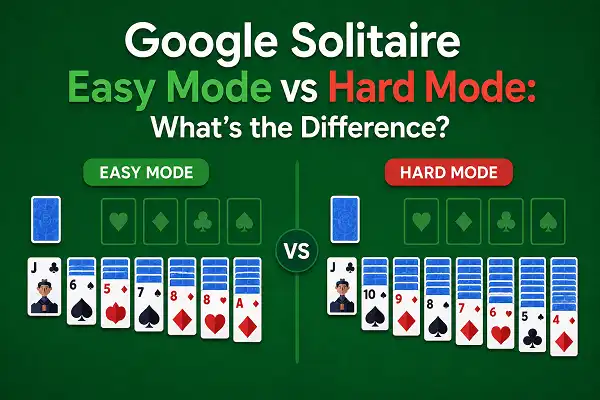
Easy and Hard mode in Google Solitaire look like a simple difficulty slider. They’re not. One mechanical change that how many cards flip from the stock at once creates two games that require completely different strategies and produce dramatically different win rates.
Here’s exactly what separates them, what the numbers look like, and which one makes sense for you.
The One Thing That Changes Everything
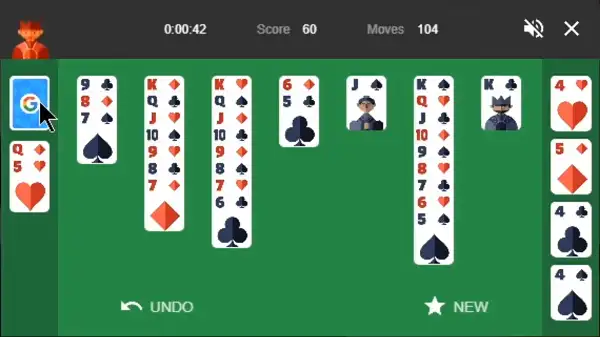
Easy Mode (Draw 1) flips one card at a time from the stock. You can cycle through the full deck as many times as you need. Every card will eventually surface.
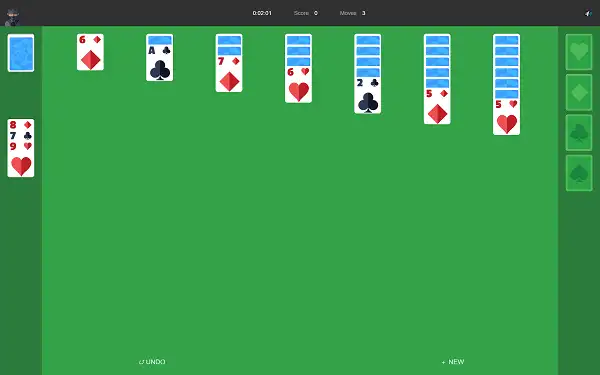
Hard Mode (Draw 3) flips three cards at once. Only the top card is playable — the two underneath stay buried until the pile cycles back. Redeals are unlimited in both modes — but in Hard Mode, most draws bury your target card 2 positions deeper each cycle, making specific cards increasingly hard to reach.
That’s the entire difference. One card vs three. But the ripple effect on strategy and win rate is significant.
Win Rates — The Actual Numbers
Both modes deal from the same deck. Theoretically, about 82% of deals are solvable in either mode — that figure comes from large-scale computer analysis, including the Solvitaire research paper (arXiv, updated 2024). In practice, the results look very different.
| Mode | Theoretical Winnability | Average Player | Skilled Player |
|---|---|---|---|
| Easy Mode | ~82% | 33–40% | Up to 43% |
| Hard Mode | ~82% | 10–15% | Up to 25% |
Same theoretical ceiling, but Hard Mode’s practical win rate is roughly a third of Easy Mode’s. The reason: the draw-three restriction buries useful cards at the wrong moment. Deals that are technically solvable become practically unwinnable because the right card never reaches the top before redeals expire. The deal isn’t harder — access to it is.
The remaining ~18% of deals in both modes are mathematically unwinnable regardless of skill. See our full breakdown in Is Google Solitaire Always Winnable?
How Strategy Differs Between Modes
Easy Mode — Be Patient, Prioritize Reveals
- Every card surfaces eventually — you can pass on a waste card and wait for a better moment.
- Use the stock as a scouting tool early on. Cycle through to see what’s coming before committing.
- Focus on uncovering face-down tableau cards before worrying about foundations.
- Balanced, methodical play wins more often than rushing.
Hard Mode — Manage the Waste Pile as a Queue
- Each redeal pass is a finite resource. Don’t draw unless you’ve exhausted tableau options first.
- Before playing a waste pile card, ask what’s underneath it — sometimes the buried card is more urgent right now.
- Empty columns become critical storage for cards that are stuck mid-pile.
- Accept that some games will end without warning. That’s the draw-three format, not a mistake.
For strategies that work across both modes, see 10 Tips to Win Google Solitaire Every Time.
Which Mode Should You Play?
| You want to… | Pick this mode |
|---|---|
| Learn the game | Easy Mode |
| Win consistently | Easy Mode |
| Relax without pressure | Easy Mode |
| A genuine challenge | Hard Mode |
| Practice planning multiple moves ahead | Hard Mode |
| Play closer to traditional Klondike rules | Hard Mode (draw three was the original format) |
Most regular players use both — Easy Mode for a quick relaxed game, Hard Mode when they want something that actually tests them. There’s no rule saying you have to pick one and stick with it.
Frequently Asked Questions
Which mode is better for beginners?
Easy Mode, without question. One card at a time and unlimited redeals means nothing is permanently out of reach. You can learn tableau rules, foundation building, and basic strategy without the stock restriction fighting you at the same time.
Why is Hard Mode so much harder if the theoretical win rate is the same?
Because the draw-three restriction buries cards at the wrong moment. A deal that’s theoretically solvable becomes practically unwinnable when the card you need is trapped as the second or third in a three-card flip and the redeals run out before it reaches the top.
Can I switch between modes between games?
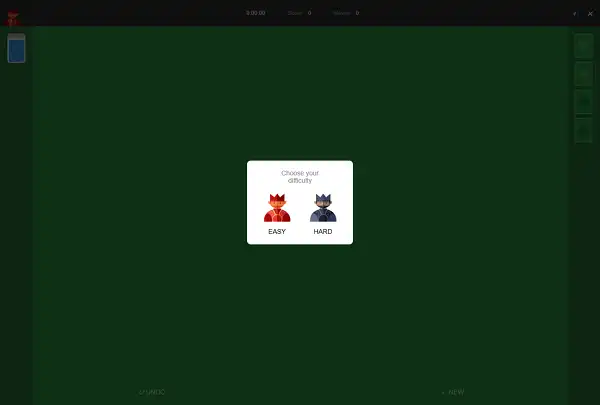
Yes. Mode selection appears at the start of every new game. Switch as often as you like — there’s no penalty for changing.
Which mode is the “real” version of Klondike?
Hard Mode. Traditional casino Klondike has always been draw three with limited redeals. Easy Mode is a modern, more accessible design popularized by digital versions of the game.
Is it possible to win Hard Mode consistently?
Consistently is a stretch — even skilled players only win around 25% of Hard Mode games. But you can meaningfully improve your rate by managing the waste pile deliberately and treating each redeal as a resource rather than a free action.
Try Both Modes and See
The fastest way to understand the difference is to play three games in Easy Mode, then three in Hard Mode back to back. The change in how the stock feels — what it demands from you — is immediately obvious. Open Google Solitaire here and give both a run.
If you want a card game where nearly every deal is winnable with the right plan, FreeCell is worth trying next — all cards are visible from the start, and the access problem that makes Hard Mode so punishing simply doesn’t exist.
Blog
Muzamil Aslam
Muzamil Aslam is the founder and author behind GoogleSolitaire.me. He enjoys writing about solitaire, browser-based games, and gaming strategies, helping players improve their skills while enjoying classic card games online.