FreeCell Solitaire Tips: How to Win Almost Every Game
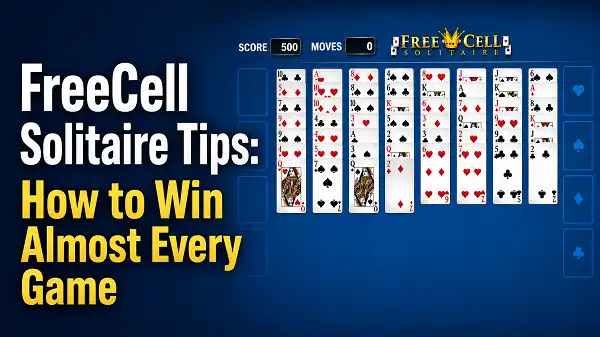
FreeCell is the closest thing to a solvable puzzle in all of Solitaire. Every card is visible from the first move. There’s no draw pile hiding information. Nearly every deal — roughly 99.999% — has a winning solution. Of the original 32,000 numbered Microsoft FreeCell deals, only one confirmed unwinnable game exists: deal #11982.
And yet most players win fewer than half their games. The problem isn’t the cards — it’s the decisions. FreeCell is almost pure skill. If you’re losing, there’s a specific reason and it can be fixed.
These tips cover exactly what separates players who lose constantly from players who win almost every time.
➜ Play FreeCell here while you read.
How FreeCell Works (The Short Version)
All 52 cards are dealt face-up across eight tableau columns — columns 1–4 get 7 cards each, columns 5–8 get 6 cards each. You have four free cells at the top left (single-card temporary parking spots) and four foundation piles at the top right (build each suit from Ace to King to win).
Tableau stacking follows the same alternating-color descending rule as Klondike: a red 8 goes on a black 9, a black Queen goes on a red King. Empty columns accept any card or valid sequence.
No stock. No hidden cards. No luck. Everything is visible, and the game is yours to win or lose entirely on the quality of your decisions.
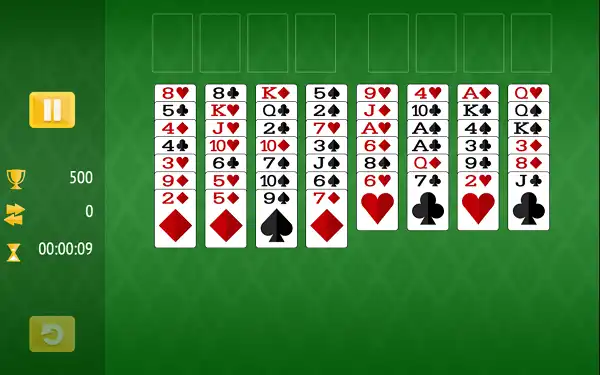
Tip 1 — Survey the Whole Board Before Touching Anything
FreeCell rewards players who think before they move. Take 30–60 seconds at the start of every game to do this:
- Find all four Aces. How deep is each one? How many cards are on top of it?
- Find the 2s. Which are accessible now, which are buried?
- Identify your longest, most disorganized columns — those need work early.
- Look for any cards already in or near sequence. Can you extend any of those?
The players who lose FreeCell are almost always the ones who make the first obvious move they see. FreeCell rewards the player who makes the best move, not the first one.
Tip 2 — Free Your Aces and 2s as Early as Possible
Foundations can’t start without Aces and can’t grow without 2s. Both are your highest priority. If an Ace is buried under three cards, freeing it should be one of your first planned sequences — not something you get to eventually.
Before making moves that rearrange the middle of the board, check: does this sequence get me closer to an Ace or 2? If no, reconsider.
Tip 3 — Treat Free Cells as Emergency Reserves, Not Regular Storage
The four free cells are what make FreeCell winnable — they give you room to maneuver. But every free cell you fill reduces how much you can do on your next move. The golden rule:
Never put a card in a free cell without a plan for getting it out.
Dumping cards there because there’s nowhere else to put them is the fastest way to reach a dead end. Two or three occupied free cells is a warning sign. All four occupied free cells is nearly always fatal.
Think of free cells as short-term loans. When you take one, you already know when you’re paying it back.
Tip 4 — Empty Columns Are More Powerful Than Free Cells
A free cell holds one card. An empty tableau column holds an entire sequence — and can act as a massive maneuver space. The difference matters enormously.
When you create an empty column, your options multiply. You can temporarily move a long sequence there, rearrange what’s underneath, and then rebuild. That’s not possible with a free cell holding a single card.
Creating an empty column early — even at the cost of some free cell usage — is often one of the highest-value moves in the game. When you see a short column that could be cleared in two or three moves, that’s worth prioritizing.
Tip 5 — Understand the Supermove
Technically, FreeCell only lets you move one card at a time. But digital versions (including the one on this site) allow you to move sequences of cards together — as long as you have enough free cells and empty columns to make it physically possible.
The formula: with N free cells available and M empty columns, you can move a group of up to (N + 1) × 2^M cards.
In plain English:
- 2 free cells, 0 empty columns → move up to 3 cards at once
- 2 free cells, 1 empty column → move up to 6 cards
- 3 free cells, 1 empty column → move up to 8 cards
- 2 free cells, 2 empty columns → move up to 12 cards
You don’t need to calculate this every move — just understand that filling free cells and empty columns dramatically reduces how much you can do at once. Keeping both free is what gives you the power to make large, decisive rearrangements.
Tip 6 — Plan 5 to 10 Moves Ahead, Not Just One
One-move thinking is what loses FreeCell. The game punishes short-sightedness because every move changes the board state in ways that cascade forward.
When you’re considering a move, trace out what happens next: if I move this card here, what becomes available? If I park this in a free cell, when does it come out, and what does it land on? What does that open up after?
The players who win 99%+ of their FreeCell games aren’t faster — they’re deeper. They see sequences of five to ten moves that work together toward a goal (clearing a column, freeing an Ace, completing a foundation run) rather than making one good-looking move at a time.
Tip 7 — Build Foundations Evenly Across All Four Suits
Rushing one foundation suit to 8 or 9 while the others sit at 2 creates an imbalance that’s hard to recover from. The cards you need for the lagging suits are still spread across the tableau, taking up space and blocking moves, while the advanced suit’s cards are no longer helping you maneuver.
Aim to keep your four foundations within two or three ranks of each other. When you’re deciding which card to send up next, pick the suit that’s furthest behind — not whichever card is easiest to move.
Tip 8 — Use Undo as a Planning Tool
There’s no penalty for using undo in FreeCell, and it’s one of the most powerful tools in the game. Use it proactively — not just when you realize a move was wrong, but as a way of testing move sequences before committing.
Make a move. See what it opens up. If the result looks worse, undo it and try a different sequence. Treating undo as a “back button” for bad moves is fine. Using it as a look-ahead planning tool is better. Playing through five moves to see where they lead, then undoing back to try a different path — that’s how expert players operate.
Tip 9 — Target Buried Aces in Short Columns First
Not all buried Aces are equal. An Ace under one card is a one-move problem. An Ace under six cards in the longest column is a major excavation project.
Early in the game, look for Aces under short columns — two or three cards deep. These are often resolvable with one or two free cell uses and a quick tableau move. Freeing an Ace early puts that foundation suite in motion and reduces the number of cards working against you for the rest of the game.
Tip 10 — Keep Working When You Seem Stuck
FreeCell games that look stuck often aren’t. Because every card is visible, what looks like a dead end is usually a sequencing problem — the moves are there, but not in the order you’ve been trying.
When stuck:
- Check every face-up card against every open position — not just the obvious ones
- Look for moves that free up a free cell or empty a column, not just moves that advance sequences
- Undo back several moves and try a completely different approach — the first path you chose isn’t the only one
If you’ve genuinely exhausted every combination and still have no moves, the game might be one of the extremely rare unwinnable deals. But truly stuck FreeCell games are almost never actually stuck — they’re usually a sequencing order problem that undo can fix.

Quick Reference
| Tip | The Core Principle |
|---|---|
| Survey first | Find all Aces and 2s before making a single move |
| Free Aces first | Foundations can’t grow without them |
| Free cells = emergency only | Never park a card there without knowing when it leaves |
| Empty columns > free cells | A column holds sequences; a free cell holds one card |
| Know the supermove | More free cells + empty columns = larger groups you can move |
| Plan 5–10 moves ahead | One-move thinking is what loses FreeCell |
| Balance foundations | Keep all four suits within 2–3 ranks of each other |
| Undo proactively | Test sequences before committing, not just after mistakes |
| Short columns first | Aces buried shallowly are the fastest wins |
| Stuck isn’t over | Try undo + different sequence before accepting defeat |
Frequently Asked Questions
Is FreeCell always winnable?
Almost. Of the original 32,000 Microsoft numbered FreeCell deals, only deal #11982 is confirmed unwinnable. In practical terms, every game you’ll play has a solution. If you’re losing, the cause is almost certainly strategic, not the cards.
What’s the win rate for FreeCell?
It varies dramatically by skill. Beginners who play reactively win around 30–50% of games. Players who learn the core strategies — keeping free cells available, planning multiple moves ahead, targeting buried Aces — reach 80%+. Expert players who plan 10+ moves ahead win over 99% of games.
What’s a free cell and how do I use it?
A free cell is a single-card temporary parking space above the tableau. You can move any card there at any time, and move it back out to the tableau when it becomes useful. You have four of them. Each one occupied reduces what you can do on subsequent moves — treat them as emergency reserves rather than regular storage.
Can I move groups of cards in FreeCell?
Yes, in digital versions. The number of cards you can move as a group depends on how many free cells and empty columns you have: (free cells + 1) × 2^(empty columns). Having both free cells and empty columns available is what makes large, game-changing rearrangements possible.
What should I do first in FreeCell?
Before any move: scan the board for all four Aces and all four 2s. Map out how deep each one is buried. Your opening moves should create a path to freeing the most accessible Ace, using as few free cells as possible. Set up the first foundation run, then build from there.
How is FreeCell different from Klondike (Google Solitaire)?
Every card in FreeCell is visible from the start — there are no hidden face-down cards and no draw pile. You have four free cells for temporary storage and eight columns (versus seven in Klondike). FreeCell is nearly always winnable with correct play; Klondike has an ~18% proportion of genuinely unwinnable deals and relies more on luck. See our full comparison in Klondike vs Spider Solitaire for more on how the variants compare.
Play FreeCell Now
Open FreeCell here — free, all cards visible from the start, no download needed. Apply the survey-first habit on your next game and see how much it changes your opening moves. That single habit is where most of the win rate improvement comes from. Everything else builds on it.
If you’re still building your card game foundations on Klondike, Google Solitaire is there with Easy and Hard mode — and our 10 Tips to Win Google Solitaire covers the Klondike strategy fundamentals that carry over to FreeCell planning.
Blog
Muzamil Aslam
Muzamil Aslam is the founder and author behind GoogleSolitaire.me. He enjoys writing about solitaire, browser-based games, and gaming strategies, helping players improve their skills while enjoying classic card games online.