Pyramid Solitaire Rules and How to Win (Complete Guide)
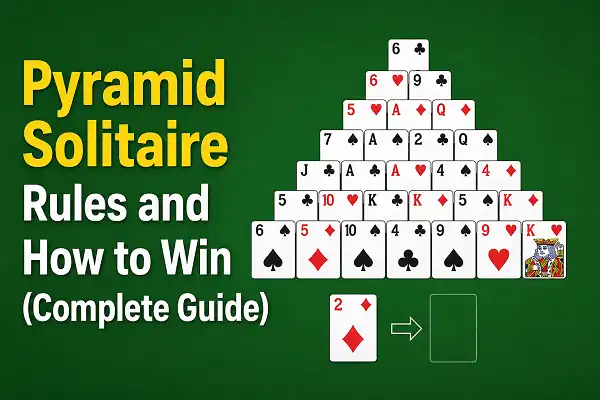
Pyramid Solitaire plays nothing like Klondike. There’s no building sequences, no alternating colors, no sending cards to foundation piles as you go. The entire game is about one thing: pairing cards that add up to 13 until the pyramid is gone.
It’s one of the most accessible Solitaire variants to learn and one of the hardest to win. This guide covers the full ruleset and the strategies that actually improve your odds.
➜ Play Pyramid Solitaire free here
The Setup
One standard 52-card deck. At the start:
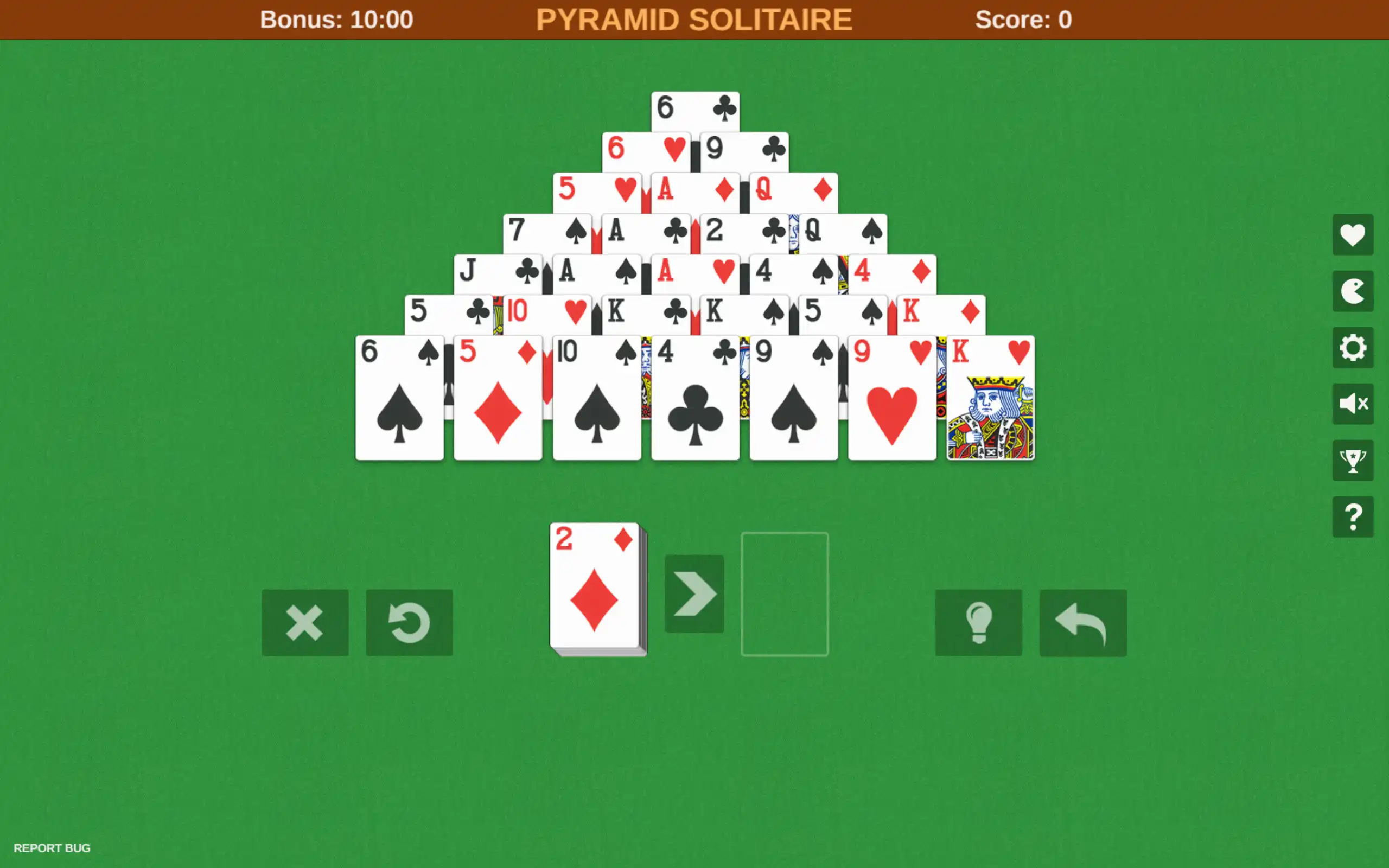
- 28 cards are dealt face-up in a pyramid — 7 rows, with 1 card at the top and 7 along the base. Each card in rows 1–6 is partially covered by two cards in the row below it.
- The remaining 24 cards form the stock pile, face-down in the corner.
- There is no separate foundation pile to build toward — matched pairs are simply removed from play.
Card Values
| Card | Value |
|---|---|
| Ace | 1 |
| 2–10 | Face value |
| Jack | 11 |
| Queen | 12 |
| King | 13 |
Suits are completely irrelevant in Pyramid Solitaire. Only the numerical value matters.
How to Play
The goal: clear the entire pyramid by pairing exposed cards that add up to 13. Remove all pyramid cards and you win.
Exposed cards: a card is only available to play if nothing is covering it from the row below. At the start, only the seven cards along the base are exposed. As you remove cards, cards higher in the pyramid become exposed and available.
Making a pair: select any two exposed cards whose values add up to exactly 13. Both cards are removed from the pyramid. You can also pair a pyramid card with the top card of the waste pile — they don’t both have to come from the pyramid.
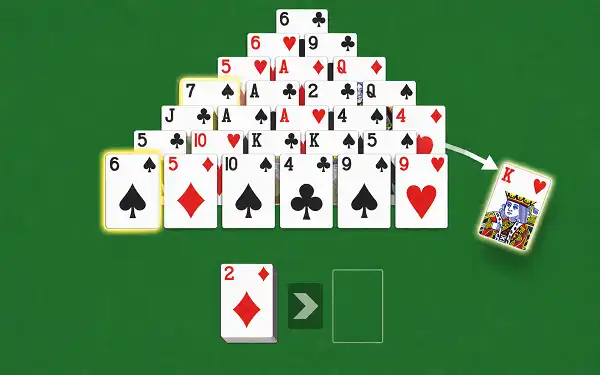
Kings: a King has a value of 13 on its own. Click a King to remove it without needing a partner.
The stock: click the stock pile to flip one card face-up to the waste pile. If the top waste card can pair with an exposed pyramid card, you can remove both. You can pass through the stock a maximum of three times in standard play. When the stock is empty, flip the waste pile over to form a new stock — but only twice, making three total passes.
Empty spaces: when cards are removed, the gaps they leave cannot be filled. The pyramid simply has holes — you work around them.
All Pairs That Add Up to 13
| Card 1 | Card 2 | Total |
|---|---|---|
| King | (no pair needed) | 13 |
| Queen (12) | Ace (1) | 13 |
| Jack (11) | 2 | 13 |
| 10 | 3 | 13 |
| 9 | 4 | 13 |
| 8 | 5 | 13 |
| 7 | 6 | 13 |
Memorize this table and the game immediately becomes cleaner. You stop scanning every card and start spotting pairs automatically.
How to Win — Strategy That Actually Helps
Remove Kings First
Kings remove alone, which means they free up space and expose the cards beneath them at zero cost to your other options. Any time a King is exposed, remove it immediately before doing anything else.
Unblock from the Top Down
Removing cards from the upper rows cascades value downward — clearing a card in row 3 potentially exposes a card in row 2, then row 1. Prioritize pairs in the upper rows over the base when both options are available. The top of the pyramid is the bottleneck.
Protect Your Aces and 2s
Queens can only pair with Aces. Jacks can only pair with 2s. These are the most constrained pairings in the game — each Queen needs a specific Ace, each Jack needs a specific 2. If you burn an Ace pairing it with something else (a 12-value card doesn’t exist, so this can’t happen directly) or if your Aces get buried in the stock at the wrong moment, Queens become stuck. Be aware of where your Aces and 2s are at all times.
Think About What a Removal Exposes
Before pairing two cards, ask: what gets exposed when these are removed? A pair removal that exposes a King is often worth prioritizing over one that exposes nothing useful. Every removal should ideally move the board toward another removal — chain reactions are how you clear the pyramid quickly.
Use the Stock Carefully — You Get Three Passes
Three passes through 24 cards is your entire resource beyond the pyramid. Don’t flip stock cards just because you’re momentarily stuck in the pyramid — check the pyramid thoroughly first. If you burn through all three stock passes with the pyramid half-full, the game is over.
Also remember: you can pair the top waste card with a pyramid card. After cycling a few cards into the waste, the top card is always in play — factor it into your planning even when you’re focused on the pyramid.
How Hard Is Pyramid Solitaire?
Pyramid is one of the harder Solitaire variants to win in standard form. With three stock passes and standard rules, around 15–20% of deals are winnable with optimal play — and actual player win rates are considerably lower because the high luck component means even good strategy can’t compensate for a badly distributed deck.
In Relaxed Pyramid — a variant where you only need to clear the pyramid itself, not the full 52-card deck — win rates jump to 50–70%. If you’re finding the game consistently punishing, checking whether your version uses standard or relaxed rules is worth doing.
The low win rate is part of why short sessions work well for this game. Each round is fast — usually under five minutes — so losing doesn’t cost much and trying again is immediate.
Frequently Asked Questions
How do cards become exposed in Pyramid Solitaire?
A card becomes exposed when neither of the two cards overlapping it from the row below remains on the pyramid. Remove both cards covering a pyramid card and it becomes available to pair.
Can I pair two cards from the waste pile?
No. Only the top card of the waste pile is available at any time, and it can only be paired with an exposed pyramid card — not with another waste pile card.
Do suits matter in Pyramid Solitaire?
Not at all. Pairs are formed based on numerical value only. A 7 of Spades pairs with a 6 of Hearts just as validly as a 7 of Spades pairs with a 6 of Spades.
What happens if I can’t make any more pairs?
Flip cards from the stock. If the stock is exhausted and no pairs are available in the pyramid or between the pyramid and waste pile, the game is lost. Start a new deal.
Can I win without clearing the stock pile?
In standard rules, yes — if you clear all 28 cards from the pyramid, you win regardless of whether the stock still has cards. Some versions require clearing all 52 cards, which is significantly harder.
How many times can I go through the stock?
Three times in standard Pyramid Solitaire. Once all stock cards are in the waste pile, click the waste to flip it back into a new stock — you can do this twice, for three total passes. After the third pass is exhausted, no more stock cards are available.
Is Pyramid Solitaire harder than Klondike?
In standard form, yes — significantly. Pyramid’s win rate with perfect play is around 15–20%, compared to ~82% theoretical winnability for Klondike. The high luck dependency makes even skilled play inconsistent. See our Klondike vs Spider guide for full difficulty comparisons across Solitaire variants.
More Card Games
- Google Solitaire — classic Klondike, Easy and Hard mode. More winnable than Pyramid, great for a longer strategic session.
- TriPeaks Solitaire — three peaks to clear, one-rank-higher-or-lower matching, combo scoring. Faster than Pyramid, different mechanic.
- FreeCell — the opposite of Pyramid in terms of winnability. Nearly every deal is solvable with the right plan.
- Golf Solitaire — quick rounds, similar one-rank matching to TriPeaks, good for short breaks.

Muzamil Aslam
Muzamil Aslam is the founder and author behind GoogleSolitaire.me. He enjoys writing about solitaire, browser-based games, and gaming strategies, helping players improve their skills while enjoying classic card games online.