



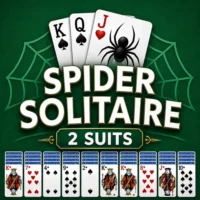


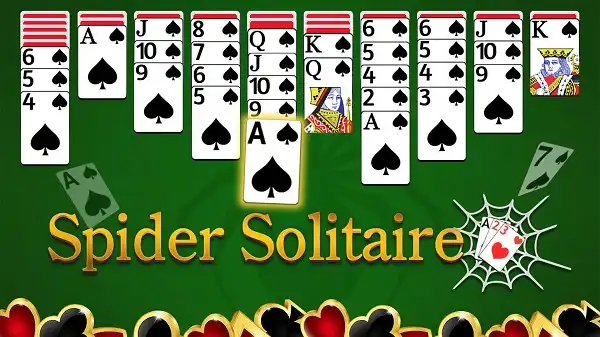


Play Spider Solitaire free online no download needed. Choose 1, 2, or 4 suits, build King-to-Ace sequences, and clear the board. Spider Solitaire trades Klondike’s foundations for something trickier: you’re building entire King-to-Ace runs of the same suit, right there in the tableau, using two full decks instead of one.
It’s slower to start and faster to spiral — in a good way. Early moves open up the board fast, and there’s a real “just one more column” pull once you get a sequence going. Pick 1 Suit if you’re easing in, 2 Suits for a proper challenge, or 4 Suits if you want the version that’s genuinely hard to beat.
If Spider isn’t quite your speed, you can check Doodle Solitaire a single deck, foundation piles, the version most people played.
A Short History of Spider Solitaire
Spider Solitaire didn’t start as a computer game, but it became one of the most-played computer games almost by accident. Microsoft bundled it into the Windows 98 Plus! Pack back in 1998, then made it a built-in part of Windows Me and, a couple of years later, Windows XP — and that’s where it really took off. By the mid-2000s, Spider had quietly overtaken classic Solitaire as the most-played card game on Windows PCs, helped along by the same three difficulty levels you’ll find here: 1 Suit, 2 Suits, and 4 Suits, letting brand-new players and longtime fans use the same game in very different ways.
The version on this page keeps that exact structure — same tableau, same suit-based difficulty tiers, same King-to-Ace sequences — just built to run on its own, outside of any specific operating system.
How to Play Spider Solitaire
Objective
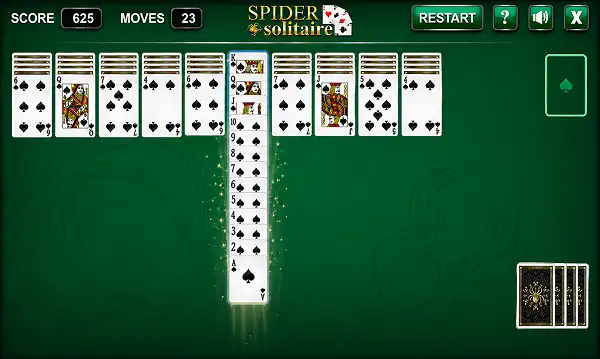
Clear the entire tableau by building eight complete sequences — King down to Ace, same suit — somewhere within the ten columns. Each time you complete one of these runs, it’s automatically lifted off the board and set aside. Do that eight times (all 104 cards), and you’ve won.
Game Setup
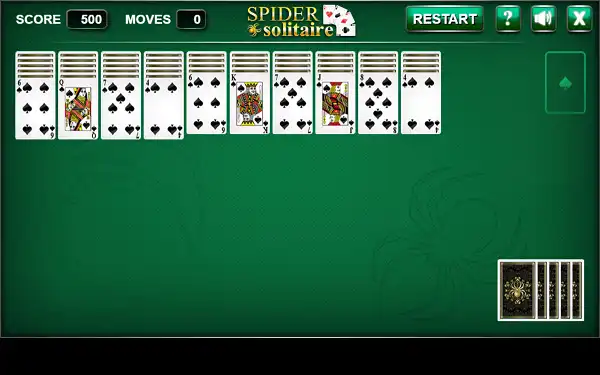
Spider Solitaire uses two full 52-card decks — 104 cards total. Here’s how they’re laid out:
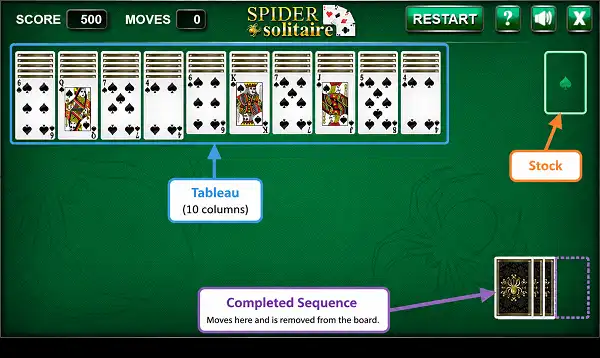
- The Tableau — ten columns across the board. The first four columns get 6 cards each, and the last six columns get 5 cards each (54 cards total). Only the top card of each column starts face-up; everything underneath is face-down.
- The Stock — the remaining 50 cards, face-down, off to one side. Clicking the stock deals one new card, face-up, onto every column at once — ten cards per click.
- Completed Sequences — there’s no traditional foundation here. Instead, when you build a full King-to-Ace run of the same suit within a column, it’s automatically removed from play and counted toward your eight.
Rules of Play
- Cards move onto cards one rank higher — suit doesn’t matter for this. A 6 of any suit can sit on a 7 of any suit, regardless of color. This is the single biggest difference from Klondike, where color matters. In Spider, only the number matters for placing a single card.
- Moving groups is stricter. You can move a whole sequence of cards together only if every card in that group is the same suit and in proper descending order. A mixed-suit run can’t be moved as a group — only one card at a time.
- Empty columns accept any Card. Clear a column completely, and you can drop any single card — or any same-suit sequence — into it. Early empty columns are some of the most valuable things you can create.
- Completed runs disappear automatically. The moment a King-to-Ace same-suit sequence is sitting in one column, it’s removed from the tableau on its own. You don’t need to do anything to “send it” anywhere.
- The stock deals to every column at once. Click the stock pile, and each of the ten columns gets one new face-up card. In most versions, you can’t deal from the stock while any column is completely empty — so plan around that if you’ve cleared a column.
- Use hint and undo as much as you need. Spider has a lot of moving pieces, and even strong players misjudge a sequence now and then. Neither button costs you anything.
1 Suit vs. 2 Suits vs. 4 Suits — Which Should You Pick?
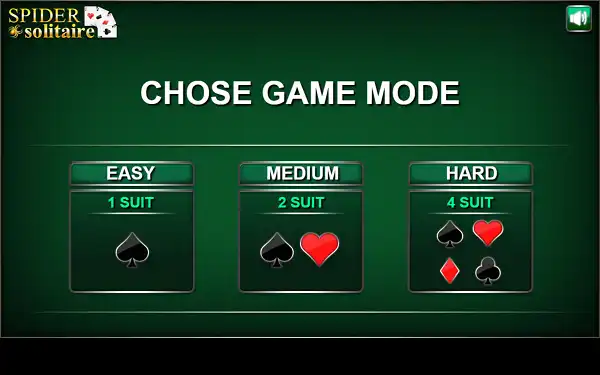
Spider Solitaire doesn’t have an Easy/Hard toggle the way Klondike does — instead, the difficulty comes from how many suits are in play.
1 Suit (Beginner):
All 104 cards come from a single suit, usually Spades. Since suit never matters for individual moves anyway, the only thing 1-Suit removes is the group-move restriction in practice — every card can join every sequence, because everything’s already the same suit.
This is by far the most winnable version, and the right place to start if Spider’s new to you.
2 Suits (Intermediate):
Now you’re working with two suits across those same 104 cards. Single-card moves still ignore suit, but moving groups together gets noticeably harder — you’ll often have a perfect-looking run that you can only move one card at a time because it’s mixed suits underneath.
This is where Spider starts to feel like a real puzzle.
4 Suits (Expert):
All four suits, fully shuffled through both decks. This is the version most people mean when they just say “Spider Solitaire,” and it’s notoriously tough — casual players often go many games without a win, while experienced players report win rates that, while still far from guaranteed, climb substantially with practice and careful sequencing.
Strategies to Win Spider Solitaire
Spider rewards patience and setup far more than quick reactions. These habits make the biggest difference, especially once you move past 1-Suit.
Don’t deal from the stock too early.
Every stock deal adds 10 new face-up cards to the board — one per column — and none of them help you if your columns are already a mess. Clear up as much of the existing tableau as you reasonably can before clicking the stock.
Build same-suit runs whenever you have the choice.
A run of mixed suits looks fine, but it can’t move as a group. Given two equally “valid” moves, pick the one that keeps a sequence same-suit — it’ll pay off later when you need to relocate that whole run.
Prioritize uncovering face-down cards
Columns 1–4 start with six cards each, one more than columns 5–10. Those extra hidden cards are worth digging toward early.
Treat empty columns as most valuable
An empty column can absorb almost any problem — a stuck King, an awkward partial run, anything. Don’t fill one back up the moment it clears; hold it until you actually need it.
In 2-Suit and 4-Suit, watch for “almost” sequences
A run like 9-8-7 of mixed suits is still useful — it just moves one card at a time. Sometimes breaking it apart deliberately, to rebuild it as same-suit, is worth the extra moves.
Plan your stock deals
Since you can’t deal with an empty column on the board, sometimes the right move is to delay clearing that last column until right before you need a fresh batch of cards.
Lean on hint when a 4-Suit board feels frozen
Four-suit Spider can genuinely lock up even for strong players. A hint will tell you whether there’s a move left at all — sometimes there isn’t, and that’s normal.
How Difficult Is Spider Solitaire?
Spider’s difficulty curve is steep, and it’s steep on purpose — that’s why the three suit-count modes exist.
1 Suit is genuinely beginner-friendly. With every card sharing a suit, group moves are far less restrictive, and most deals can be cleared with patient, methodical play. It’s a good way to learn the core mechanics — uncovering cards, managing empty columns, deciding when to deal — without the added headache of suit-matching.
2 Suits is where the real challenge starts. You’ll regularly find yourself with a perfectly ordered run that you can’t move as a group because of suit, and that single restriction changes almost everything about how you plan ahead.
4 Suits is the version Spider is famous for being hard. It’s commonly described as winnable only a small percentage of the time for casual players, while players who’ve put in serious practice — learning to prioritize same-suit sequencing and manage stock deals carefully — report meaningfully higher win rates over large numbers of games. Either way, it’s a “easy to learn, takes years to get good at” kind of game, and that’s a big part of its appeal.
Is Spider Solitaire the Same as Klondike / Doodle Solitaire?
No — and this trips people up more than you’d think, because both games get called “Solitaire” interchangeably.
Klondike / Google Solitaire uses one deck, seven tableau columns, and four foundation piles you build up by suit from Ace to King — and moving cards within the tableau depends on alternating colors.
Spider Solitaire uses two decks, ten tableau columns, no traditional foundations at all, and you’re building sequences down from King to Ace — with color/suit only mattering when you want to move a group of cards together, not for single-card moves.
If you’ve only played Klondike / (Doodle Solitaire), the biggest adjustment is usually that color-blind single-card placement — it feels almost too easy at first, until you realize the group-move restriction is where all the real difficulty hides.
Other Similar Card Games
- FreeCell Solitaire
- Pyramid Solitaire
- TriPeaks Solitaire
- Golf Solitaire
- Hearts Game
- Four Colors
- Google Soliatire
Frequently Asked Questions
How many decks does Spider Solitaire use?
Two full 52-card decks — 104 cards total. That’s the biggest structural difference from Klondike, which uses just one.
What’s the difference between 1, 2, and 4 suit Spider Solitaire?
It’s the number of suits in play across those 104 cards. 1 Suit is the easiest and best for learning. 2 Suits adds a real layer of difficulty around moving groups of cards. 4 Suits is the full, classic challenge — and the version most people mean when they just say “Spider Solitaire.”
Do I need an account or download to play?
No. Everything runs in your browser — no installs, no sign-ups.
Can I play Spider Solitaire on my phone?
Yes. Drag-and-drop works with touch, and the board resizes to fit smaller screens. With ten columns on screen at once, landscape orientation tends to work best on phones.
Is every game of Spider Solitaire winnable?
Not always — especially in 2-Suit and 4-Suit modes, where some deals can lock up with no legal moves left. 1-Suit is winnable the large majority of the time with careful play.
What happens if I get stuck?
Use the hint button to check whether a move is available, or undo to back up and try a different approach. If hint comes up empty, that particular deal may not be solvable — starting a new game is the move at that point.
Is Spider Solitaire the same as the version that came with Windows?
The core rules are the same — two decks, ten columns, King-to-Ace same-suit sequences, with 1/2/4 suit difficulty tiers. This is our own build of that ruleset, made to run as a standalone browser game.
Card GamesDisclaimer: This site is independently operated and is not affiliated with, endorsed by, or sponsored by Google LLC, Microsoft Corporation, or any of their subsidiaries or affiliates. All trademarks belong to their respective owners and are referenced here for descriptive purposes only.