








Pyramid Solitaire runs on one simple idea: find two cards that add up to 13, and they’re gone. A 9 and a 4. A 6 and a 7. A King, all on its own, worth exactly 13 by itself. That’s the entire engine of the game, and it’s deceptively easy to explain and surprisingly hard to put down.
Play free, right in your browser — no download, no account, no timer pressuring you into a bad move. Clear the pyramid, work through the stock, and see how close you can get to a clean sweep.
A Short History of Pyramid Solitaire
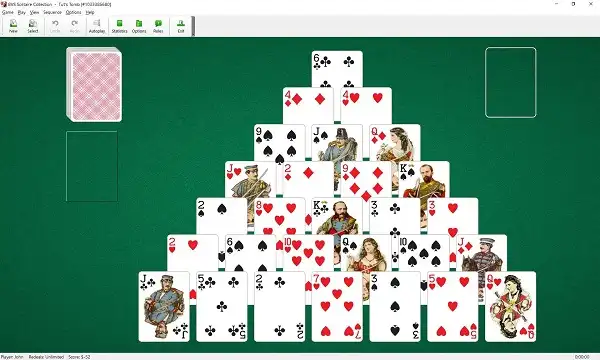
Like a lot of Solitaire variants, nobody can point to the exact moment Pyramid Solitaire was invented — card historians generally place it somewhere in the 18th or 19th century, alongside the wave of “patience” games that spread across Europe during that period. It got its real foothold on computers in 1990, when Microsoft included it in the Entertainment Pack for Windows — though under a different name: Tut’s Tomb, a nod to the tomb of the Egyptian pharaoh Tutankhamun.
That naming choice is also why so many Pyramid Solitaire games, even decades later, still lean into pyramid and ancient-Egypt visuals — it’s a direct echo of how the game was first introduced to a mass audience. The version on this page keeps the same core mechanic that made it stick: 28 cards, one pyramid, and pairs that add to 13.
How to Play Pyramid Solitaire
Objective
Clear every card from the pyramid by removing pairs of cards whose values add up to 13. Some versions also ask you to clear the stock and waste piles for a full win — but the pyramid itself is always the main target.
Game Setup
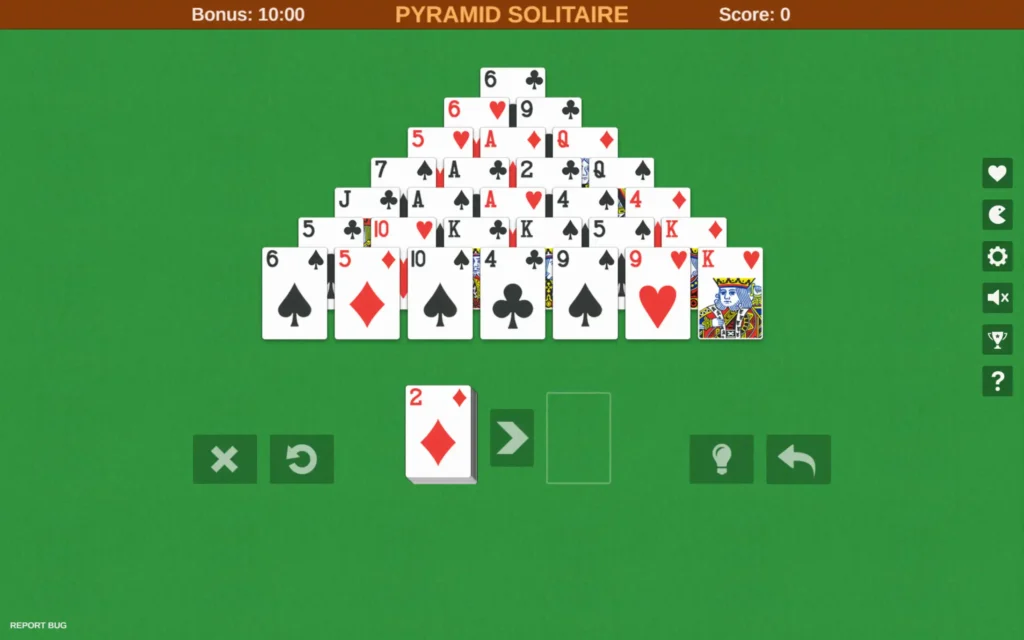
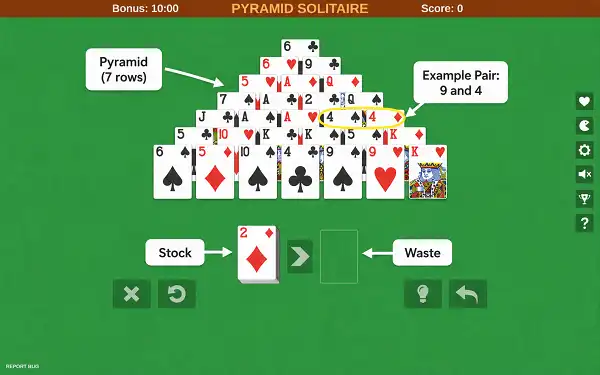
Pyramid Solitaire uses a single 52-card deck, split into three areas:
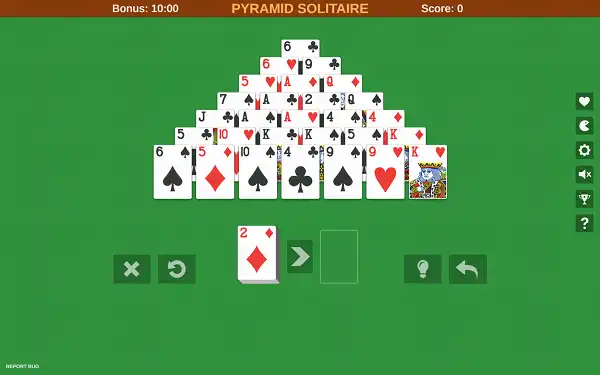
- The Pyramid — 28 cards arranged in 7 overlapping rows, from 1 card at the top down to 7 cards along the bottom. Only cards that aren’t covered by any other card are “exposed” and playable.
- The Stock — the remaining 24 cards, face-down, off to one side.
- The Waste — where cards from the stock land face-up after you click through them. The top card here is always available for pairing.
Card values for pairing purposes: number cards count as their face value, an Ace counts as 1, a Jack as 11, a Queen as 12, and a King as 13.
Rules of Play
- Only exposed cards can be paired. A card is exposed if no other card in the pyramid is overlapping it. Cards buried under others aren’t playable until the cards covering them are cleared.
- Two exposed cards that add up to 13 can be removed together. A 5 and an 8. A 10 and a 3. A Jack and a 2. Any combination that totals 13 works, regardless of suit or color.
- A King is worth 13 on its own and can be removed by itself. No pairing needed — if a King is exposed, it’s an automatic, free removal.
- The waste pile’s top card counts as exposed too. You can pair a pyramid card with whatever’s currently face-up in the waste — this is often the move that breaks an otherwise stuck board open.
- When you run out of moves, draw from the stock. Clicking the stock flips the next card face-up into the waste pile. Depending on the version, you can cycle back through the stock a limited number of times (traditionally three passes) or, in more relaxed versions, as many times as you need.
- The game ends when the pyramid is empty — or when no moves are left. If you run out of stock passes with cards still on the board, that’s the end of the round.
Strategies to Win Pyramid Solitaire
Pyramid Solitaire has more luck baked in than Klondike or FreeCell — how the cards fall matters. But within any given deal, these habits make a real difference:
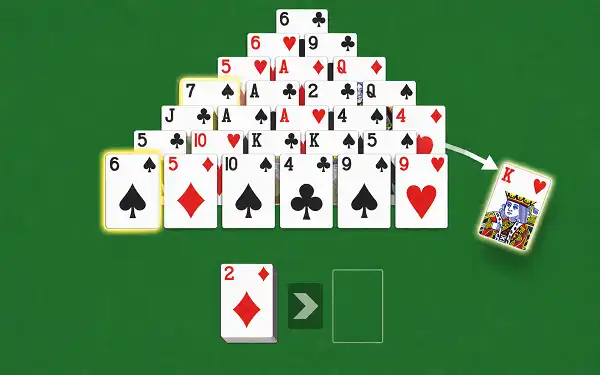
- Clear Kings the moment you see them. A King is a free removal — it never costs you a pairing opportunity, so there’s no reason to leave one sitting on the board.
- Look for moves that expose new cards, not just any legal move. Removing a pair from the bottom row might be “legal,” but if it doesn’t uncover anything new, it’s often less valuable than a pair higher up that opens a path to more cards.
- Work both sides of the pyramid evenly. It’s easy to tunnel into one side and clear it out, only to find the other side is full of cards that can only pair with each other — and they’re all still buried. Try to keep both sides progressing together.
- Don’t waste a stock card if you don’t have to. Before clicking the stock, double-check the pyramid and waste pile for any pair you might have missed — especially once your stock passes start running low.
- Keep a mental note of what’s likely still in the stock. If you’ve seen most of one rank already, you know roughly what’s left — useful for deciding whether to hold out for a specific pairing card.
- Use hint when the board looks frozen. Sometimes the only available pair involves the waste pile card, which is easy to overlook. A hint will catch that for you.
How Difficult Is Pyramid Solitaire?
Pyramid is generally considered one of the easier Solitaire variants to learn — the rule is just “find 13” — but it’s one of the harder ones to consistently win, because so much depends on how the cards happen to fall in the pyramid and stock.
Reported win rates vary widely depending on the exact rules a version uses — especially how many times you’re allowed to cycle through the stock. Stricter versions (three passes through the stock, no redeals) tend to report win rates in the low single digits to around 15%. More relaxed versions, including many that allow unlimited stock cycling, report win rates closer to 30%. If you’re losing more often than you’d like, it’s worth checking whether you’re using all of your available stock passes before giving up on a board — that’s the single biggest lever most players leave on the table.
Other Similar Card Games
- Spider Solitaire
- FreeCell Solitaire
- TriPeaks Solitaire
- Golf Solitaire
- Hearts Game
- Four Colors
- Google Soliatire
Frequently Asked Questions
What card values do I need to remember?
Number cards (2–10) are worth their face value. An Ace is worth 1, a Jack is worth 11, a Queen is worth 12, and a King is worth 13 — which is why a King can be removed on its own.
Can I pair a pyramid card with the waste pile?
Yes. The top card of the waste pile is always available for pairing with any exposed pyramid card, as long as the two values add up to 13.
Do I need to download anything or sign up?
No. The game runs entirely in your browser — nothing to install, nothing to create an account for.
Can I play Pyramid Solitaire on my phone?
Yes. Tap-to-pair works naturally on touchscreens, and the pyramid layout resizes to fit smaller screens.
Is every game of Pyramid Solitaire winnable?
No — this is one of the more luck-dependent Solitaire variants. Some deals simply don’t have a path to clearing the full pyramid, no matter how well you play. If you’re stuck, undo and hint can help confirm whether any moves remain.
What happens if I make a mistake?
Use undo — there’s no limit and no penalty. Since exposed cards and pairing options change as the board clears, undo is a useful way to compare different orders of removal.
Why is Pyramid Solitaire sometimes called “Tut’s Tomb”?
That’s the name Microsoft originally used when it included the game in the Windows Entertainment Pack in 1990, referencing the tomb of Tutankhamun. The rules are the same — only the name and theme changed over time.
Card Games