
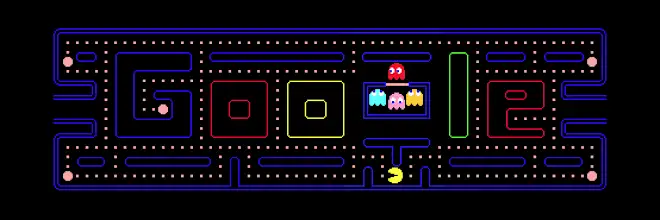
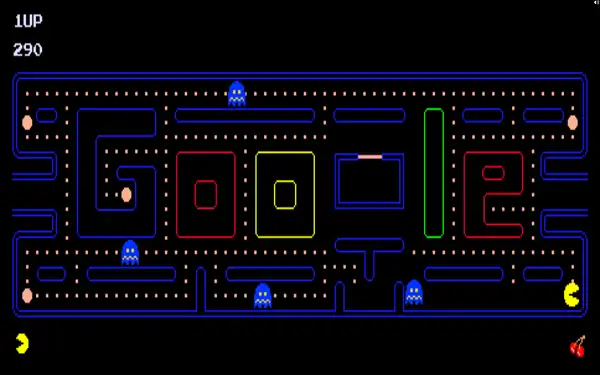
This is the Google Pac-Man Doodle — the playable arcade game Google built right into its own logo in 2010. The maze is shaped like the word Google. The ghosts are real. And somewhere in this page is a hidden two-player mode most people never find.
Arrow keys to move. No download. No sign-up. Click Play Now and start playing.
The Doodle That Shut Down Productivity Worldwide
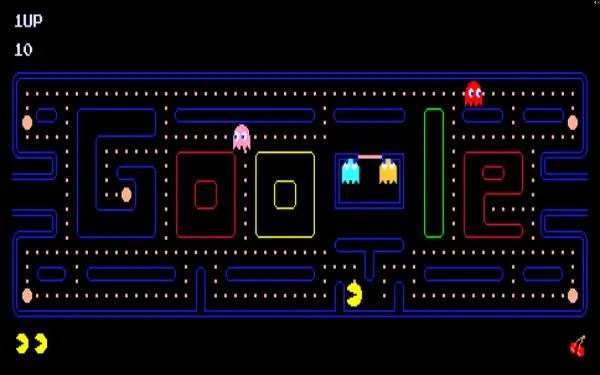
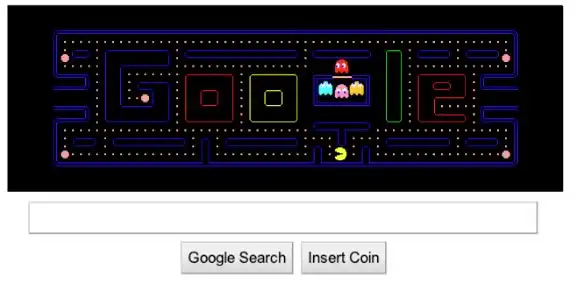
On May 21, 2010, Google replaced its homepage logo with a fully playable version of Pac-Man to celebrate the arcade game’s 30th anniversary. It was the first Google Doodle that could actually be played — not just looked at. Built from scratch using JavaScript, HTML, and CSS by Google developer Marcin Wichary and doodler Ryan Germick, in collaboration with Bandai Namco (the original game’s publisher), the whole thing was designed to feel exactly like the 1980 arcade cabinet — same ghost AI, same sounds, same physics, same maze logic. The only difference was the shape of the maze itself, redesigned to spell out G-O-O-G-L-E.
It was supposed to live on Google’s homepage for 48 hours. It ended up staying permanently.
The impact was immediate and a little absurd. Time-tracking firm RescueTime analyzed user data and estimated that on launch day alone, players across Google’s 505 million daily users spent an extra 36 seconds on the homepage compared to the previous Friday — adding up to roughly 4.8 million hours of lost productivity and an estimated $120 million in economic damage. The story went viral. Guinness World Records later confirmed that users had logged a combined 500 million hours of playtime on the Doodle. For a game that was meant to last two days, that’s quite a run.
A Game 30 Years in the Making
Pac-Man was created by Toru Iwatani at Namco and first released in Japanese arcades on May 22, 1980 — originally under the name Puck-Man. The name was changed for Western markets over concerns about the obvious vandalism potential of that name on physical arcade cabinets. Within a year of its international release, Pac-Man had become the highest-grossing arcade game in history and arguably the first video game character to cross over into genuine pop culture — TV shows, merchandise, a Billboard-charting song, and an animated series all followed within two years of launch.
The Google Doodle honors that specific 1980 version. Every behavior, every sound, every ghost pattern is faithfully recreated. The developers even preserved the famous kill screen bug on level 256, where the original game runs out of memory and the right half of the screen fills with garbled characters — because authentic meant authentic, all the way down to the glitches.
How to Play
The goal is the same as it’s always been: eat every dot in the maze without getting caught by the four ghosts. Clear all the dots and you advance to the next level. Touch a ghost in its normal state and you lose a life. Run out of lives and the game ends.
The maze contains 240 regular dots and 4 power pellets — the larger flashing dots in the corners. Eat every single one to clear the board.
- Arrow keys — move Pac-Man up, down, left, right
- Insert Coin (once) — starts a single-player game
- Insert Coin (twice) — activates the hidden two-player mode (see below)
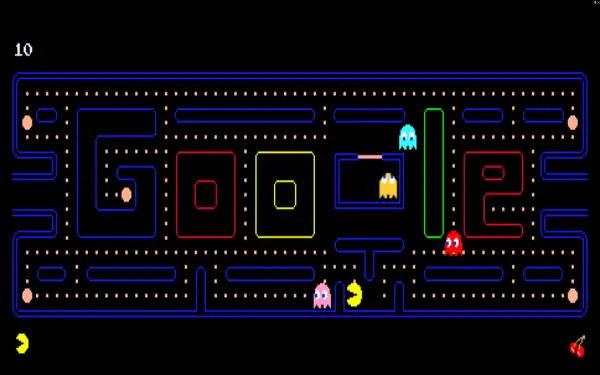
Pac-Man turns faster than the ghosts, but he can’t go through walls. The tunnels on the left and right edges of the maze are your escape route — Pac-Man maintains full speed through them, while ghosts slow down. When you’re being cornered, the tunnel can buy enough time to completely change the situation.
Power Pellets and How to Use Them
The four power pellets — one in each corner of the maze — are the most important tools in the game. Eat one and all four ghosts turn blue and vulnerable for a short time. While they’re blue, Pac-Man can eat them. Each ghost eaten sends its eyes floating back to the ghost house to regenerate, and gives you points.
The scoring scales up the more ghosts you eat in a single power pellet window:
- 1st ghost eaten: 200 points
- 2nd ghost eaten: 400 points
- 3rd ghost eaten: 800 points
- 4th ghost eaten: 1,600 points
That 1,600-point ghost is worth more than clearing a third of the maze in regular dots. Which is why the biggest skill gap in Pac-Man isn’t dodging — it’s learning when to eat a power pellet and when to wait. Ghosts flash white before they turn back to normal — that’s your warning to stop chasing and start dodging again. A ghost that flashes and then touches you still kills you.
Meet the Four Ghosts
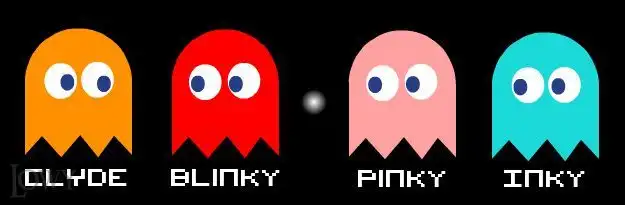
The ghosts aren’t just obstacles chasing you randomly. Each one runs its own behavioral algorithm, and understanding them is the difference between a 5-second run and a long one.
- Blinky (red) — “Shadow”
The direct pursuer. Blinky locks onto Pac-Man’s exact current position and heads straight for it. He’s the most predictable ghost in the early levels — but as you eat more dots, he speeds up. Once the board gets thin enough, he enters a mode players call “Cruise Elroy” and becomes significantly faster than Pac-Man. On later levels, he can reach this speed almost immediately. - Pinky (pink) — “Speedy”
The ambusher. Pinky doesn’t chase where you are — she targets a point four tiles ahead of whichever direction Pac-Man is currently moving. She’s trying to cut you off, not follow you. This makes her genuinely more dangerous in corridors and tight turns than Blinky, because she arrives where you’re going rather than where you were. - Inky (cyan) — “Bashful”
The wildcard. Inky’s targeting uses a formula that factors in both Pac-Man’s current position and Blinky’s position simultaneously. The result is erratic, unpredictable movement that varies even when the game state looks the same. Experienced players fear Inky more than Blinky for exactly this reason — you can predict Blinky, but Inky surprises you. - Clyde (orange) — “Pokey”
The wanderer. Clyde alternates between chasing Pac-Man directly and retreating toward the bottom-left corner of the maze. When he’s more than eight tiles away from Pac-Man, he chases. When he gets close, he turns and wanders back. This makes him seem harmless — until you cut through the bottom-left area and find him already there, moving away from the corner and straight at you.
All four ghosts also periodically enter “scatter mode” where they stop chasing entirely and head toward their assigned maze corners. This happens four times per life. It’s your window to eat dots safely, and experienced players use scatter timing to plan power pellet usage.
Bonus Fruit — Worth Grabbing
Twice per level, a bonus item appears beneath the ghost house at the center of the maze. The first appears when you’ve eaten 70 dots; the second when you’ve eaten 170. Early levels offer cherries and strawberries. Later levels bring higher-value items.
The fruit is only available for a few seconds. It’s worth picking up when your route naturally passes by the center — but don’t deviate wildly from your path just for it. A detour that puts you in ghost danger costs far more than any fruit bonus is worth.
The Secret Two-Player Mode
Here’s the Easter egg most people never find. Click “Insert Coin” a second time while the game is running and Ms. Pac-Man joins the maze.
The second player controls her with W, A, S, D — W for up, A for left, S for down, D for right. Both Pac-Man and Ms. Pac-Man share the same maze and the same lives. You’re cooperating, not competing — clear the board together, avoid the same four ghosts together.
Ms. Pac-Man was first introduced in 1982 as a Namco arcade game in her own right. The Google Doodle’s two-player mode is a nod to that sequel — and one of the few places you can play both characters simultaneously on a shared keyboard without any additional software.
Tips to Last Longer and Score Higher
- Don’t eat power pellets the moment you see them. A power pellet eaten with only one ghost nearby wastes most of its potential. Wait until two or more ghosts are in range, then eat it and chain as many as possible. The difference between eating one ghost and four is 200 points versus 3,000.
- Use the tunnels as reset buttons. When you’re being chased from multiple directions, ducking through a tunnel changes your position completely. Ghosts slow down inside tunnels — Pac-Man doesn’t.
- Clear top-heavy routes first. Don’t zigzag randomly. Pick a side of the maze, clear it, and move on. Scattered dots left across the whole board at once means nowhere safe to maneuver when Blinky speeds up.
- Watch for ghost scatter intervals. The ghosts stop chasing and retreat to their corners four times per life. When you see them suddenly turn away from you, that’s scatter mode — the safest window in the whole game to eat dots freely.
- The bottom-left corner belongs to Clyde. He retreats there in scatter mode. If you need to cross it, do it while he’s in chase mode and moving toward you from a distance, not when he’s retreating home directly into your path.
- Don’t chase Pinky — she’s going where you’re going. If Pinky is ahead of you and you keep moving in the same direction, you’ll run straight into her. Change direction when she’s cutting you off, not when she’s already in front of you.
Other Doodle Games
- Google Snake Doodle
- Doodle Cricket
- Doodle Baseball
- Google Solitaire
- Google Minesweeper
- Google Block Breaker
Frequently Asked Questions
Is this the real Google Pac-Man Doodle?
Yes — this page embeds the original 2010 Google Doodle. The game, the maze, the ghost AI, and the sounds are all exactly as Google released them in 2010.
How do I start the game?
Click the Insert Coin button once. The game launches immediately — no loading screen, no setup.
How do I unlock two-player mode?
Click Insert Coin a second time while a game is running. Ms. Pac-Man will appear in the maze. Player 1 (Pac-Man) uses the arrow keys. Player 2 (Ms. Pac-Man) uses W, A, S, D.
Why is the maze shaped like “Google”?
Google Doodles traditionally replace the Google logo on the homepage for special occasions. For Pac-Man’s 30th anniversary, the team built the entire playable maze around the letterforms of the word “Google” — making it simultaneously the logo and the game board.
Does it include all 255 levels?
Yes. The game replicates the original arcade’s full level structure. It also includes the authentic level 256 kill screen bug — where the original hardware runs out of memory and the right half of the screen fills with corrupted graphics — because the developers wanted the recreation to be completely faithful.
Can I play on mobile?
The Doodle was built in 2010 primarily for desktop browsers. On modern mobile browsers it loads and runs, but touch controls depend on your device and browser — arrow key input works best on desktop. If you’re on mobile and controls feel unresponsive, try a desktop browser for the smoothest experience.
Who built the Google Pac-Man Doodle?
It was developed by Marcin Wichary (Google UX designer and programmer) and Ryan Germick (Google Doodle team), built from scratch using JavaScript, HTML, and CSS in collaboration with Bandai Namco. It launched May 21, 2010 — the day before Pac-Man’s official 30th anniversary.
Why did it only stay on Google’s homepage for 48 hours?
Google originally planned to run it for exactly 48 hours as a special anniversary feature. The response was so large — and the reported productivity impact so viral — that Google made it permanently accessible. It’s been playable at its own URL ever since.
Doodle Games