
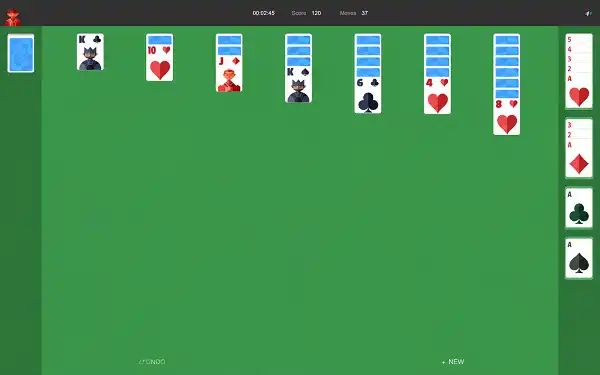

Play Google Doodle Solitaire free online, the classic Klondike card game with Easy and Hard modes. No download, no sign-up. Google Solitaire is a free, browser-based version of Klondike Solitaire that Google embeds directly into its search results.
Here at GoogleSolitaire.me, we’ve built the same experience — a clean, fast-loading version of the classic game that works on desktop, tablet, and mobile. The game you see above is fully playable right now. One click and you’re dealing cards.
Note: This website is an independent project created by card game fans. We are not affiliated with, endorsed by, or connected to Google LLC in any way.
How to Play Google Solitaire (Step by Step)
Solitaire game looks simple. And it is easy to learn. But playing it well takes a little more than dragging cards around. Here’s exactly how the game works, from the moment you hit “Deal” to the moment those cards cascade into the foundation in that satisfying winning animation.
The Setup
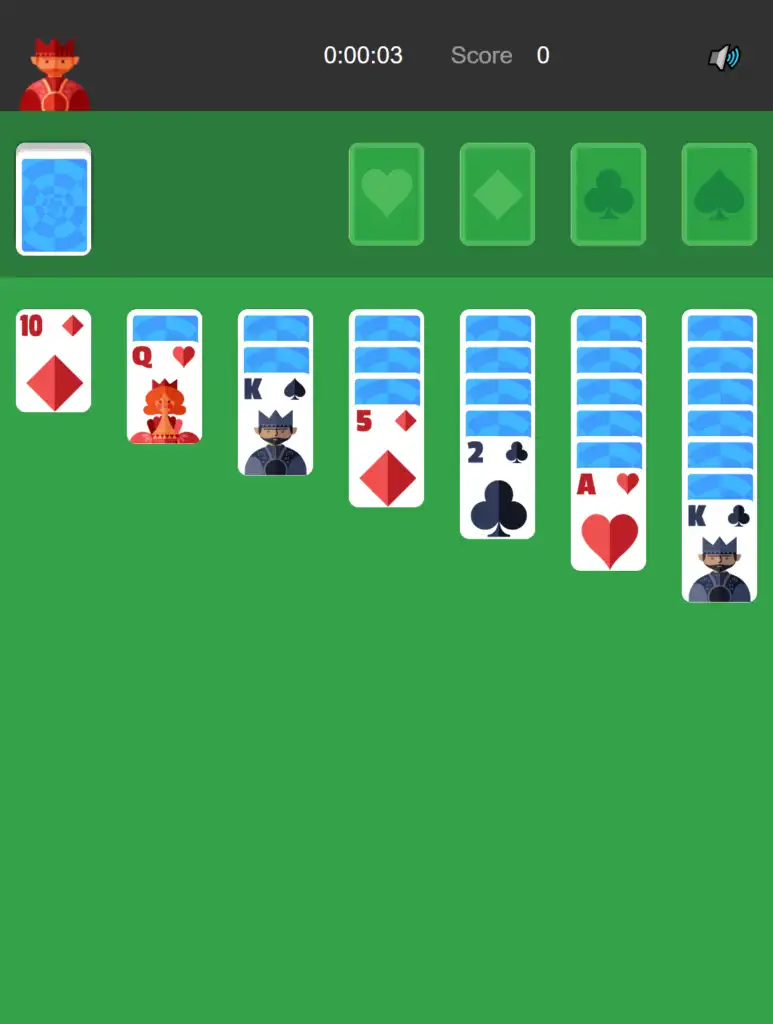
When you start a new game, 52 cards are automatically dealt into what’s called the tableau — seven columns of cards arranged in a downward-stepping layout. The first column gets one card (face up). The second gets two cards (one face down, one face up). The pattern continues until the seventh column, which has seven cards — six face down and one face up on top.
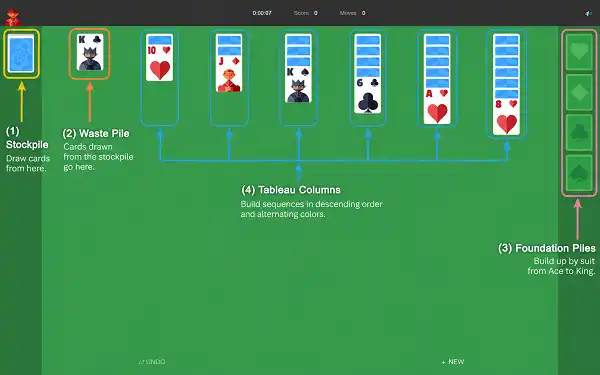
The remaining 24 cards become your stockpile, which are on the top-left corner. Above the tableau, you can see four empty spaces those are your foundation piles, one for each suit: hearts, diamonds, clubs, and spades.
The Goal
Your objective is to move all 52 cards into the four foundation piles. Each foundation pile holds one suit, built in ascending order from Ace to King. So the hearts foundation starts with the Ace of Hearts, then 2, then 3… all the way up to the King.
The Moves
Here’s what you can actually do on each turn:
Moving tableau to tableau: You can place a card on top of another card in the tableau — but only if it’s one rank lower and the opposite color. A red 7 can go on a black 8. A black Jack can go on a red Queen. This alternating-color rule is the core mechanic of the game.
Moving to the foundation: Any time an Ace appears, move it immediately to the foundation. Then keep building that suit upward — 2, 3, 4… as cards become available.
Drawing from the stockpile: Click the stockpile to flip cards. In Easy Mode (Draw 1), you flip one card at a time. In Hard Mode (Draw 3), you flip three cards at a time and can only play the top one.
Using empty columns: Once you clear a tableau column completely, only a King (or a sequence starting with a King) can move into that empty space.
The undo button: This undo button is your best friend. Unlike a physical deck of cards, the digital version lets you undo moves. Use it generously, especially when you’re learning
Google Solitaire Rules of Playing
The rules of Klondike Solitaire have been the same for decades. And this version follows them faithfully. Here’s the complete rule set, written plainly.
Rule 1 – The alternating-color rule: Cards in the tableau must be placed in descending order and alternating colors. Red goes on black, black goes on red.
Rule 2 – The foundation rule: Foundation piles are built by suit, in ascending order. Only an Ace can start a foundation pile. You must complete all four piles (Ace to King of each suit) to win.
Rule 3 – Only Kings fill empty columns: If you’ve emptied a tableau column, the only card (or group of cards) you can place there is a King, or a sequence that starts with a King.
Rule 4 – Sequences move together: If you have a legal sequence of face-up cards (say, a red 5 on a black 6 on a red 7), you can move the entire sequence as a unit.
Rule 5 – The stockpile limit: In Easy Mode, you can cycle through the stockpile as many times as you need. In Hard Mode, cycling is also unlimited, but you’re drawing three at a time — which makes specific cards much harder to reach.
Rule 6 – Winning Rule: You win when all 52 cards are in the foundations. The game will animate the win automatically.
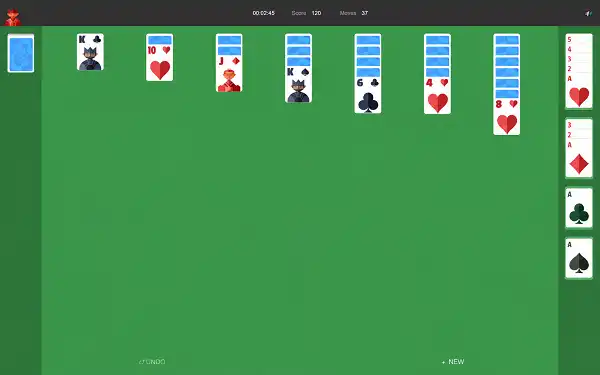
10 Tips and Tricks That Will Actually Help You Win More Often
Most people play solitaire by instinct — moving whatever card is available without thinking two steps ahead. That works for casual play. But if you want to win more consistently, these ten strategies make a real difference. They’re the same principles used by serious players across every solitaire platform.
- Flip the first card in the Stock Pile, as it gives an extra option.
- Move cards on the Table first.
- Look through the Stock Pile to see what cards are available.
- Build up your Ace stacks evenly (Foundation Piles).
- Only move cards if there is a reason.
- Move cards from the larger stacks first.
- Don’t clear a Table stack if there is no King to use on this free spot.
- Empty spot – decide if a red or black King is best. Consider the available Queens, Jacks, Tens…
- If you run out of options, then move cards even if it goes against the above rules.
- Must have “Patience” to win at Solitaire.
Easy Mode vs Hard Mode — Which Should You Play?
Google Solitaire gives you a choice at the start of every game: Easy or Hard. It’s a small selection, but it changes the experience quite significantly. Here’s what each one actually means.
Easy Mode (Draw 1)
In Easy Mode, every time you click the stockpile, one card is turned face-up and added to the waste pile. You see it immediately and can play it if it fits somewhere. This version is more forgiving because you can access every card in the stockpile one at a time, in sequence.
Easy Mode is ideal if you’re new to solitaire, if you want a relaxed session, or if you’re playing on mobile where precision moves are harder. Win rates in Draw 1 Klondike sit around 33% for casual players — roughly one win in every three games.
Hard Mode (Draw 3)
In Hard Mode, clicking the stockpile flips three cards at once. Only the top card of those three is playable. The other two are temporarily inaccessible until you either play the top card or cycle through the deck again.
This mechanic buries key cards in layers that are frustratingly just out of reach. Your win rate in Draw 3 drops to roughly 11% for most players — about one win in nine games. That’s not a bug; it’s the design. The challenge is part of the appeal for experienced players who find Easy Mode too simple.
Which should you choose? Start with Easy Mode until you’re winning regularly and the game feels predictable. Switch to Hard Mode when you want a real mental challenge. A lot of long-time solitaire players treat Easy Mode as a warmup and Hard Mode as the actual game.
The Story Behind Solitaire — 250 Years of the World’s Most Played Card Game
Solitaire doesn’t have a single inventor. Its origins are older than the internet, older than the light bulb, older than the United States of America. Here’s the real history — and why Google’s version sitting in a browser feels like such a natural endpoint for a 250-year-long story.
It Started in 18th-Century Europe
The first known written reference to a single-player patience card game appears in a German book published in 1783. But the game almost certainly existed before that — it was just being played, not documented. Early evidence points to Northern Europe: Germany, France, and Scandinavia all have strong claims to the game’s origins.
In Scandinavian countries, the game was called kabale — meaning “secret” or “hidden knowledge” — because it was originally tied to cartomancy, the practice of fortune-telling with cards.
Microsoft Made It Global
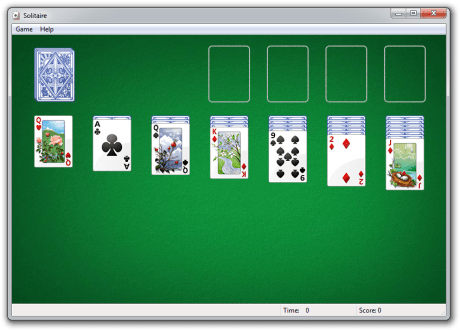
The modern story of solitaire begins on May 22, 1990, when Microsoft launched Windows 3.0 with a card game bundled inside. Microsoft Solitaire was written by a 25-year-old intern named Wes Cherry, who coded it in his spare time
Google Added It to Search
Google introduced Solitaire directly into its search results in 2015. Search “solitaire” on Google and an embedded playable game appears at the top of the results page — no need to click through to any website. It’s built on the same Klondike Solitaire rules that Microsoft standardized in 1990.
Why Playing Solitaire Is Actually Good for You
Plenty of things you do to relax are purely passive — watching TV, scrolling social media, listening to music. Solitaire is different. It looks like a way to kill time, and it is, but your brain is doing real work the whole time. There’s a growing body of research on why card games like this one are genuinely beneficial.
It Exercises Your Working Memory
Every time you look at the tableau and plan a sequence of moves, you’re holding multiple pieces of information in your head simultaneously — card positions, suit colors, what’s face-down, what you’ve seen in the stockpile. That’s your working memory being actively engaged. Studies on card games and cognitive function consistently show that regularly engaging working memory helps maintain and improve this capacity over time, especially as we age.
It Genuinely Reduces Stress
There’s a reason people open solitaire when they need a mental break at work. The game creates a narrow focus — you’re thinking about cards, not your inbox. Brain imaging research has shown decreased activity in the amygdala (the brain’s stress-processing center) during strategy card games. The game’s repetitive, patterned nature creates a state that’s close to light meditation for many players.
It Builds Problem-Solving Thinking
Every game of solitaire is a puzzle that’s different from every other game of solitaire. The 52-card deck has a fixed set of possible arrangements, but the number of possible deals runs into the billions. Each game requires you to assess an unfamiliar situation and build a plan. That kind of adaptive reasoning — forming a hypothesis, testing it, revising when it doesn’t work — is genuinely transferable cognitive skill.
Cognitive neuroscientist Dr. Denise Park of the University of Texas has noted that simple games like solitaire activate multiple brain systems simultaneously — from memory to attention — in a sustainable and low-stress way. Regular play builds what researchers call “cognitive reserve,” a form of neurological resilience that protects against age-related mental decline.
Frequently Asked Questions
Is Google Solitaire free to play?
Yes, completely free. You don’t need to create an account, download anything, or subscribe. Click the game above, choose your difficulty, and play.
Does the game work on mobile?
Absolutely. The game is fully playable on iPhone and Android. Tap to select cards and tap again to move them, or simply drag. The interface automatically adjusts to your screen size.
What’s the difference between Easy and Hard Mode?
Easy Mode (Draw 1) flips one card at a time from the stockpile. Hard Mode (Draw 3) flips three cards and only the top one is playable. Hard Mode is significantly more difficult — typical win rates drop from around 33% to roughly 11%.
Can every game of Google Solitaire be won?
No. Research shows that approximately 18–21% of Klondike Solitaire deals have no possible winning sequence regardless of how you play. If you’ve gone through the entire stockpile multiple times with no available moves, the deal is likely unwinnable. Start a new game.
What are the four foundation suits?
Hearts (♥), Diamonds (♦), Clubs (♣), and Spades (♠). Each foundation starts with the Ace of that suit and builds up to the King.
Is this game the same as the one that appears in Google Search?
This game follows the same Klondike Solitaire rules as the game embedded in Google’s search results. We are not affiliated with Google LLC. The rules, card mechanics, and win conditions are identical.
How long does a typical game take?
A single game takes anywhere from 5 to 20 minutes depending on difficulty and how the deal falls. Most casual players average around 8–10 minutes per game in Easy Mode.
Can I undo moves?
Yes. The undo button is visible during gameplay and can be used at any point. There’s no penalty for undoing moves — use it freely.
What are the best strategies for beginners?
Focus on uncovering face-down cards, move Aces to the foundation immediately, and don’t clear a tableau column unless you have a King ready to fill it.
Is solitaire good for your brain?
Research consistently shows that card games like solitaire improve working memory, reduce stress, and support long-term cognitive health. A 2003 New England Journal of Medicine study found regular card game play associated with reduced dementia risk. See our full breakdown:
Card Games